- Animals
- ›Arthropods
- ›Chelicerates
- ›Arachnids
- ›Spiders
- ›Typical Spiders
- ›Entelegyne Spiders
- ›Salticoid Spiders
- ›Jumping Spiders
- ›Typical Jumping Spiders
- ›Plexippini
- ›Plexippina
- ›Evarcha
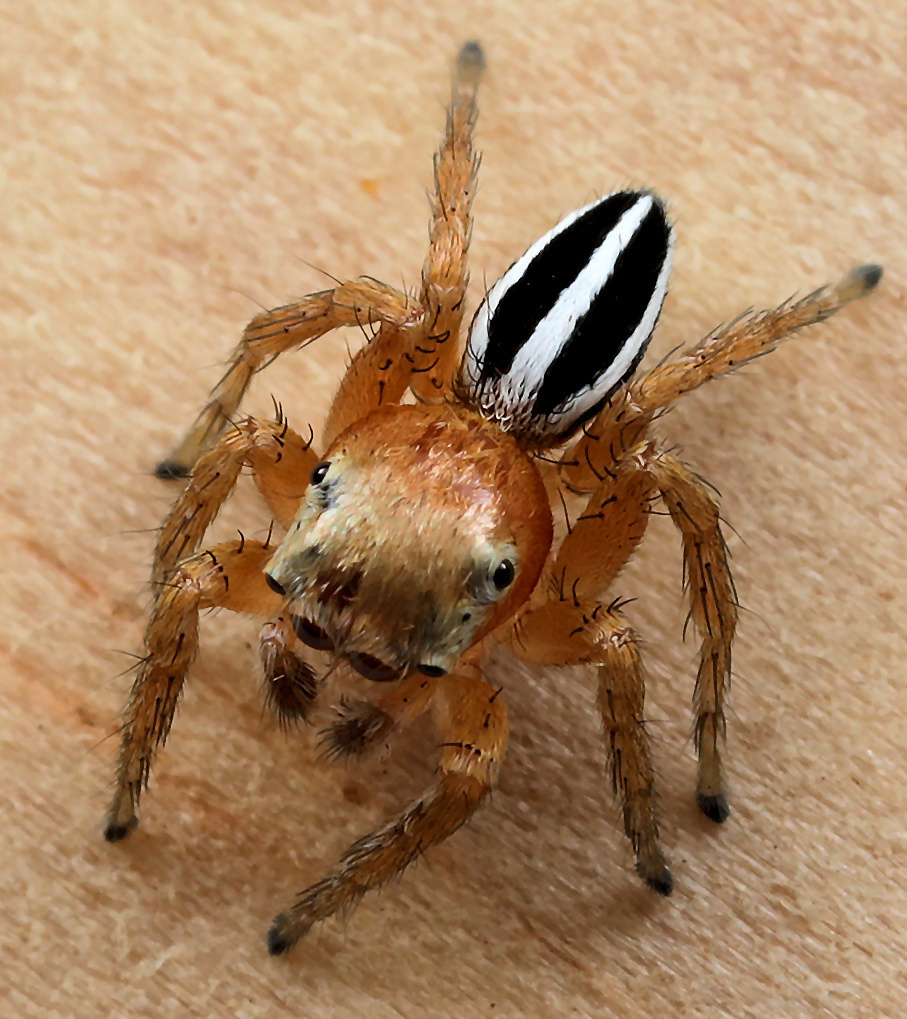
Evarcha striolata
Evarcha striolata is a species of jumping spider in the genus Evarcha that lives in South Africa. The species was first described in 2009 by Wanda Wesołowska and Charles Haddad. The spider lives in savanna and forests. Medium-sized, the spider has a dark orange or yellowish-orange carapace, the top side of its cephalothorax, measuring between 2.1 and 2.6 mm (0.08 and 0.10 in) in length and an abdomen that is between 2 and 2.5 mm (0.08 and 0.10 in) long. The male has a pattern of dark stripes on the top of its abdomen, which is recalled in the species name. The female is generally lighter and has indistinct lines formed of dots on both the top and bottom of its abdomen. The underside of cephalothorax, or sternum, is dark yellow in both the female and male. It can be distinguished from other species in the genus by its copulatory organs, particularly the shape of the male's palpal bulb and the female spermathecae (receptacles at the end of its insemination ducts). These are also more similar to Asian and Australian spiders in the genus, which has led Jerzy Prószyński to suggest that it should be a member of a different genus named Evacin.
From the article Evarcha striolata on Wikipedia (CC BY-SA), quoted section by section
Description
Evarcha striolata is a medium-sized spider with looks that are typical for the genus. It has a body divided into two main parts: a rectangular cephalothorax and thinner, more oval abdomen. The male has a carapace, the hard upper side of the cephalothorax, that is typically 2.1 mm (0.08 in) long and 1.6 mm (0.06 in) wide. Generally rather high with a sharply sloping back. it is generally dark orange and hairless with dark rings around the eyes. There are a few delicate bristles near the front eyes. The underside of the cephalothorax, or sternum, is dark yellow. The spider's clypeus, or face, is low and is decorated with a scattering of delicate hairs. The mouthparts, including the chelicerae, labium and maxillae, are dark yellow. The male spider's abdomen is narrower than its carapace, typically measuring 2 mm (0.08 in) in length and having a width of typically 1.1 mm (0.04 in). The top side has a distinctive striped pattern, with two brown streaks formed of dark hairs running down the abdomen from front to back, divided by three yellow streaks. It lacks the scutum on the back that marks out the similar Evarcha flagellaris. There are dark streaks on the sides while the underside is light yellow with a pattern of two thin dark lines running from front to back crossed by another line that runs across near the pale spinnerets. …
Range & habitat
Evarcha striolata lives on the ground amongst grasses, particularly grassy tussocks and grass litter. It has been spotted living in forests in the shade of Vachellia xanthophloea and in savanna dominated by Vachellia tortilis. Evarcha spiders will often live in nests constructed of webs amongst the trees. A study of the related Evarcha arcuata found that the spider will rest hanging from a silken thread. They eat a wide range of food, including aphids, flies and other spiders. Like other jumping spiders, they do not spin webs to catch their prey but instead hunt by ambushing, feeding on insects and other spiders.
Wikipedia: “Behaviour and habitat”
In human culture
Evarcha striolata is a species of jumping spider, a member of the family Salticidae, that was first described by the arachnologists Wanda Wesołowska and Charles Haddad in 2009. Named for a Latin word meaning "striped", it was one of over 500 species identified by Wesołowska during her career. They allocated it to the genus Evarcha, which had been first circumscribed by Eugène Simon in 1902. The genus is one of the most speciose of the family, with members found on four continents. In 1976, Jerzy Prószyński placed the genus Evarcha in the subfamily Pelleninae, along with the genera Bianor and Pellenes. In Wayne Maddison's 2015 study of spider phylogenetic classification, the genus Evarcha was moved to the subtribe Plexippina. Plexippina is a member of the tribe Plexippini, which was listed in the subclade Simonida in the clade Saltafresia by Maddison. In 2016, Jerzy Prószyński added the genus to a group of genera named Evarchines along with Hasarinella and Nigorella based on similarities in the spiders' copulatory organs. According to Maddison, Melissa Bodner and Karen Needham, the genus is closely related to the genera Hyllus and Plexippus. Analysis of protein-coding genes showed it is particularly related to Telamonia. Prószyński placed the spider in a new genus Evacin in 2018 based on its copulatory organs and the way that they differ from other African Evarcha spiders. …
Wikipedia: “Taxonomy and etymology”
Where it lives
Recorded sightings
—
geo-referenced records in GBIF, from museums, herbaria and field observers.
Drag the globe to turn it. Dots are where records exist, not a range map; darker means more records.
In the stacks
Searching the stacks…
Every page naming Evarcha striolata in the Biodiversity Heritage Library →
This page is assembled live from iNaturalist, GBIF, Wikipedia, the Source Library and the Internet Archive. It is not yet part of the hand-edited codex. iNaturalist taxon 666106.