- Animals
- ›Arthropods
- ›Chelicerates
- ›Arachnids
- ›Spiders
- ›Typical Spiders
- ›Entelegyne Spiders
- ›Salticoid Spiders
- ›Jumping Spiders
- ›Typical Jumping Spiders
- ›Chrysillini
- ›Icius
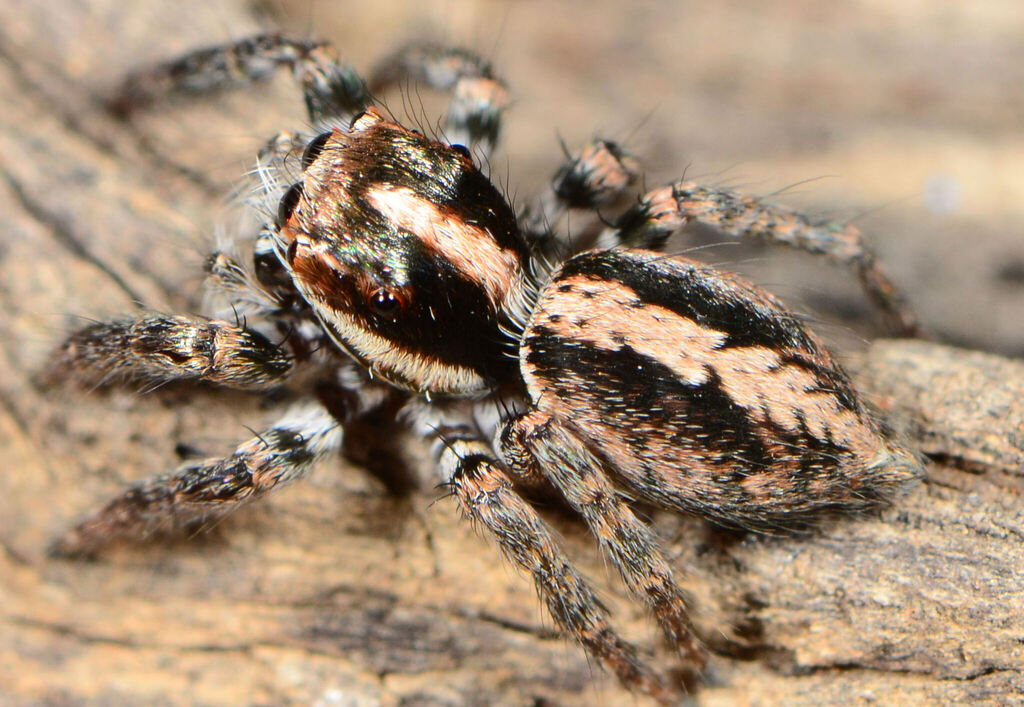
Icius insolidus
Icius insolidus is a species of jumping spider in the genus Icius that lives in Namibia and South Africa. First described in 1999 by Wanda Wesołowska and allocated to the genus Menemerus, the species was transferred to its current genus in 2006.
It lives in rocky environments, primarily granite rocks and boulders, but also the walls of gardens. It is a small spider, with a carapace between 1.8 and 2.4 mm (0.071 and 0.094 in) and an abdomen between 1.7 and 2.4 mm (0.067 and 0.094 in) in length. It is very dark brown or black. The male carapace and abdomen have a white stripe down the middle. The female abdomen has a vague white leaf-like pattern on the top. The male has a prominent tooth (projection) on the base of the chelicerae. It is this tooth that helps distinguish the species from others in the genus. The female epigyne has two widely separated rounded depressions. The species lives in nests, and the male and female will often share a nest after mating.
From the article Icius insolidus on Wikipedia (CC BY-SA), quoted section by section
Description
Icius insolidus is a small spider. The spider's body is divided into two main parts: a rather rounded almost rectangular cephalothorax and more pointed and ovoid abdomen. The male has an ovoid and moderately high carapace, the hard upper part of the cephalothorax, that is between 1.8 and 2.4 mm (0.071 and 0.094 in) long and between 1.3 and 1.9 mm (0.051 and 0.075 in) wide. It is very dark brown, nearly black, with a wide streak down the middle formed of white hairs, stripes on the sides and a scattering of grey hairs on its slopes. The eye field has a few brown bristles and short white hairs around the eyes. The spider's sternum, the underside of the carapace, is brown. Its face, the clypeus, is also brown and low with sparse white hairs. Its mouthparts are brown. The chelicerae have a few white hairs visible on the edges; they are large and unidentate with a very large tooth visible on the inner margin of the base. Its maxillae have yellow tips. The male's oval abdomen is between 1.7 and 2.4 mm (0.067 and 0.094 in) long and between 1.3 and 1.6 mm (0.051 and 0.063 in) wide. It is black and hairy with a broad streak of white hairs on top and a slightly lighter underside. Its spinnerets are dark. Its legs are dark brown, the foremost pair being longer than the others. All the legs have long black hairs. The spider's pedipalps, sensual organs near its mouth, are small and dark. …
Range & habitat
Icius insolidus is considered endemic to southern Africa. The species is found in Namibia, Zimbabwe and South Africa. The holotype was discovered in Kimberley in South Africa. Specimens were found near Prieska in Northern Cape, South Africa, in 2002. It has subsequently been found in many parts of South Africa, including the areas around Bloemfontein, Brandfort, Fauresmith, Jagersfontein and Philippolis in Free State. Meanwhile, the first examples from Zimbabwe were found in 1998 in suburban Harare. The first specimen from Namibia was found in the Diamond Area. Examples were also identified in Etosha National Park. Others were discovered near Brandberg Mountain in 2000. The species lives in rocky environments, typically on the faces of granite rocks or boulders. It frequently hides in crevices or under ledges. It can also be found on grass tussocks and on soils. In gardens, it is almost exclusively seen on stone, concrete or mortared brick walls. It thrives in these domestic settings, with a long-term sample making 320 observations over a nine-year period.
Wikipedia: “Distribution and habitat”
What it does
Jumping spiders are mainly diurnal hunters that use their good eyesight to spot their prey. Icius insolidus feeds on a range of prey, including bugs, flies, Hymenoptera, tangle-web spiders and wall crab spiders. It does not spin webs. Instead, it will stalk its prey and then pounce. The spider constructs nests made of spider silk and debris that is mounts on vertical walls. The female constructs a more substantial nest to the male, often next to each other. The female will undertake a courtship dance for the male, which will respond by mirroring. Mating lasts for about 3 minutes. After mating, the male and female will share a nest. The spider transmits vibratory signals through silk to communicate to other spiders.
Wikipedia: “Behaviour”
In human culture
Icius insolidus is a species of jumping spider, a member of the family Salticidae, that was first described by Wanda Wesołowska in 1999. It was one of over 500 species identified by the Polish arachnologist Wesołowska during her career, making her one of the most prolific in the field. She originally allocated the spider to the genus Menemerus, first circumscribed in 1868 by Eugène Simon. Originally, only the female had been identified. In 2006, when she first described the male, Wesołowska moved the species to the genus Icius on the basis of its chelicerae and the structure of its palpal bulb. The genus was circumscribed by Eugène Simon in 1876. The genus was provisionally placed alongside Pseudicius. Icius was placed in the tribe Heliophaninae, which was renamed Chrysillini by Wayne Maddison in 2015. The tribe is ubiquitous across most of the continents of the world. It is allocated to the subclade Saltafresia in the clade Salticoida. Chrysillines, which had previously been termed heliophanines, are a monophyletic group. In 2016, Jerzy Prószyński split the genus from the Chrysillines into a group called Iciines, named after the genus. He stated the split was for practical reasons as Chrysillines had become unwieldy. The genus name is based on two Greek words, ίδιος and όψη, that can be translated distinct, or special, face. …
Wikipedia: “Taxonomy and etymology”
Where it lives
Recorded sightings
—
geo-referenced records in GBIF, from museums, herbaria and field observers.
Drag the globe to turn it. Dots are where records exist, not a range map; darker means more records.
In the stacks
Searching the stacks…
Every page naming Icius insolidus in the Biodiversity Heritage Library →
This page is assembled live from iNaturalist, GBIF, Wikipedia, the Source Library and the Internet Archive. It is not yet part of the hand-edited codex. iNaturalist taxon 670783.