- Animals
- ›Arthropods
- ›Chelicerates
- ›Arachnids
- ›Spiders
- ›Typical Spiders
- ›Entelegyne Spiders
- ›Salticoid Spiders
- ›Jumping Spiders
- ›Typical Jumping Spiders
- ›Chrysillini
- ›Icius
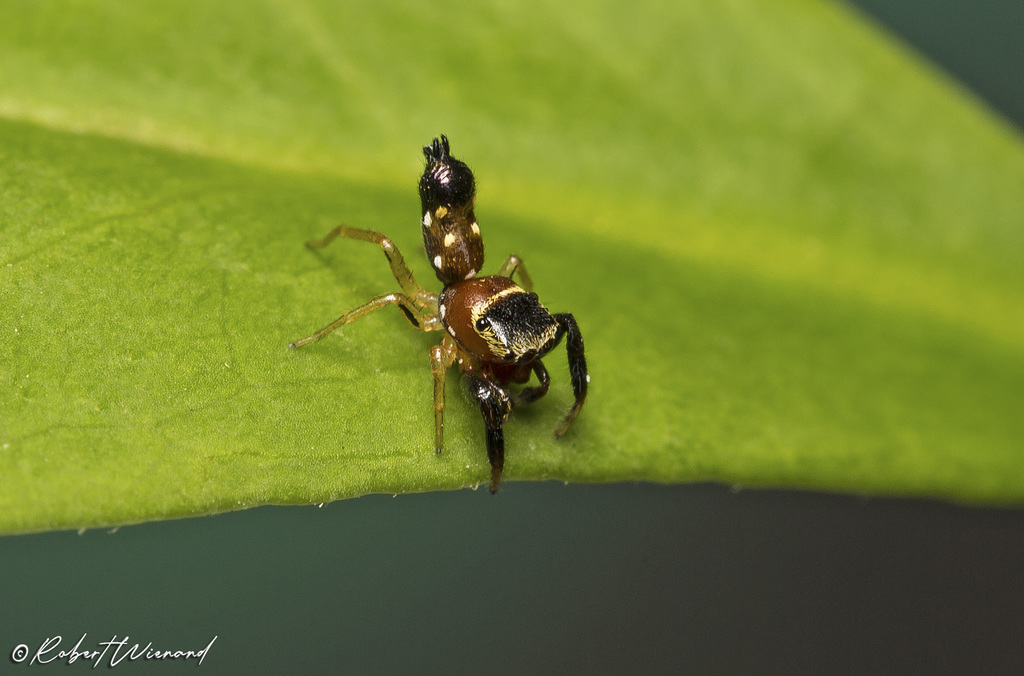
Blacktailed Icius Jumping Spider
Icius nigricaudus
Icius nigricaudus, the Blacktailed Icius Jumping Spider, is a species of jumping spider in the genus Icius that lives in South Africa. It was first described in 2009 by Wanda Wesołowska and Charles Haddad. The spider is small, with a carapace measuring between 1.3 and 1.4 mm (0.05 and 0.06 in) long and an abdomen that is between 1.2 and 1.6 mm (0.05 and 0.06 in) in length. The female has a larger abdomen than the male, but otherwise they are similarly sized. The carapace is brown with a white stripe down the middle, the male also having white spots. The female abdomen is black with a white stripe. The male black and olive-yellow with white patches. The spider has distinctive copulatory organs. The male has a distinctive pedipalp with a tegulum with a low posterior node, a straight embolus, and hooked tibial apophysis, or appendage. The female has a simple epigyne with long and narrow seminal ducts.
From the article Icius nigricaudus on Wikipedia (CC BY-SA), quoted section by section
Description
Icius nigricaudus is a small slender spider. The male has a carapace that is between 1.3 and 1.4 mm (0.05 and 0.06 in) long and 0.9 and 1.0 mm (0.04 and 0.04 in) wide. It is oval, low with a back that is particularly sloped. It is generally brown with a black line running along its edges and a pattern of four small patches of white hairs on the sides, the whole covered in delicate translucent hairs. The eye field is black with small scales near the eyes themselves. The underside of the spider opposite the carapace, the sternum, is light brown. The spider's face, or clypeus, is very low. The chelicerae are brown and unidentate. The other mouthparts include the labium, which is fawn-brown. The abdomen is between 1.2 and 1.3 mm (0.05 and 0.05 in) long and between 0.6 and 0.8 mm (0.02 and 0.03 in) wide. It is an elongated oval, the frontal two-thirds olive-yellow and the rearmost third black, marked with five patches formed of white scales. The underside is similar in colour to the topside. The spinnerets are black. The front legs are larger than the others, and black rather than brown. All the legs have fine brown hairs. The pedipalps are dark with a scattering of white hairs. The tegulum has a low posterior node, the embolus is straight and the tibial apophysis, or appendage, is hooked. The female is similar in size and shape to the male. …
Range & habitat
Icius nigricaudus is endemic to South Africa. The holotype was discovered in 2005 in the Ndumo Game Reserve. The species is rare and lives on grasses found near to rivers and other wetlands and in the bark of Vachellia xanthophloea. It has been declared to be an Endangered species in 2019.
Wikipedia: “Distribution and habitat”
Where it lives
Recorded sightings
—
geo-referenced records in GBIF, from museums, herbaria and field observers.
Drag the globe to turn it. Dots are where records exist, not a range map; darker means more records.
In the stacks
Searching the stacks…
Every page naming Icius nigricaudus in the Biodiversity Heritage Library →
This page is assembled live from iNaturalist, GBIF, Wikipedia, the Source Library and the Internet Archive. It is not yet part of the hand-edited codex. iNaturalist taxon 670784.