- Animals
- ›Arthropods
- ›Chelicerates
- ›Arachnids
- ›Spiders
- ›Typical Spiders
- ›Entelegyne Spiders
- ›Orbweavers and Allies
- ›Orbweavers
- ›Argiopinae
- ›Argiope
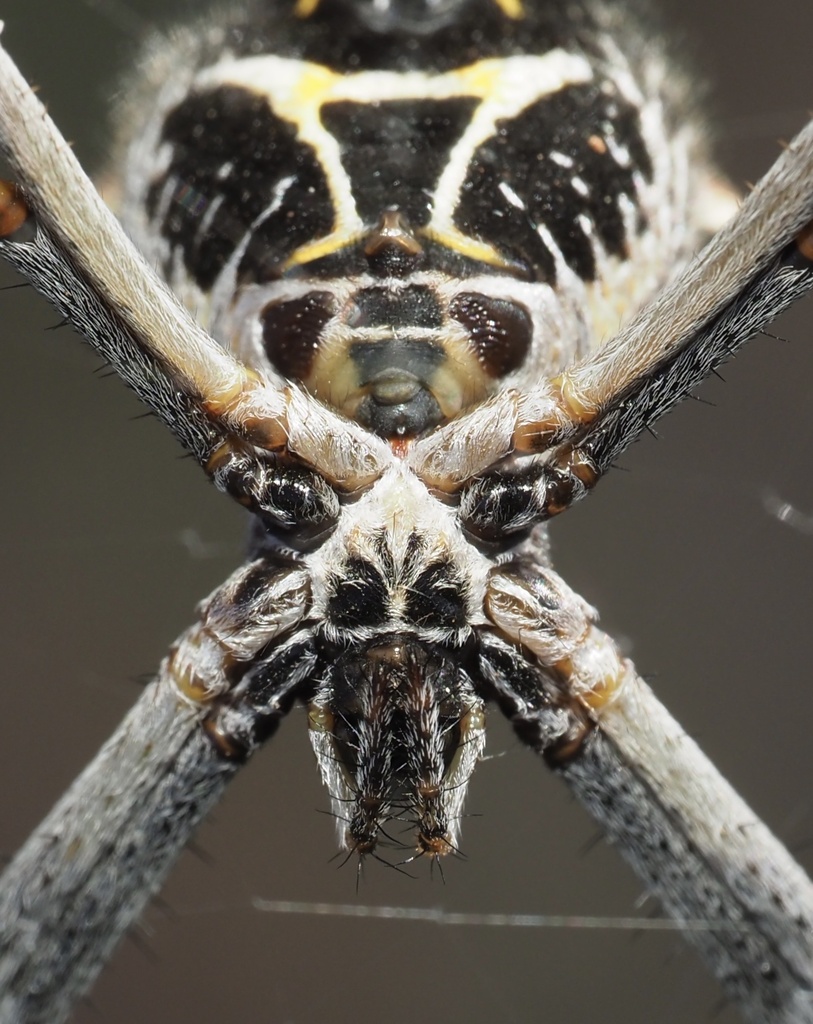
Silver Garden Orbweaver
Argiope argentata
Argiope argentata, commonly known as the silver argiope or silver garden spider due to the silvery color of its cephalothorax, is a member of the orb-weaver spider family Araneidae. This species resides in arid and warm environments in North America, Central America, the Caribbean and widely across South America. In the United States, it is found at least in Southern California, Florida, Arizona, and Texas. A. argentata create stabilimenta and a unique zig-zag in its web design, and it utilizes its UV-reflecting silk to attract pollinating species to prey upon. Like other species of Argiope, its venom is not harmful to humans; however, it can be employed to immobilize its prey. A. argentata engages in sexual cannibalism either mid- or post-copulation. One aspect of particular interest regarding this species is its extinction patterns, which notably have minimal correlation with its population size but rather occur sporadically for the species.
From the article Argiope argentata on Wikipedia (CC BY-SA), quoted section by section
Description
Argiope argentata belongs to the genus Argiope. As with all Argiope, there is notable sexual dimorphism in regards to size, with the male being much smaller than the female. The average size of the female A. argentata is 12 millimeters, which is three times the size of the average male. UV-light reflects off of the top surface of their bodies. This UV-reflectance may serve the same purpose as the UV-silk used to spin their webs: to attract pollinating prey by imitating the characteristics of flowers. The under-area of A. argentata has a dark-brown coloring, with a yellow stripe going across it. A. argentata has two sets of eyes: a primary set and a secondary set.
Range & habitat
Argiope argentata are native to areas of Southern California. It is also found southwards as far as Argentina and Chile. As a spider that is attracted to dry and humid environments, it thrives on the prickly-pear plants of Southern California. This spider is not typically found in Europe, or in places with seasons that involve cooler temperatures. This spider is relatively abundant within its distribution. Argiope argentata are commonly seen and photographed by hikers in Southern California and the Andes Mountains.
Wikipedia: “Habitat and distribution”
What it does
Argiope argentata eats butterflies and moths, both of which require a long bite upon first encounter. This is contrary to other insects that are immediately wrapped in silk. It also preys upon mosquitoes, grasshoppers, and flies. The species incorporates UV-reflecting silks into its web design which serve as an attractor to their prey. These patterns have been hypothesized to specifically attract prey that engage in pollination. Flowers incorporate UV-reflecting patterns to ensure their pollination by insects.
Wikipedia: “Diet”
Where it lives
Recorded sightings
—
geo-referenced records in GBIF, from museums, herbaria and field observers.
Drag the globe to turn it. Dots are where records exist, not a range map; darker means more records.
In the stacks
Searching the stacks…
Every page naming Argiope argentata in the Biodiversity Heritage Library →
This page is assembled live from iNaturalist, GBIF, Wikipedia, the Source Library and the Internet Archive. It is not yet part of the hand-edited codex. iNaturalist taxon 67706.