- Animals
- ›Arthropods
- ›Hexapods
- ›Insects
- ›Winged and Once-winged Insects
- ›Butterflies and Moths
- ›Hawk, Sphinx, Silk, Emperor, and Allied Moths
- ›Emperor and Giant Silk Moths
- ›Emperor Moths
- ›Saturniini
- ›Opodiphthera
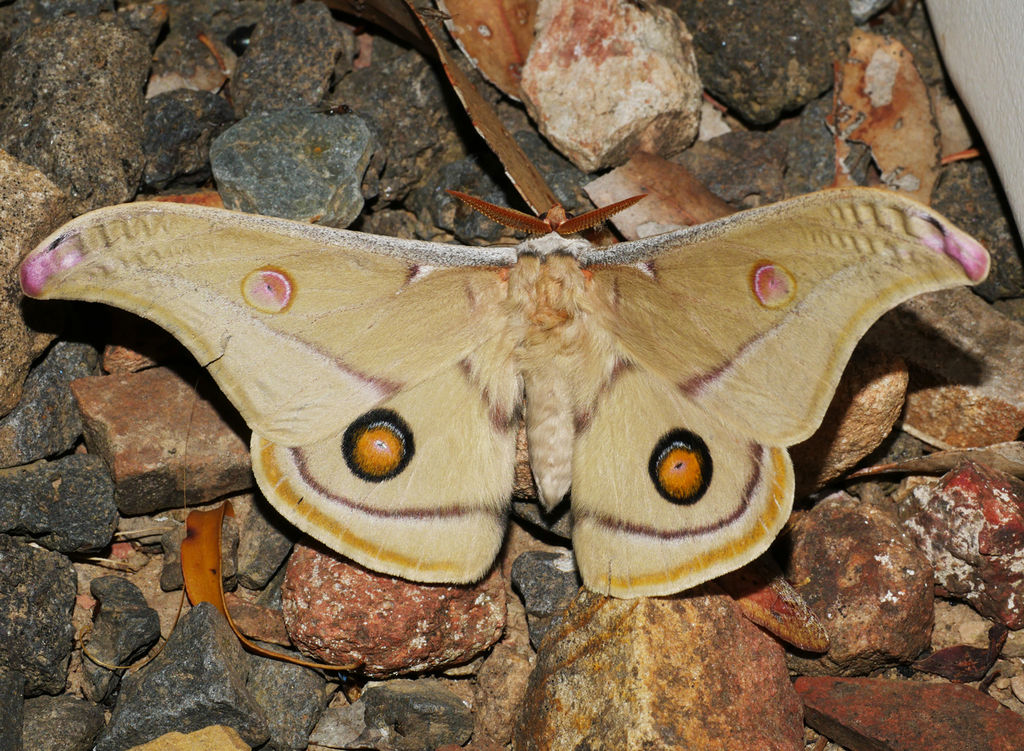
Emperor Gum Moth
Opodiphthera eucalypti
Opodiphthera eucalypti, the emperor gum moth, is a species of moth in the family Saturniidae native to Australia. This species was formerly placed in the genus Antheraea.
From the article Opodiphthera eucalypti on Wikipedia (CC BY-SA), quoted section by section
Range & habitat
The emperor gum moth may inhabit all states of Australia, however it is scarce in the more southerly states where the climate is less suitable. They are also found as an introduced species on both the North and South Islands of New Zealand.
Caterpillars. Caterpillars can usually be found on young adult leaves between October and March (the Australian Spring and Summer). When the caterpillars hatch they are black with short hairs on top of small nodes on their bodies called tubercles. The hairs are not poisonous and will not sting. As the caterpillars mature they change color each time they shed their skin (which totals to five stages in the caterpillar's appearance). The fully grown caterpillars are usually found on the highest branches of the host tree where the leaves are the youngest and easiest to digest. By the final stage before pupation the caterpillars have developed striking coloration, having a yellow/cream stripe down their bright green/blue body and nodes of red and blue. Despite this they are still surprisingly hard to spot. The caterpillar stage in the emperor gum moth's life cycle can last for many weeks, depending on the temperature and weather conditions.
Cocoon. When the caterpillar is fully mature it spins a dark brown silken cocoon on a branch which usually has a leaf to protect it with. …
Wikipedia: “Distribution”
Listen
Looking for field recordings…
Where it lives
Recorded sightings
—
geo-referenced records in GBIF, from museums, herbaria and field observers.
Drag the globe to turn it. Dots are where records exist, not a range map; darker means more records.
In the stacks
Searching the stacks…
Every page naming Opodiphthera eucalypti in the Biodiversity Heritage Library →
This page is assembled live from iNaturalist, GBIF, Wikipedia, the Source Library and the Internet Archive. It is not yet part of the hand-edited codex. iNaturalist taxon 68135.