- Animals
- ›Arthropods
- ›Chelicerates
- ›Arachnids
- ›Spiders
- ›Typical Spiders
- ›Entelegyne Spiders
- ›Orbweavers and Allies
- ›Orbweavers
- ›Typical Orbweavers
- ›Pararaneus
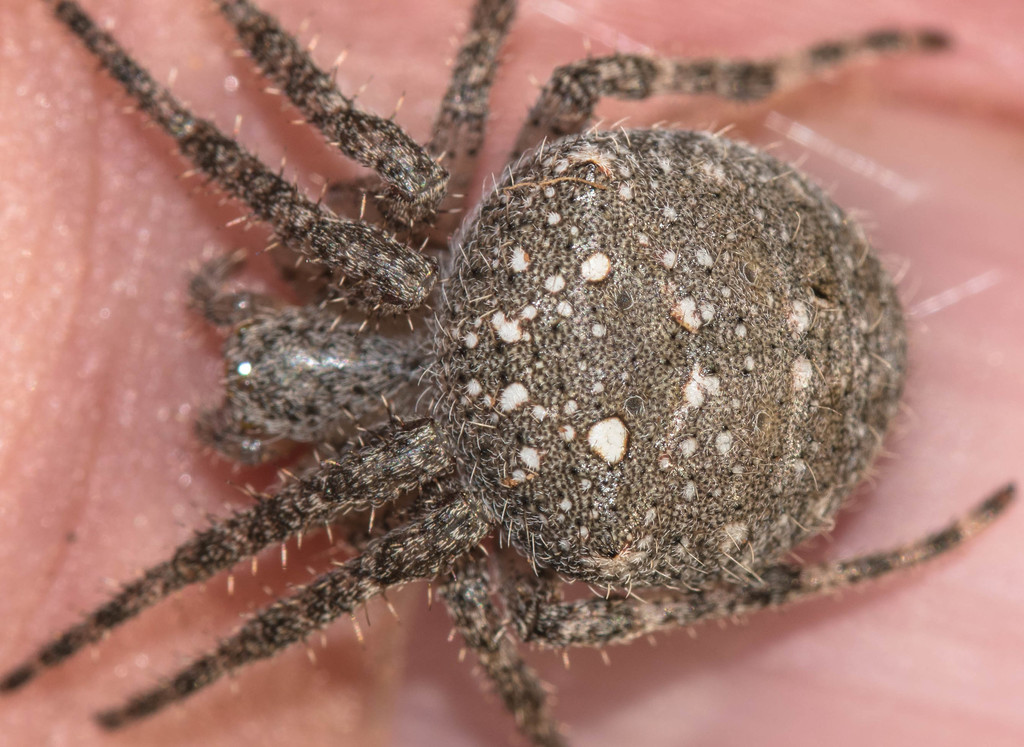
Spiky Field Spider
Pararaneus cyrtoscapus
Pararaneus cyrtoscapus is a species of spider in the family Araneidae. It is commonly known as the spiky field spider and is an African endemic species.
From the article Pararaneus cyrtoscapus on Wikipedia (CC BY-SA), quoted section by section
Range & habitat
Pararaneus cyrtoscapus is an African endemic species originally described in 1898 as Araneus cyrtoscapus from the type locality Estcourt in South Africa. The species has also been collected from six other African countries including Botswana, Ethiopia, Kenya, Malawi, Socotra, and Zimbabwe. In South Africa, the species is known from eight provinces and occurs in more than 10 protected areas at altitudes ranging from 1 to 1,593 m above sea level. The species has a widespread distribution across the country, with records from Eastern Cape, Free State, Gauteng, KwaZulu-Natal, Limpopo, Mpumalanga, North West, and Western Cape provinces.
Wikipedia: “Distribution”
What it does
The species is an orb-weaver with webs made in the field layer. The mature spider makes a typical vertical orb-web while the immature spiders make a horizontal web with a defective frame that is cone-shaped with threads pulling the hub out of the plane of the frame. The species is commonly sampled with a sweep net from the Fynbos, Forest, Grassland, Nama Karoo, Savanna and Thicket biomes. It has also been sampled from avocado, citrus and pistachio orchards and tomato fields.
Wikipedia: “Habitat and ecology”
Where it lives
Recorded sightings
—
geo-referenced records in GBIF, from museums, herbaria and field observers.
Drag the globe to turn it. Dots are where records exist, not a range map; darker means more records.
In the stacks
Searching the stacks…
Every page naming Pararaneus cyrtoscapus in the Biodiversity Heritage Library →
This page is assembled live from iNaturalist, GBIF, Wikipedia, the Source Library and the Internet Archive. It is not yet part of the hand-edited codex. iNaturalist taxon 681740.