- Animals
- ›Arthropods
- ›Chelicerates
- ›Arachnids
- ›Spiders
- ›Typical Spiders
- ›Entelegyne Spiders
- ›RTA Clade Spiders
- ›Oval calamistrum clade spiders
- ›Wolf Spiders and Allies
- ›Lynx Spiders
- ›Peucetia
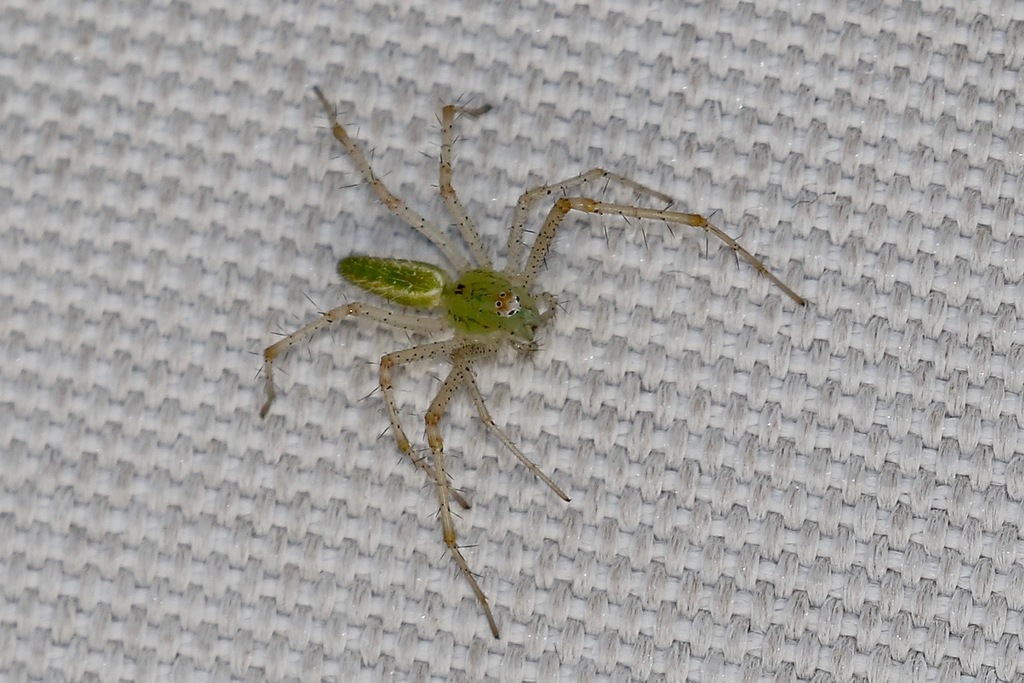
Namibia Green Lynx Spider
Peucetia crucifera
Peucetia crucifera is a species of spider in the family Oxyopidae. It is endemic to southern Africa and is commonly known as the Namibia green lynx spider.
From the article Peucetia crucifera on Wikipedia (CC BY-SA), quoted section by section
Description
Peucetia crucifera is known from both sexes. The species is characterized by the absence of clypeal lines, which distinguishes it from several other Peucetia species. Like other green lynx spiders, it is a medium to large-sized spider with a bright green coloration and long, slender legs with prominent spines.
Range & habitat
Peucetia crucifera has a wide distribution across southern Africa, occurring in Namibia, Botswana, Zimbabwe, and South Africa. In South Africa, the species is recorded from four provinces: Limpopo, Mpumalanga, Northern Cape, and Western Cape.
Wikipedia: “Distribution”
What it does
The species inhabits multiple biomes including Grassland, Nama Karoo, and Savanna biomes at altitudes ranging from 263 to 1,412 m above sea level. Peucetia crucifera is a free-living plant dweller that occurs on vegetation.
Wikipedia: “Habitat and ecology”
Where it lives
Recorded sightings
—
geo-referenced records in GBIF, from museums, herbaria and field observers.
Drag the globe to turn it. Dots are where records exist, not a range map; darker means more records.
In the stacks
Searching the stacks…
Every page naming Peucetia crucifera in the Biodiversity Heritage Library →
This page is assembled live from iNaturalist, GBIF, Wikipedia, the Source Library and the Internet Archive. It is not yet part of the hand-edited codex. iNaturalist taxon 682852.