- Animals
- ›Arthropods
- ›Hexapods
- ›Insects
- ›Winged and Once-winged Insects
- ›Butterflies and Moths
- ›Hawk, Sphinx, Silk, Emperor, and Allied Moths
- ›Emperor and Giant Silk Moths
- ›Emperor Moths
- ›Saturniini
- ›Actias
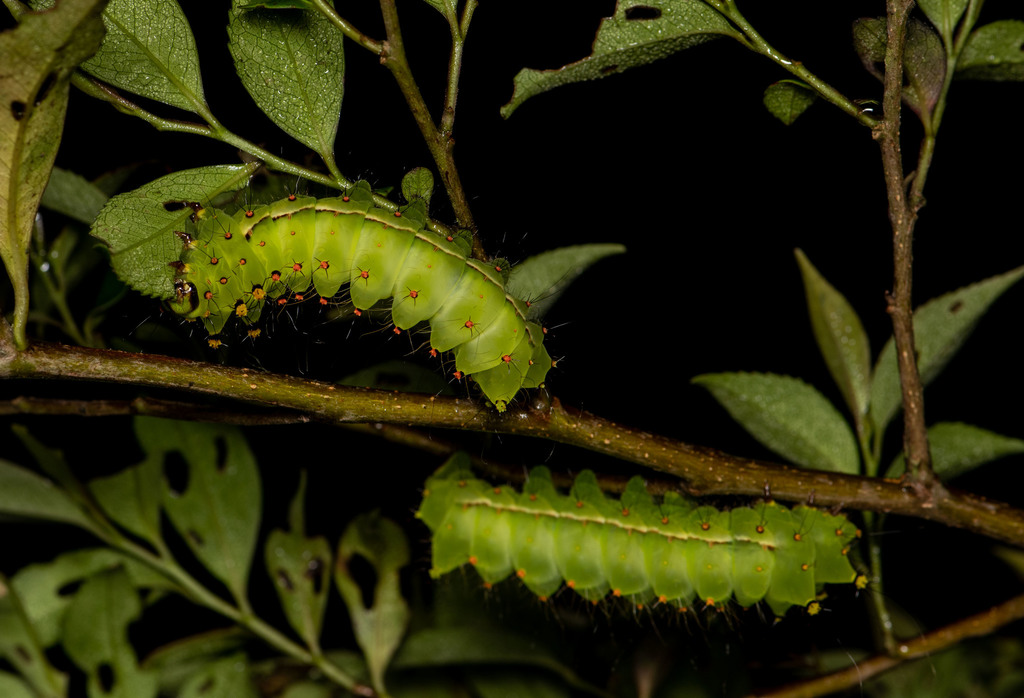
Chinese Moon Moth
Actias ningpoana
Actias ningpoana, commonly known as the Chinese moon moth, is a species of moth in the family Saturniidae. The species was first described by father-and-son entomologists Cajetan and Rudolf Felder in 1862.
It is a large moth with long, curved hindwing tails. There are many congeners across Asia; the Luna moth (A. luna) of eastern Canada and the United States is closely related.
From the article Actias ningpoana on Wikipedia (CC BY-SA), quoted section by section
Range & habitat
China (Jilin, Liaoning, Hebei, Henan, Jiangsu, Zhejiang, Jiangxi, Hubei, Hunan, Fujian, Guangdong, Hong Kong, Hainan, Sichuan, Yunnan) (Zhu & Wang, 1996) Russia (far east) (Zolotuhin & Chuvilin, 2009) India – Western Ghats
Wikipedia: “Range”
What it does
Larvae are typically fleshy, with clumps of raised bristles. The pupa develops in a silken cocoon or in the soil. Adults lack functional mouthparts, and their lifespan is measured in days. They have small heads, densely hairy bodies, and wingspans ranging from 13 to 15 centimeters.
Wikipedia: “Life cycle”
Listen
Looking for field recordings…
Where it lives
Recorded sightings
—
geo-referenced records in GBIF, from museums, herbaria and field observers.
Drag the globe to turn it. Dots are where records exist, not a range map; darker means more records.
In the stacks
Searching the stacks…
Every page naming Actias ningpoana in the Biodiversity Heritage Library →
This page is assembled live from iNaturalist, GBIF, Wikipedia, the Source Library and the Internet Archive. It is not yet part of the hand-edited codex. iNaturalist taxon 68365.