- Animals
- ›Arthropods
- ›Chelicerates
- ›Arachnids
- ›Spiders
- ›Typical Spiders
- ›Entelegyne Spiders
- ›Orbweavers and Allies
- ›Golden Orbweavers
- ›Nephila
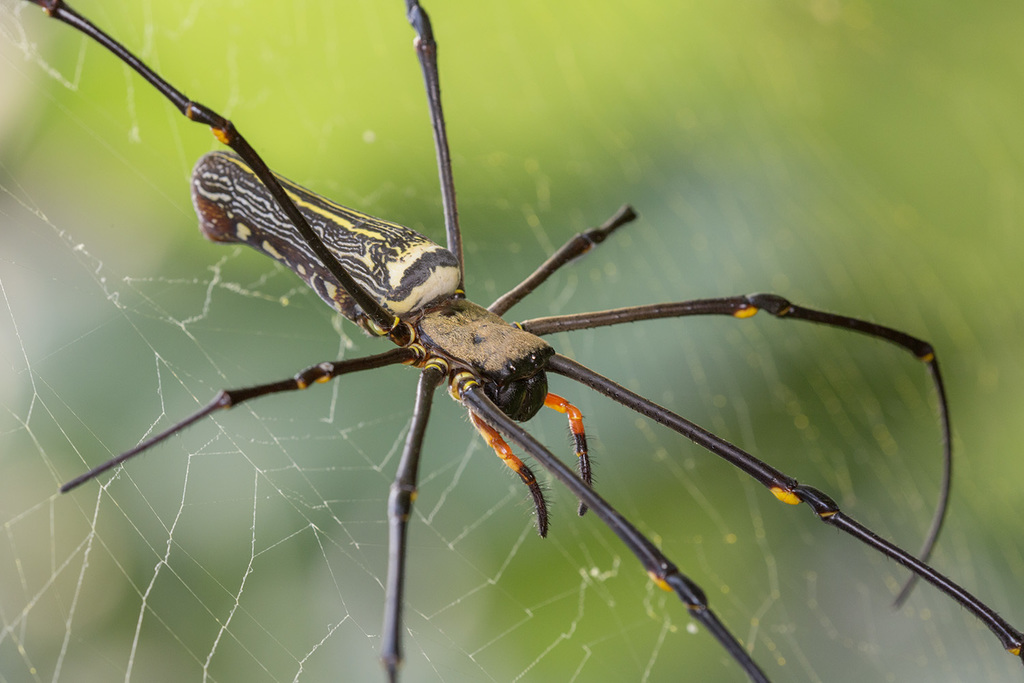
Giant Golden Orbweaver
Nephila pilipes
Nephila pilipes (northern golden orb weaver or giant golden orb weaver) is a species of golden orb-web spider. It resides all over countries in East and Southeast Asia as well as Oceania. It is commonly found in forests and coastal areas, near surface water, and against buildings and other terrain structures. Adult females are very large, with a body length of 25 to 50 mm (1 to 2 inches). Males are dwarfs, measuring only 4 to 6 mm (about 0.2 inch). It is the second largest of the orb-weaving spiders apart from the recently discovered Nephila komaci. The first, second, and fourth pairs of legs of juvenile females have dense hairy brushes, but these brushes disappear as the spider matures.
The N. pilipes golden web is vertical with a fine irregular mesh. It is not symmetrical, with the hub usually nearer the top. Rather than egg sacs being hung in the web, a pit is dug which is then covered with plant debris or soil.
From the article Nephila pilipes on Wikipedia (CC BY-SA), quoted section by section
Description
N. pilipes display female gigantism and male dwarfism (see Sexual dimorphism section). In terrestrial animals, N. pilipes have the most size differences between males and females. This can be explained by the evolutionary selection for females with better fecundity. Female N. pilipes have huge parental investments to their progenies, including egg production and web construction (see Parental care section).
Female. Females typically have a body size of 30–50 mm. The cephalothorax is about 15 mm long, 10 mm wide. The abdomen is about 30 mm long, 15 mm wide, mostly dark yellow-brown color with yellow stripes. The tergum is generally black or brown, covered with dense hairs. Both rows of eyes bulge towards the rear. The plastron is mostly black and brown. The legs span very long, and they are black and yellow. There are no apparent hairs on all legs. It has been reported that this sharp contrast between yellow and black color can increase foraging success towards visually-oriented prey.
Male. Males' body size is typically 5 mm to 6.5 mm. The cephalothorax is about 2.5 mm long, 2 mm wide. The abdomen is about 4 mm long, 1.5 mm wide. Front eyes are larger than rear eyes. Males have light brown legs, with some hairs. The carapace is yellow with very few hairs.
Difference from close relatives. N. …
Range & habitat
N. pilipes prefers moist habitats with no direct sunlight. It can be found in Japan, China, Hong Kong, Macau, Taiwan, Vietnam, Cambodia, Malaysia, Singapore, Myanmar, Indonesia, Thailand, Laos, Philippines, Sri Lanka, India, Pakistan, Nepal, Papua New Guinea, and Australia. In Australia, most N. pilipes are found in rainforest habitats in northern and eastern Australia, where climate is humid and vegetation offers shade against direct sunlight. In general, N. pilipes are distributed along coastal lines, where precipitation is ample. However, reports show that N. pilipes can be found in dry sclerophyll and low shrublands, hundred miles away from the coast. N. pilipes can survive in many climate types, including temperate coastal, Mediterranean, subtropical and tropical savannah climates. They construct webs in bushes and trees, near surface water, and against buildings and other terrain structures. To reduce heat from the sun, like other spiders, Nephila spp. has a thermoregulatory behavior. Experiments show that when the temperature reaches 32 °C (90 °F), Nephila spp. will adjust the angle between its body and the incoming sunlight, orienting its abdomen towards the sun but keeping the cephalothorax parallel to the web. When temperature further rises, it will align the full body along the sunlight direction, further reducing the area that is receiving heat from the sun. …
Wikipedia: “Habitat and distribution”
What it does
Nephila spp. prey upon only a few species. Nephila spp. will remove some specific insects from their webs. They avoid vespid wasps, alate ants, and other insects that secrete distasteful compounds. Due to Nephila's large body size, it can prey on insects with a broad size range, from 2 mm to even larger sizes than themselves. They adopt different strategies for different sizes of prey. Small prey are directly caught and removed from the web. For larger prey, they inject venom and wait. However, Nephila spp. have a dramatic change in predation style from the spiderling stage to adulthood. During the spiderling stage, they feed collectively on a common web. Upon reaching adulthood, they construct their own webs. Nephila spp. also reserve food caches to deal with periods of food shortage. They wrap surplus prey in silk and store them in the hub of the web. The silk covering can significantly reduce water loss due to evaporation. Food cache can reduce weight loss during periods with limited prey. It has been reported that some N. pilipes can adjust the ultraviolet radiation reflected by stripes on their body to attract preys that are UV light oriented. The bands on the legs and body of N. pilipes can reflect UV radiation, so they are more visible to flying insects. The contrast of colors makes them look like food sources for insects, rather than a predator spider.
Wikipedia: “Diet”
Where it lives
Recorded sightings
—
geo-referenced records in GBIF, from museums, herbaria and field observers.
Drag the globe to turn it. Dots are where records exist, not a range map; darker means more records.
In the stacks
Searching the stacks…
Every page naming Nephila pilipes in the Biodiversity Heritage Library →
This page is assembled live from iNaturalist, GBIF, Wikipedia, the Source Library and the Internet Archive. It is not yet part of the hand-edited codex. iNaturalist taxon 68390.