- Animals
- ›Arthropods
- ›Chelicerates
- ›Arachnids
- ›Spiders
- ›Mygalomorphs
- ›Avicularioidea
- ›Horned Trapdoor Spiders
- ›Stasimopus
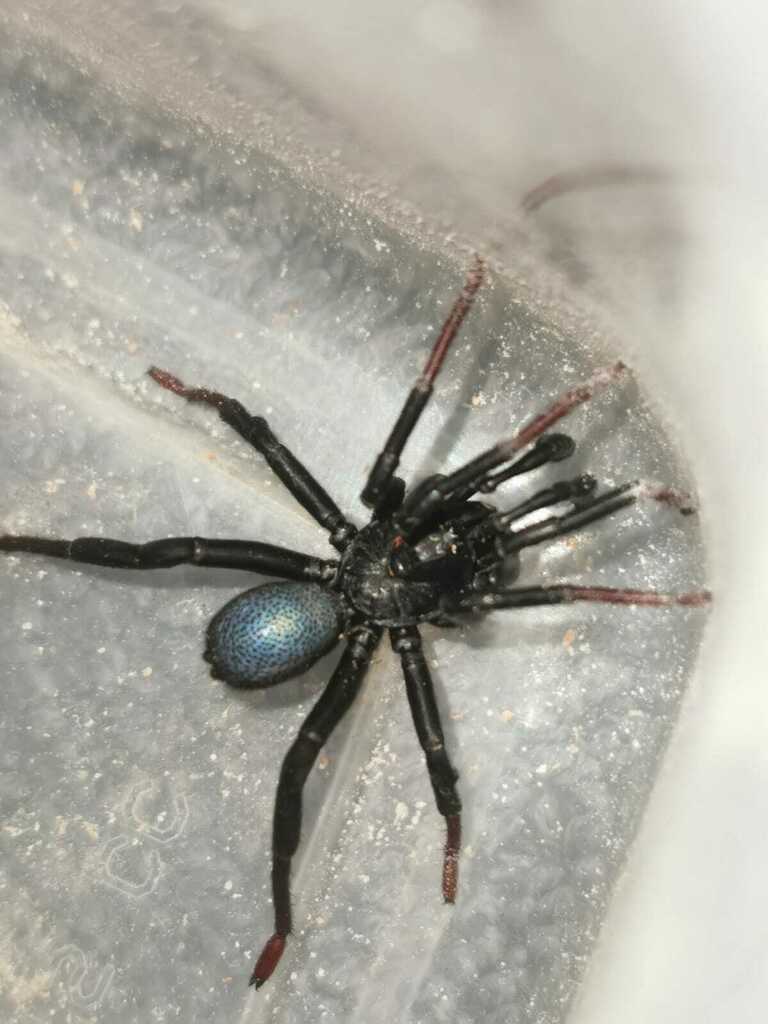
Stasimopus hewitti
Stasimopus hewitti is a species of spider in the family Stasimopidae. It is endemic to South Africa and is commonly known as Hewitt's cork-lid trapdoor spider.
From the article Stasimopus hewitti on Wikipedia (CC BY-SA), quoted section by section
Description
Stasimopus hewitti is known from both sexes and are medium-sized spiders with carapace length of 8–12 mm. The male carapace is black, with legs I–IV metatarsi and tarsi red (IV occasionally black proximally). The rest of the legs and pedipalps are black. The opisthosoma has ventral and lateral surfaces black, with the dorsal surface powder blue. Book lung covers are yellow. Females resemble S. robertsi.
Range & habitat
Stasimopus hewitti is found in the Gauteng province of South Africa. It occurs at multiple locations including Eldoraigne (Centurion), Gesina (Pretoria), Grand Central airport complex, Hartebeeshoek, Olympus (Pretoria), Roodeplaat areas, Swavelpoort, Tswaing Crater Nature Reserve, and Zeekoegat, at altitudes ranging from 1,142 to 1,618 m above sea level.
Wikipedia: “Distribution”
What it does
The species is a ground burrow dweller that occurs in a wide range of habitats and soil types, appearing to be absent only from very sandy soils. It has been sampled from the Grassland biome.
Wikipedia: “Habitat and ecology”
Where it lives
Recorded sightings
—
geo-referenced records in GBIF, from museums, herbaria and field observers.
Drag the globe to turn it. Dots are where records exist, not a range map; darker means more records.
In the stacks
Searching the stacks…
Every page naming Stasimopus hewitti in the Biodiversity Heritage Library →
This page is assembled live from iNaturalist, GBIF, Wikipedia, the Source Library and the Internet Archive. It is not yet part of the hand-edited codex. iNaturalist taxon 690935.