- Animals
- ›Arthropods
- ›Chelicerates
- ›Arachnids
- ›Spiders
- ›Typical Spiders
- ›Entelegyne Spiders
- ›Orbweavers and Allies
- ›Comb-footed Spiders
- ›Theridiinae
- ›Theridion
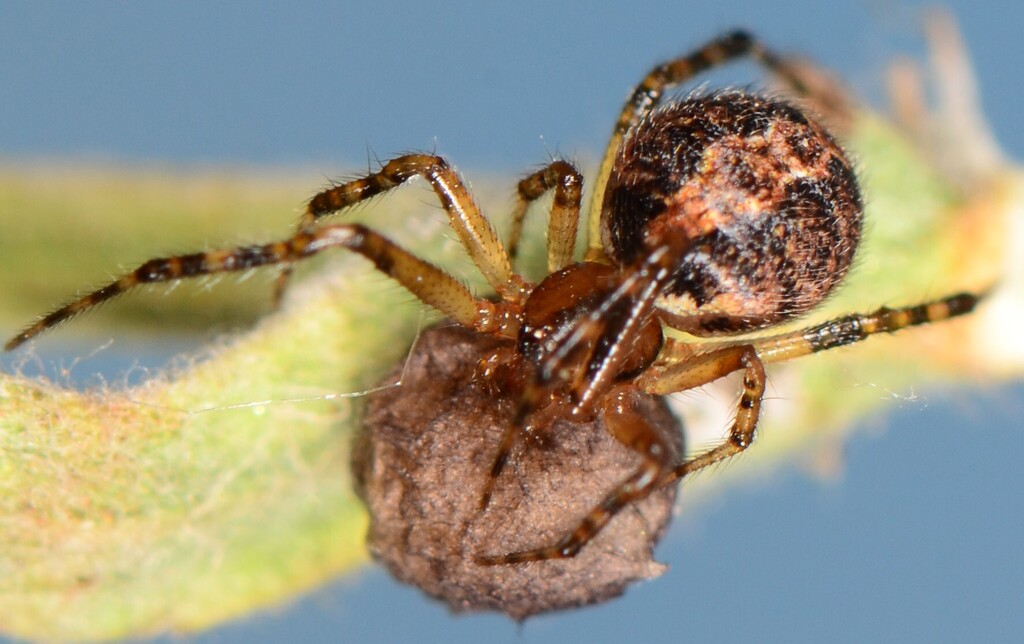
Purcell's Theridion Comb-Feet Spider
Theridion purcelli
Theridion purcelli is a species of spider in the family Theridiidae. It is found in Saint Helena, Namibia, and South Africa, and is commonly known as Purcell's Theridion comb-feet spider.
From the article Theridion purcelli on Wikipedia (CC BY-SA), quoted section by section
Description
The abdomen is subglobular and furnished with bristly setae. The colour is dull yellowish with a longitudinal central sharply dentated band, obtuse anteriorly and tapering towards the spinnerets. The band is marked with pale spots. Ventrally the abdomen is black-brown with a central white patch. The female resembles the male.
Range & habitat
Theridion purcelli is found in Saint Helena, Namibia, and South Africa. In South Africa it is known from all provinces.
Wikipedia: “Distribution”
What it does
This species builds a conical retreat of twigs and leaves in its three-dimensional labyrinth web. It has been sampled from all the floral biomes except the Indian Ocean Coastal Belt Forest and Succulent Karoo biomes at altitudes ranging from 5 to 1809 m. The species is also commonly found in crops including citrus, cotton, macadamia, maize, strawberries, sunflowers and tomatoes. It is also synantropic and found in and around houses.
Wikipedia: “Habitat and ecology”
In human culture
The species is named after William Frederick Purcell, a South African naturalist and museum curator who made significant contributions to the study of southern African arachnids.
Wikipedia: “Etymology”
Where it lives
Recorded sightings
—
geo-referenced records in GBIF, from museums, herbaria and field observers.
Drag the globe to turn it. Dots are where records exist, not a range map; darker means more records.
In the stacks
Searching the stacks…
Every page naming Theridion purcelli in the Biodiversity Heritage Library →
This page is assembled live from iNaturalist, GBIF, Wikipedia, the Source Library and the Internet Archive. It is not yet part of the hand-edited codex. iNaturalist taxon 693235.