- Animals
- ›Arthropods
- ›Chelicerates
- ›Arachnids
- ›Spiders
- ›Typical Spiders
- ›Entelegyne Spiders
- ›Salticoid Spiders
- ›Jumping Spiders
- ›Typical Jumping Spiders
- ›Euophryini
- ›Thyenula
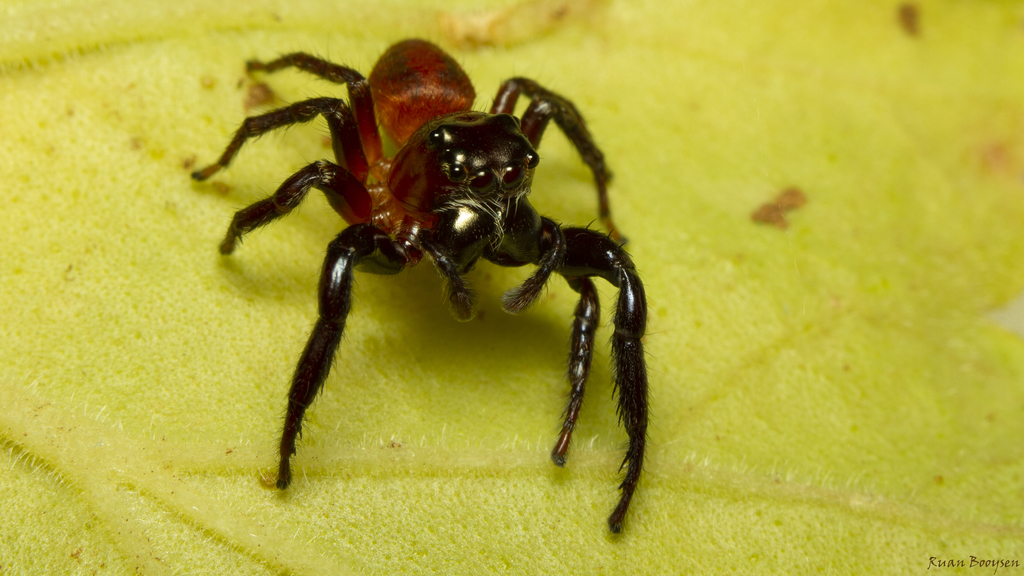
Thyenula rufa
Thyenula rufa is a jumping spider species that lives in South Africa. A member of the genus Thyenula, it is a large spider measuring between 7 and 10 mm (0.28 and 0.39 in) in total body length, the male being generally larger than the female. It has been found living on coastal forests. The spider has distinctive copper-coloured hairs on its body, which is referred to in its specific name, the Latin word for 'red headed'. Its carapace, the hard upper part of the front section of the spider, is a orange-brownish oval. Its rear section, or abdomen, varies between specimens. Males are generally grey-ish brown with a stripe visible running across the middle. Females are generally yellowish-brown with some having a marking of brown patches on them. All have generally yellowish-brown legs.
From the article Thyenula rufa on Wikipedia (CC BY-SA), quoted section by section
Description
Thyenula are medium-sized to large spiders. They have a body that is divided into two main parts: a rounded cephalothorax, behind that, and a more bulbous abdomen. Thyenula rufa is a large spider. The male has a cephalothorax that is between 4.8 and 5.2 mm (0.19 and 0.20 in) long, 3.6 and 4.2 mm (0.14 and 0.17 in) and 2.4 and 2.6 mm (0.09 and 0.10 in) high. Its carapace, the hard upper part of the cephalothorax, is a orange-brownish oval with a short eye field and a clear depression, or fovea visible in the middle of its [thorax. There are black rings around its eyes. Overall, there are a few hairs on the spiders thorax and a few longer bristles near its eyes. The part of the underside of the carapace known as the sternum is yellow. The spider's face, or clypeus, is low and brown. Its chelicerae are characteristically large and robust with a single teeth at the front margin and one more behind. A large fang is visible. Its remaining mouthparts, including its labium and maxillae, are light brown with cream tips. Behind its cephalothorax, the male has an ovoid abdomen that is between 4.6 and 4.8 mm (0.18 and 0.19 in) long and between 2.7 and 3.4 mm (0.11 and 0.13 in) wide. Its topside is greyish-brown and covered in reddish-copper coloured hairs that are particularly dense on its sides and front edge. …
Range & habitat
Although Thyenula spiders can be found across Southern Africa. Thyenula rufa is endemic to South Africa. The species has be found in the coastal area along the southeast of the country. It has been seen living in coastal evergreen forests and particularly on Vepris lanceolata trees.
Wikipedia: “Distribution and habitat”
In human culture
Thyenula rufa is a species of jumping spider, a member of the family Salticidae, that was first described by the arachnologists Wanda Wesołowska, Galina Azarkina and Anthony Russell-Smith in 2014. They allocated it to the genus Thyenula, which had been itself been first circumscribed by the naturalist Eugène Simon in 1902. The spider was one of over 500 species identified by Wesołowska during her career, only Simon having described more. Its specific name is the Latin word for 'red headed' and is named for the copper-coloured hairs that are found on its body. In 2015, the evolutionary biologist Wayne Maddison undertook a phylogenetic classification that showed that the genus is a member of tribe Euophryini. First circumscribed by Simon in 1901, the tribe has also been known as Euophrydinae, but the original name is now more prevalent. It is a member of the clade Saltafresia. The genus was part of a proposed clade named after it alongside the related genus Rumburak. In 2017, the arachnologist Jerzy Prószyński added the genus to a group of genera named Euopherines.
Wikipedia: “Etymology and taxonomy”
Where it lives
Recorded sightings
—
geo-referenced records in GBIF, from museums, herbaria and field observers.
Drag the globe to turn it. Dots are where records exist, not a range map; darker means more records.
In the stacks
Searching the stacks…
Every page naming Thyenula rufa in the Biodiversity Heritage Library →
This page is assembled live from iNaturalist, GBIF, Wikipedia, the Source Library and the Internet Archive. It is not yet part of the hand-edited codex. iNaturalist taxon 693430.