- Animals
- ›Arthropods
- ›Hexapods
- ›Insects
- ›Winged and Once-winged Insects
- ›Ants, Bees, Wasps, and Sawflies
- ›Narrow-waisted Wasps, Ants, and Bees
- ›Ants, Bees, and Stinging Wasps
- ›Formicoidea
- ›Ants
- ›Myrmicine Ants
- ›Crematogastrini
- ›Temnothorax
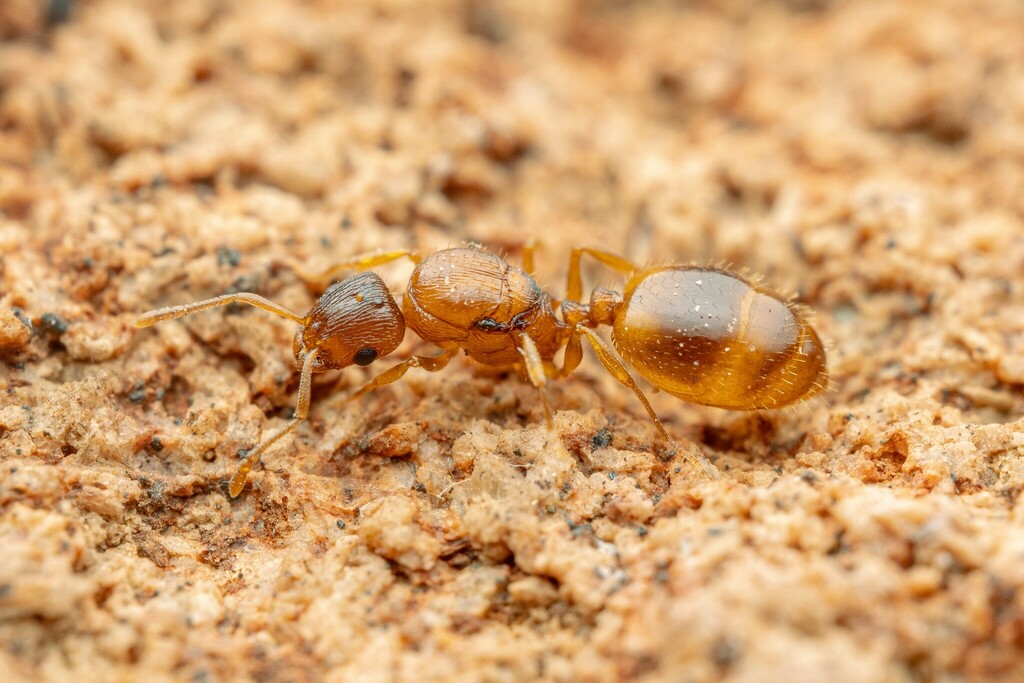
Temnothorax rugatulus
Temnothorax rugatulus is a species of ant in the genus Temnothorax.
It is found in North America. More specifically, it is found in the forests of the western United States. Colonies are either monogynous (with single reproductive queen) or polygynous (multiple queens). Queens in monogynous colonies are generally larger (macrogynes), about twice the size of conspecific workers; polygynous colonies have smaller queens (microgynes), typically slightly smaller than the workers. T. rugatulus ants are a subdominant ant group.
From the article Temnothorax rugatulus on Wikipedia (CC BY-SA), quoted section by section
Range & habitat
T. rugatulus is distributed across all of the western U.S.A, North Dakota, South Dakota, and Western Texas. The species has a presence in the northern Mexican states Baja California, Sonora and Chihuahua. The species' range extends north into Canada, occupying the provinces of Saskatchewan, Alberta, British Columbia and the Yukon Territories.
Wikipedia: “Distribution”
What it does
For T. rugatulus ants, visual cues help them understand their surroundings and include celestial, local landmarks, or memorization of their surroundings. When presented with a choice of different sensory cues, T. rugatulus steadily chose visual cues over other forms of navigational cues. If and when visual cues were blocked with all else staying equal, the ants were heavily disoriented. The age of the ant also affects the type of navigational cues it uses. Older ants that are more familiar with their surroundings will primarily use visual cues, whereas naive ants will use pheromone signals instead.
Wikipedia: “Navigational behavior”
Listen
Looking for field recordings…
Where it lives
Recorded sightings
—
geo-referenced records in GBIF, from museums, herbaria and field observers.
Drag the globe to turn it. Dots are where records exist, not a range map; darker means more records.
In the stacks
Searching the stacks…
Every page naming Temnothorax rugatulus in the Biodiversity Heritage Library →
This page is assembled live from iNaturalist, GBIF, Wikipedia, the Source Library and the Internet Archive. It is not yet part of the hand-edited codex. iNaturalist taxon 69606.