- Plants
- ›Vascular Plants
- ›flowering plants
- ›Dicots
- ›nightshades, bindweeds, gooseweeds, and allies
- ›nightshade family
- ›schwenckias and allies
- ›Schwenckia
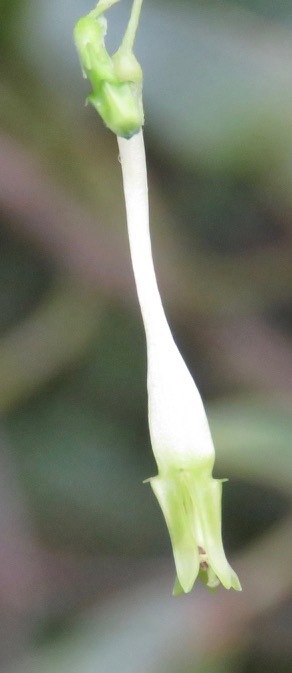
Schwenckia grandiflora
Schwenckia grandiflora is a species of flowering plant in the family Solanaceae, commonly known as the nightshade family. It is native to tropical South America, particularly eastern and central regions of Brazil. The species is a climbing shrub that primarily grows in wet tropical biomes and open forest habitats.
The species was first described by the English botanist George Bentham and published in Prodromus Systematis Naturalis Regni Vegetabilis volume 10, page 193, in 1846.
From the article Schwenckia grandiflora on Wikipedia (CC BY-SA), quoted section by section
Description
It is one of two climbing subshrubs in the genus Schwenckia, with slender, twining stems. The young branches are green, slightly glossy, and covered with fine hairs. The leaves are arranged alternately along the stem and are attached by short, slightly hairy stalks. They are oblong to heart-shaped, with pointed tips and mostly smooth edges. The upper surface of the leaves is nearly hairless, while the underside is covered with fine hairs, especially along the veins. The flowers are borne in a large, loose, branching cluster. Small, narrow bracts are present at the base of the flower stalks. As suggested by its name, this variety is characterized by its relatively large flowers.
== References ==
Where it lives
Recorded sightings
—
geo-referenced records in GBIF, from museums, herbaria and field observers.
Drag the globe to turn it. Dots are where records exist, not a range map; darker means more records.
In the stacks
Searching the stacks…
Every page naming Schwenckia grandiflora in the Biodiversity Heritage Library →
This page is assembled live from iNaturalist, GBIF, Wikipedia, the Source Library and the Internet Archive. It is not yet part of the hand-edited codex. iNaturalist taxon 700658.