- Animals
- ›Arthropods
- ›Hexapods
- ›Insects
- ›Winged and Once-winged Insects
- ›Stick Insects
- ›Verophasmatodea
- ›Areolatae
- ›Bacilloidea
- ›Heteropterygidae
- ›Obriminae
- ›Obrimini
- ›Trachyaretaon
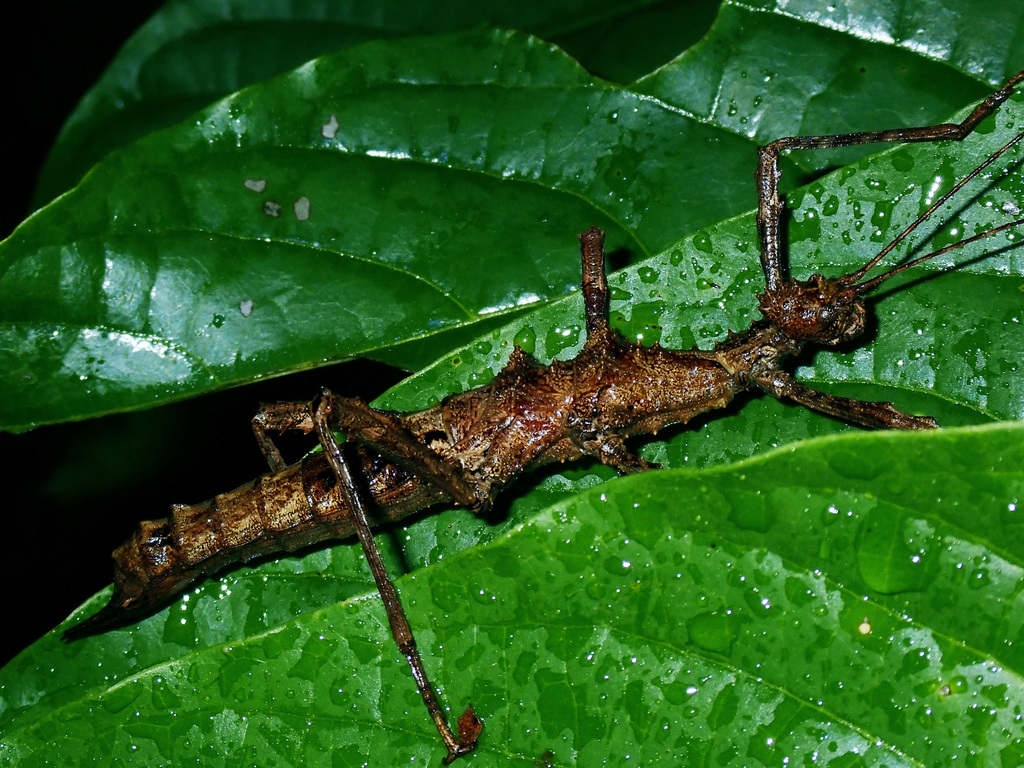
Trachyaretaon echinatus
Trachyaretaon echinatus is the type species of the genus Trachyaretaon in the order of the stick insects.
From the article Trachyaretaon echinatus on Wikipedia (CC BY-SA), quoted section by section
Description
The females of Trachyaretaon echinatus reach lengths of 71 to 86 millimetres (2.8 to 3.4 in). Males grow up to 47 to 48 millimetres (1.9 to 1.9 in) long. The lively green-brown to black-brown and very variable coloring can be dominated by dark green tones in the females. In addition to black areas on the front segments of the abdomen, they can also have white bands on the femurs or a white triangle on the pronotum. They are morphologically similar to those of the slightly smaller Trachyaretaon gatla, in which the supraanal plate (epiproct), i.e. the eleventh tergite, as well as the seventh sternite of the abdomen is clearly notched, while in the females of Trachyaretaon echinatus it ends rounded or truncated. The abdominal tergites two to seven are almost twice as wide as long, the tergites six to nine are smooth or indistinctly keeled, unlike in Trachyaretaon gatla. Compared to the significantly larger and less spined Trachyaretaon carmelae, the tiny spines between the large teeth on the ventral carina of the meso- and metafemurs are missing in both sexes.
Wikipedia: “Characteristics”
Range & habitat
While only the Philippines are mentioned as the original locality, in subsequent works the islands Luzon, Sibuyan and Masbate are mentioned as the distribution area. Because the specimens described from outside Luton are all nymphs, the locations outside of Luzon cannot be confirmed with certainty. On Luzon, specimens have been found in the provinces Mountain Province, Nueva Vizcaya, Aurora, Quezon and Sorsogon.
Wikipedia: “Distribution”
What it does
Mango and guava are known to be food plants for Trachyaretaon echinatus. Since both crops are in the range of the species, it is sometimes considered a pest species there. The females lay the eggs, which are about 4 to 45 millimetres (0.16 to 1.77 in) long and 2 to 25 millimetres (0.079 to 0.984 in) wide and high, in clutches of 10 to 15 pieces in the ground at a depth of only about 1 centimetre (0.39 in). The nymphs, which are 41 millimetres (1.6 in) long, hatch after about four to five months. Females need about six months to become adult and another five to six weeks before they begin laying eggs. After that, a clutch of eggs is laid approximately every two to three weeks.
Wikipedia: “Way of life and reproduction”
Listen
Looking for field recordings…
Where it lives
Recorded sightings
—
geo-referenced records in GBIF, from museums, herbaria and field observers.
Drag the globe to turn it. Dots are where records exist, not a range map; darker means more records.
In the stacks
Searching the stacks…
Every page naming Trachyaretaon echinatus in the Biodiversity Heritage Library →
This page is assembled live from iNaturalist, GBIF, Wikipedia, the Source Library and the Internet Archive. It is not yet part of the hand-edited codex. iNaturalist taxon 743513.