- Animals
- ›Arthropods
- ›Hexapods
- ›Insects
- ›Winged and Once-winged Insects
- ›Stick Insects
- ›Verophasmatodea
- ›Areolatae
- ›Bacilloidea
- ›Heteropterygidae
- ›Obriminae
- ›Obrimini
- ›Tisamenus
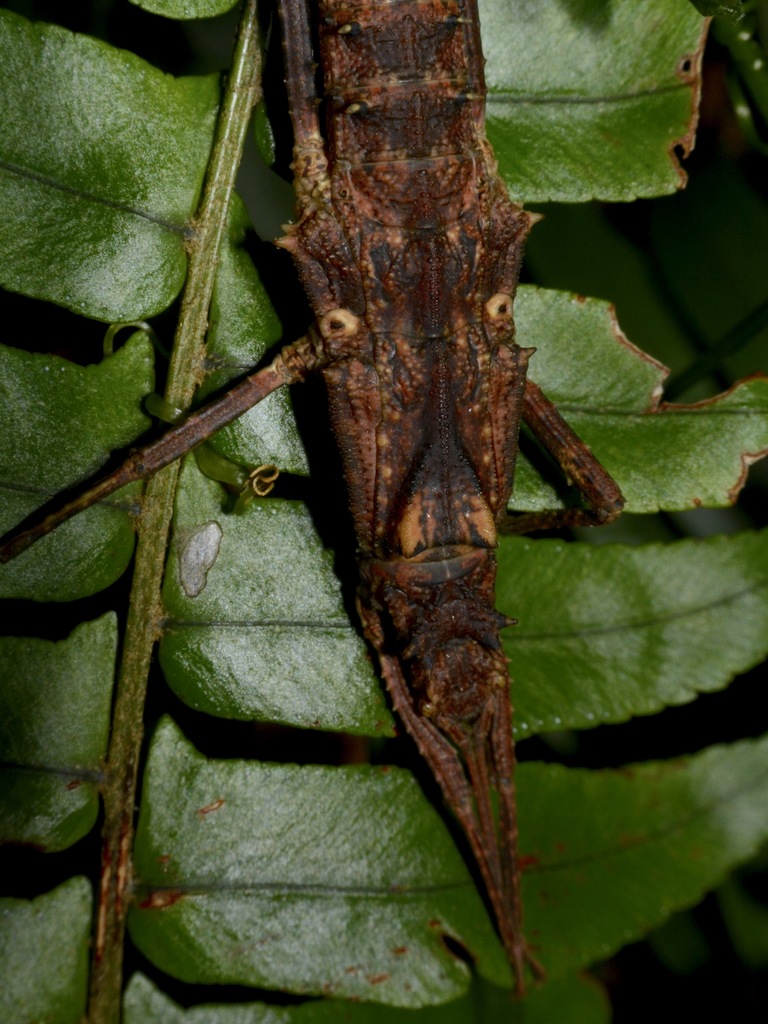
Tisamenus cervicornis
Tisamenus cervicornis is a stick insect species (Phasmatodea), in the family of the Heteropterygidae endemic to the Philippine islands Luzon, Samar and Bohol.
From the article Tisamenus cervicornis on Wikipedia (CC BY-SA), quoted section by section
Description
Tisamenus cervicornis is a medium-sized Tisamenus species. It has multitoothed postorbital crests on the head. Their second tooth is the largest. Behind the ridges sits a pair of conical tubercles. These features distinguish them from the similar Tisamenus armadillo and Tisamenus spadix. On the pronotum there are two strongly compressed, clearly bidentate combs that point obliquely backwards. The genus-typical triangle on the mesonotum is flatly concave as in Tisamenus spadix. In males it is longer than wide and reaches the middle of the mesonotum. Unlike Tisamenus tagalog, in which it is only slightly longer than wide and does not reach the middle of the mesonotum. In females of Tisamenus cervicornis, the triangle is very small overall, forming a roughly equilateral triangle and reaching only one-third the length of the mesonotum. This feature makes the females easily distinguishable from those of the similar, only slightly slimmer Tisamenus deplanatus, in which this triangle is longer than it is wide, forming a more isosceles triangle that reaches the middle of the mesonotum. The mesopleuras are toothed and have a spine above the mesocoxa. The expanded metapleurae are dentate, with the last two teeth being the larger ones. The second segment of the abdomen has an anterior and a posterior pair of tubercles on the upper side. …
Range & habitat
The currently known distribution area includes various provinces in the south of Luzon and the north of Samar. On Luzon, Tisamenus cervicornis has been found in Camarines Sur, the type locality of the species, in the Pocdol Mountains region of Sorsogon, as well as in Albay and Quezon. Photographs of the species show that it also occurs on the island of Bohol, where both sexes were photographed in Bilar. The female, designated as Hoploclonia deplanata by Rehn and Rehn, which has been assigned to Tisamenus cervicornis since 2025, originates from Surigao on the island of Mindanao. While this island could also be part of the species' distribution area, it is doubtful that it does not fit into the currently known overall distribution area of the genus.
Wikipedia: “Distribution”
What it does
The eggs laid by the females using the ovipositor are 3.9 millimetres (0.15 in) long, 2.5 millimetres (0.098 in) wide, and 2.8 millimetres (0.11 in) high, including the operculum. The nymphs begin to hatch after about four to five months and are already 16 millimetres (0.63 in) long. Males reach adulthood after about five months, and females after six to seven months. They begin laying eggs after another four to five weeks.
Wikipedia: “Reproduction and life cycle”
Listen
Looking for field recordings…
Where it lives
Recorded sightings
—
geo-referenced records in GBIF, from museums, herbaria and field observers.
Drag the globe to turn it. Dots are where records exist, not a range map; darker means more records.
In the stacks
Searching the stacks…
Every page naming Tisamenus cervicornis in the Biodiversity Heritage Library →
This page is assembled live from iNaturalist, GBIF, Wikipedia, the Source Library and the Internet Archive. It is not yet part of the hand-edited codex. iNaturalist taxon 743538.