- Animals
- ›Arthropods
- ›Hexapods
- ›Insects
- ›Winged and Once-winged Insects
- ›Stick Insects
- ›Verophasmatodea
- ›Areolatae
- ›Bacilloidea
- ›Heteropterygidae
- ›Dataminae
- ›Datamini
- ›Orestes
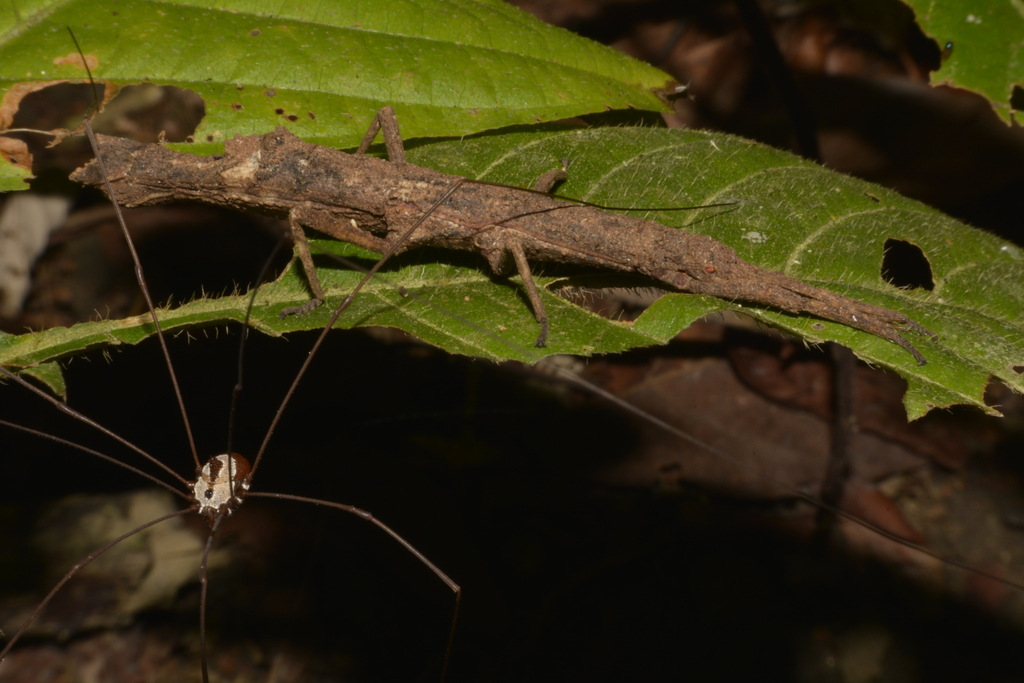
Orestes mouhotii
Orestes mouhotii is an insect species belonging to the order of Phasmatodea. Because of its synyonym Orestes verruculatus, it is the type species of the genus Orestes. Because of its compact body shape, the species is sometimes referred to as small cigar stick insect.
From the article Orestes mouhotii on Wikipedia (CC BY-SA), quoted section by section
Description
The females are 45 to 55 millimetres (1.8 to 2.2 in) long and thus longer than the maximal 40 millimetres (1.6 in) long males. Both sexes have noticeably short legs and have beige to brown patterns. The males wear semicircular horns (auricles) on their head. While they are overall thinner and are characterized by a slightly thickened end of abdomen, the more compact females have a typical thickening immediately behind the middle of the abdomen, which is especially recognizable as the height increases. Freshly adult females are very vividly drawn light and dark brown and often have light, almost white areas, especially on the sides and in the middle of the abdomen. Over the middle of the body there is usually a particularly distinct dark brown longitudinal band on the front abdomen and the metanotum, which is somewhat lighter on the mesonotum and is flanked here by black-colored tubercles. This high-contrast drawing fades with increasing age and the insects become increasingly uniformly light brown.
Wikipedia: “Characteristics”
Range & habitat
The locations of the holotypes of Orestes mouhotii and that of its synonym Orestes verruculatus in southern Thailand are considered to be a secured occurrence of the species. Otherwise, depending on the interpretation of the species belonging to Cambodia, the distribution area extends over the south of Vietnam, Malay Peninsula and Singapore to Sumatra. Also in the Chinese province Yunnan the species has been found. Males are not known from the entire range and some populations are considered parthenogenetic. Only the population found by Ingo Fritzsche in the Khao Yai National Park in Thailand, as well as the population found by Jérôme Constant in the Kirirom National Park in Cambodia in 2015 are verifiably sexual. The sister species collected in May 2018 by Christoph Röhrs on the Andamans on Havelock Island, also occurs there sexually.
Wikipedia: “Distribution area”
What it does
During the day, the insects put their hind legs back and the middle legs stretched forward close to the body. At the same time, the fore legs and the antennae are stretched forward. In this position, the phytomimesis is so perfect that the insects can hardly be distinguished from a short, broken branch. At night they feed on food plants, which includes Curculigo species, Dioscorea species like Dioscorea glabra, Dracaena species like Dracaena fragrans and Dracaena surculosa as well as Epipremnum species. The females begin about two months after the moult for the imago to lay the eggs one by one, about 3 millimetres (0.12 in) long, 2 millimetres (0.079 in) wide and an average of 14 milligrams. The nymphs hatch from the eggs after just two months. They need about a year to develop into an imago. The life expectancy of adult females is also another year. The species reproduces by parthenogenesis (female-only asexual reproduction), cyclically, so natural populations are generally exclusively female. Males are rare even in sexually reproducing populations and occur in a ratio of 1 to 20.
Wikipedia: “Way of life and reproduction”
Listen
Looking for field recordings…
Where it lives
Recorded sightings
—
geo-referenced records in GBIF, from museums, herbaria and field observers.
Drag the globe to turn it. Dots are where records exist, not a range map; darker means more records.
In the stacks
Searching the stacks…
Every page naming Orestes mouhotii in the Biodiversity Heritage Library →
This page is assembled live from iNaturalist, GBIF, Wikipedia, the Source Library and the Internet Archive. It is not yet part of the hand-edited codex. iNaturalist taxon 744637.