- Animals
- ›Arthropods
- ›Hexapods
- ›Insects
- ›Winged and Once-winged Insects
- ›Ants, Bees, Wasps, and Sawflies
- ›Narrow-waisted Wasps, Ants, and Bees
- ›Ants, Bees, and Stinging Wasps
- ›Formicoidea
- ›Ants
- ›Ponerine Ants
- ›Typical Ponerine Ants
- ›Dinoponera
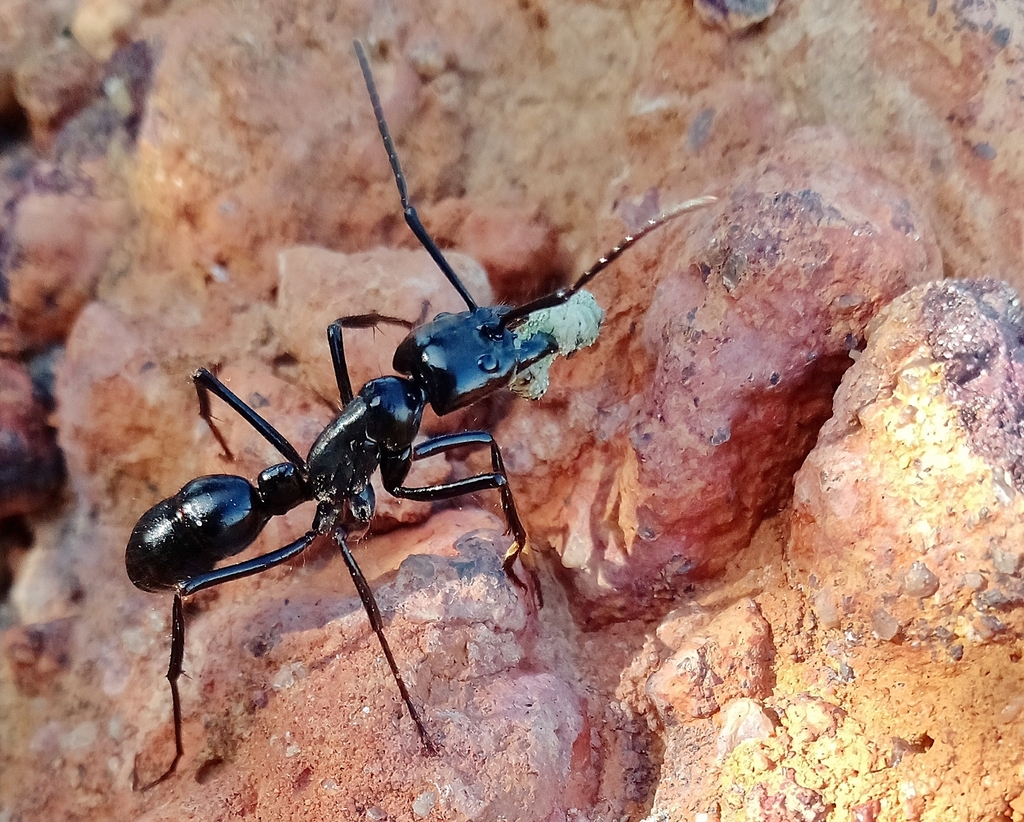
Dinoponera quadriceps
Dinoponera quadriceps is a queenless species of ants in the subfamily Ponerinae. The species, known from Brazil, is similar to Dinoponera mutica and uses venom for subduing large live prey and defense. Its venom could be of use to the pharmaceutical industry.
From the article Dinoponera quadriceps on Wikipedia (CC BY-SA), quoted section by section
Description
Workers of this species is recognized by its finely micro-sculptured integument which is not shiny, rounded anterior inferior pronotal corner lacking a tooth-like process, ventral side of the head lacking any gular striations and long/flagellate pilosity. Males are distinguished by the long fine setae of the second funicular segment, light brown coloration, long narrow parameres, volsella with two small basal teeth and lacking a lobe on the distal edge of digitus volsellaris. Dinoponera quadriceps may be confused with Dinoponera mutica, but has a finely micro-sculptured integument which is not shiny, lacks gular striations and has a petiole which bulges on the dorso-anterior edge in contrast to Dinoponera mutica's roughly microsculptured integument, striated gula and petiole with even, non-bulging corners. Dinoponera quadriceps and Dinoponera mutica differ in micro-sculpturing, gular striations and petiole shape. Distribution records show a distance of over 900 km between the two species, but if specimens are found with an integration of characters in the area of Tocantins and northern Goias then these species may need to be synonymized.
Range & habitat
Dinoponera quadriceps is found in the Caatingas, Cerrados, upland humid forest and Atlantic forest in the northeastern Brazilian states of Alagoas, Bahia, Ceará, Paraíba, Pernambuco and Rio Grande do Norte. Of all Dinoponera, Dinoponera quadriceps has the largest colonies with an average of 80 workers (range 26–238). Dinoponera quadriceps usually nest at the base of trees. Observations of Dinoponera quadriceps nests show that in more arid Caatinga and Cerrado habitats, nests are predominantly constructed under trees, whereas in Atlantic forest 60% of nests were 3 m away from any tree. Nests are deeper in Dinoponera quadriceps (and Dinoponera australis) than in Dinoponera gigantea, Monnin et al. (2003) suggests that deeper nests are a possible adaptation to seasons and aridity.
Wikipedia: “Distribution”
Toxicity
For subduing large live prey and defense, workers possess a sting that has been known to cause severe pain lasting up to 48 hours. Due to the high diversity of compounds and systemic effects, venom could be of use to the pharmaceutical industry. For instance, Sousa et al. (2012) demonstrated in mice that venom from Dinoponera quadriceps had antinociceptive properties. The authors note that the local population of northeast Brazil uses dry crushed Dinoponera quadriceps ants to treat earaches, and the stings of live ants are administered for back pain and rheumatism.
Wikipedia: “Venom”
Listen
Looking for field recordings…
Where it lives
Recorded sightings
—
geo-referenced records in GBIF, from museums, herbaria and field observers.
Drag the globe to turn it. Dots are where records exist, not a range map; darker means more records.
In the stacks
Searching the stacks…
Every page naming Dinoponera quadriceps in the Biodiversity Heritage Library →
This page is assembled live from iNaturalist, GBIF, Wikipedia, the Source Library and the Internet Archive. It is not yet part of the hand-edited codex. iNaturalist taxon 746608.