- Plants
- ›Vascular Plants
- ›flowering plants
- ›monocots
- ›grasses, sedges, cattails, and allies
- ›grasses
- ›bamboos, canes, and allies
- ›Arundinarieae
- ›Arundinaria
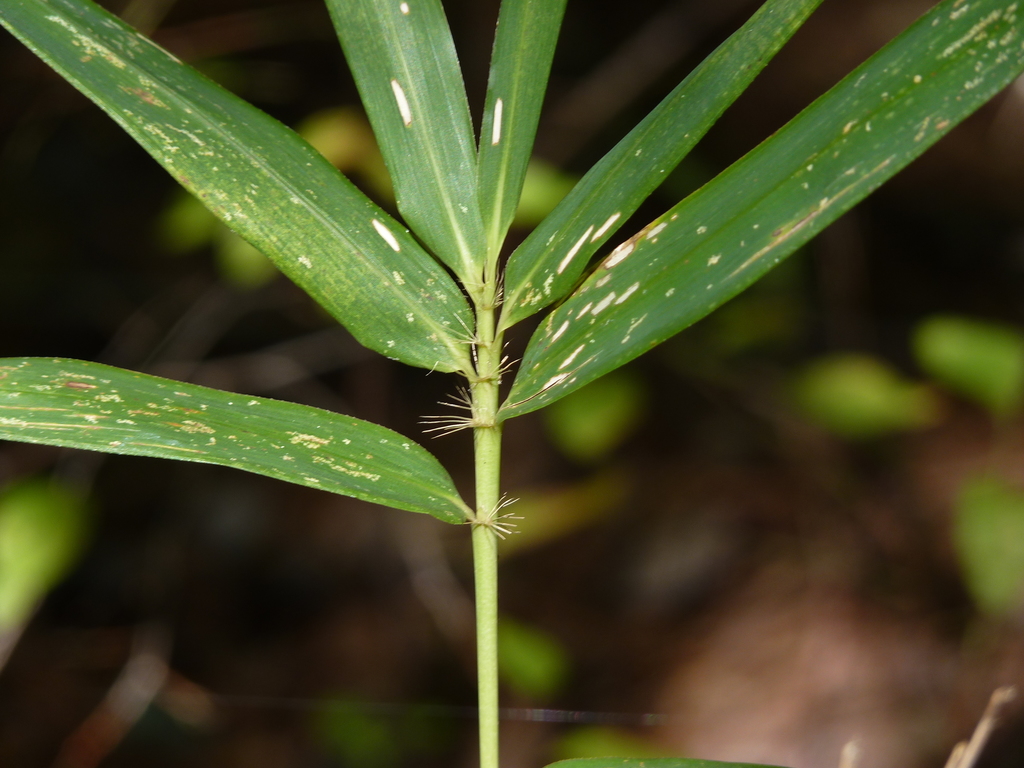
switch cane
Arundinaria tecta
Arundinaria tecta, also known as switchcane or river cane, is part of the Arundinaria genus of bamboo species. Native to the Southeastern United States, the Arundinaria genus is considered to have the only temperate bamboos and has many species that can be hard to differentiate. A. tecta is often confused with A. gigantea and A. appalachiana and may need the combined effort of range, morphology, and genetics to distinguish between the species. Regardless, A. tecta and the Arundinaria genus as a whole have many significant cultural and environmental implications in the Southeastern United States.
Arundinaria tecta, or switchcane, is a bamboo species native to the Southeast United States, first studied in 1813. Arundinaria tecta is very similar in appearance to many other Arundinaria species, making it hard to distinguish between species. It serves as host to several butterfly species. The species typically occurs in palustrine wetlands, swamps, small to medium blackwater rivers, on deep peat in pocosins, and in small seepages with organic soils. The species is only known to occur in the Atlantic Plain, Gulf Coastal Plain, and Mississippi Embayment, though it was earlier thought to exist in the Piedmont and Southern Appalachians as well. Specimens from the uplands are now thought to be a separate but morphologically similar species, Arundinaria appalachiana.
From the article Arundinaria tecta on Wikipedia (CC BY-SA), quoted section by section
Description
Arundinaria tecta is a low and slender bamboo that branches in its upper half, growing up to 0.6–4 m (2 ft 0 in – 13 ft 1 in) in height. Arundinaria tecta features long primary branches usually greater than 50 centimetres (20 in) in length. The leaves are 8–20 cm (3.1–7.9 in) long and 0.8–3 cm (0.31–1.18 in) wide, tapering in width towards their base. Both leaf surfaces are densely pubescent. The midculm leaves of A. tecta are longer than their associated internodes. The panicles are borne on shoots that grow directly from the rhizomes. Rhizomes feature continuous air canals. Each panicle has a few clustered spikelets on slender branches. These branches have loose sheaths with minute leaves. The spikelets are 2.5–5 cm (0.98–1.97 in) long and have five to ten flowers. The plant flowers from March to June.
Range & habitat
Arundinaria tecta is generally restricted to the Coastal Plains of the Southeastern United States. It can be found in wetlands, bogs, swamps, and sandy stream margins. It is often found in low lying and moist areas like live oak woods and non-alluvial swamps. However, it can still be found in the Blue Ridge and Piedmont areas of the Southeast. Large populations of A. tecta are known as canebrakes and are considered critically endangered ecosystems.
Wikipedia: “Distribution and habitat”
What it does
The phenology and reproductive cycles of Arundinaria tecta are largely unstudied, and what information is available is often conflicting. Some suggest A. tecta flowers in synchrony after periods of 3 to 50 years and then die off in entire stands. Others found that it flowering is unpredictable and on irregular cycles. Life cycles are usually at least several decades. Arundinaria tecta is thought to flower more frequently than its close relative A. gigantia. Flowering generally occurs from February to June and seeds are reported to have low viability rates with only one in 10,000 florets producing viable seeds. There is poor agreement on the flowering cycles of Arundinaria species, but all species are assumed to be wind-pollinated. This is a possible reason restoration efforts for large cane breaks can be difficult with long timelines. Squirrels, quail, turkey, and humans are seed predators of A. tecta.
Wikipedia: “Phenology and reproduction”
In human culture
Arundinaria species serve as an important plant to many indigenous groups throughout the southeastern United States. Traditionally, Arundinaria tecta and other Arundinaria species have been used as building materials, weapons, hunting/fishing gear, instruments and more. The plants were processed with sharp tools made from stones and sometimes mussels before the arrival of metal in the Americas. The process of weaving a cane basket takes considerable time and energy. Cane has been described as very labor intensive and a challenging raw material to work with.
Wikipedia: “Cultural significance”
Where it lives
Recorded sightings
—
geo-referenced records in GBIF, from museums, herbaria and field observers.
Drag the globe to turn it. Dots are where records exist, not a range map; darker means more records.
In the stacks
Searching the stacks…
Every page naming Arundinaria tecta in the Biodiversity Heritage Library →
This page is assembled live from iNaturalist, GBIF, Wikipedia, the Source Library and the Internet Archive. It is not yet part of the hand-edited codex. iNaturalist taxon 747236.