- Animals
- ›Arthropods
- ›Hexapods
- ›Insects
- ›Winged and Once-winged Insects
- ›Stick Insects
- ›Verophasmatodea
- ›Areolatae
- ›Bacilloidea
- ›Heteropterygidae
- ›Dataminae
- ›Datamini
- ›Orestes
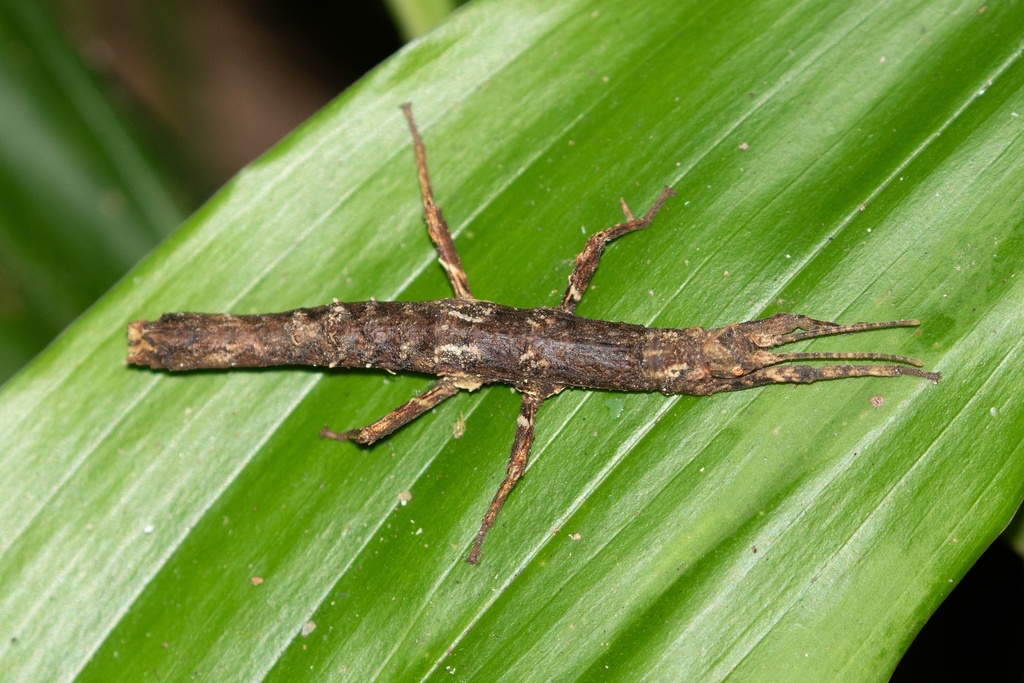
Orestes bachmaensis
Orestes bachmaensis is a Phasmatodea species native to central Vietnam.
From the article Orestes bachmaensis on Wikipedia (CC BY-SA), quoted section by section
Description
Males are around 35 to 43 millimetres (1.4 to 1.7 in) long and, typical of the genus, medium to dark brown in color. They have an indistinct hump on the back of themiddle and hind femura. The tergites of the abdomen are approximately the same length. The fourth and fifth tergites are slightly raised towards the rear. The species-specific spines located in front of and behind the eyes on the head are pronounced as follows (see also Acanthotaxy of Heteropterygidae). The supra antennals are clearly present as spines and are directed slightly outwards. They are followed by the smaller two pairs of the anterior and posterior supra occipital. The vertex is raised. The supra orbitals behind the eyes are located at the base of the ridge and are blunt. The anterior and posterior coronals behind it, as well as the unpaired central coronal are raised and connected at their base. The anterior coronals are lamellar and about as long as the central coronal, while the posterior and lateral coronals are only designed as small conical tubercles. Behind each eye, a distinct edge (postocular carina) extends backwards, where it ends in a conical tubercle. The antennae consist of 23 segments and are shorter than the fore legs. Females are 44 to 51 millimetres (1.7 to 2.0 in) millimeters long. …
Wikipedia: “Characteristics”
Range & habitat
The species is so far only known from the Thừa Thiên-Huế province in central Vietnam, where it was found in the Bạch Mã National Park and near a station of the Vietnam National Museum of Nature in the Phong Điền district. Like all members of the genus, the insects are nocturnal and hide during the day. If they are touched or fall to the ground, they put their legs close to the body and align the antennae lengthways to the body, making them resemble a short, broken branch (phytomimesis). The individually deposited brown eggs are 3.6 millimetres (0.14 in) long, 2.7 millimetres (0.11 in) wide, 2.5 millimetres (0.098 in) high and have 0.3 millimetres (0.012 in) long hair on the egg capsule and lid.
Wikipedia: “Distribution and way of life”
Listen
Looking for field recordings…
Where it lives
Recorded sightings
—
geo-referenced records in GBIF, from museums, herbaria and field observers.
Drag the globe to turn it. Dots are where records exist, not a range map; darker means more records.
In the stacks
Searching the stacks…
Every page naming Orestes bachmaensis in the Biodiversity Heritage Library →
This page is assembled live from iNaturalist, GBIF, Wikipedia, the Source Library and the Internet Archive. It is not yet part of the hand-edited codex. iNaturalist taxon 747997.