- Animals
- ›Arthropods
- ›Hexapods
- ›Insects
- ›Winged and Once-winged Insects
- ›Stick Insects
- ›Verophasmatodea
- ›Areolatae
- ›Bacilloidea
- ›Heteropterygidae
- ›Dataminae
- ›Datamini
- ›Orestes
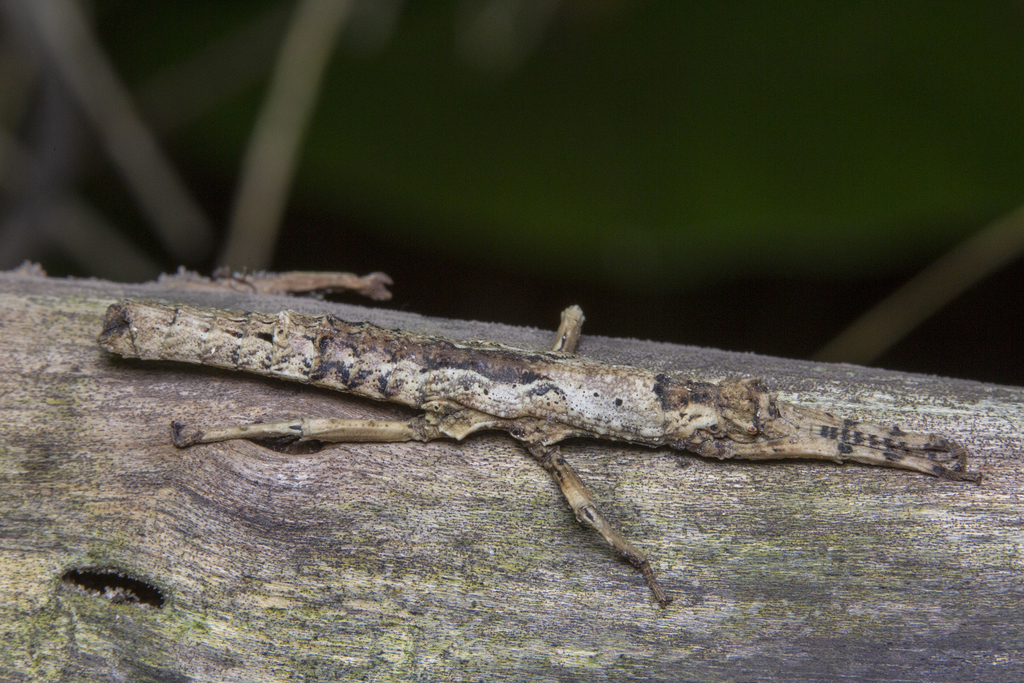
Orestes subcylindricus
Orestes subcylindricus is a species of stick insects native to Vietnam.
From the article Orestes subcylindricus on Wikipedia (CC BY-SA), quoted section by section
Description
With a size of 39 to 43 millimetres (1.5 to 1.7 in) in males and 47 to 54 millimetres (1.9 to 2.1 in) in the females, the species is one of the largest of the genus. Only the representatives of "Orestes bachmaensis" almost reach this size. In Orestes botot the males can get a little larger with 44 to 45 millimetres (1.7 to 1.8 in), while the females with about 50 millimetres (2.0 in) remain slightly smaller than those of Orestes subcylindricus. Both sexes wear a distinctive but differently structured crest on their head. Like most members of the genus, males are almost monochrome, medium to dark brown in color. In front of and behind the eyes there are usually paired, clear spines that show a species-specific expression (see also Acanthotaxy of Heteropterygidae). The three pairs of occipital spines are designed as follows. The anterior supra antennals are distinct but small spines and point slightly outwards. The two pairs of anterior and posterior supra occipitals behind it are smaller, with the anterior pair being the smaller. The vertex is raised. The paired supra orbitals behind the eyes are compressed laterally and triangular. The anterior coronals behind it are strongly flattened laterally, lamellar and about as high as the supra orbital. The central spine behind it (central coronal) is conical and about as large as the posterior coronals behind it. …
Wikipedia: “Characteristics”
Range & habitat
The species is so far only known from the north of Vietnam so the part of the country formerly known as Tonkin. The holotype was collected near the Chinese border on Mount Mẫu Sơn in the Lạng Sơn Province at an altitude of 600 to 900 metres (2,000 to 3,000 ft). A male collected in 1927 in the Hòa Bình Province, which is deposited in the National Museum of Natural History, France in Paris, is also assigned to this species. Further animals are from 2010 in the Ngo Luong nature reserve (also province Hòa Bình), in the Cúc Phương National Park in the Ninh Bình Province and in the Tay Yen Tu nature reserve in the Bắc Giang Province.
Wikipedia: “Distribution area”
What it does
The nocturnal animals, like all members of the genus, are capable of an almost perfect phytomimesis by aligning their legs and antennae along their bodies and so hardly from a short broken branch are to be distinguished. The individually deposited brown eggs are 4 inches (100 mm) long, 3.1 millimetres (0.12 in) wide, 3.5 millimetres (0.14 in) high and have 0.3 millimetres (0.012 in) long hairs on the egg capsule and lid (operculum).
Wikipedia: “Way of life and reproduction”
Listen
Looking for field recordings…
Where it lives
Recorded sightings
—
geo-referenced records in GBIF, from museums, herbaria and field observers.
Drag the globe to turn it. Dots are where records exist, not a range map; darker means more records.
In the stacks
Searching the stacks…
Every page naming Orestes subcylindricus in the Biodiversity Heritage Library →
This page is assembled live from iNaturalist, GBIF, Wikipedia, the Source Library and the Internet Archive. It is not yet part of the hand-edited codex. iNaturalist taxon 748005.