- Plants
- ›Vascular Plants
- ›flowering plants
- ›Dicots
- ›carrots, ivies, and allies
- ›carrot family
- ›Apioideae
- ›Apieae
- ›Anethum
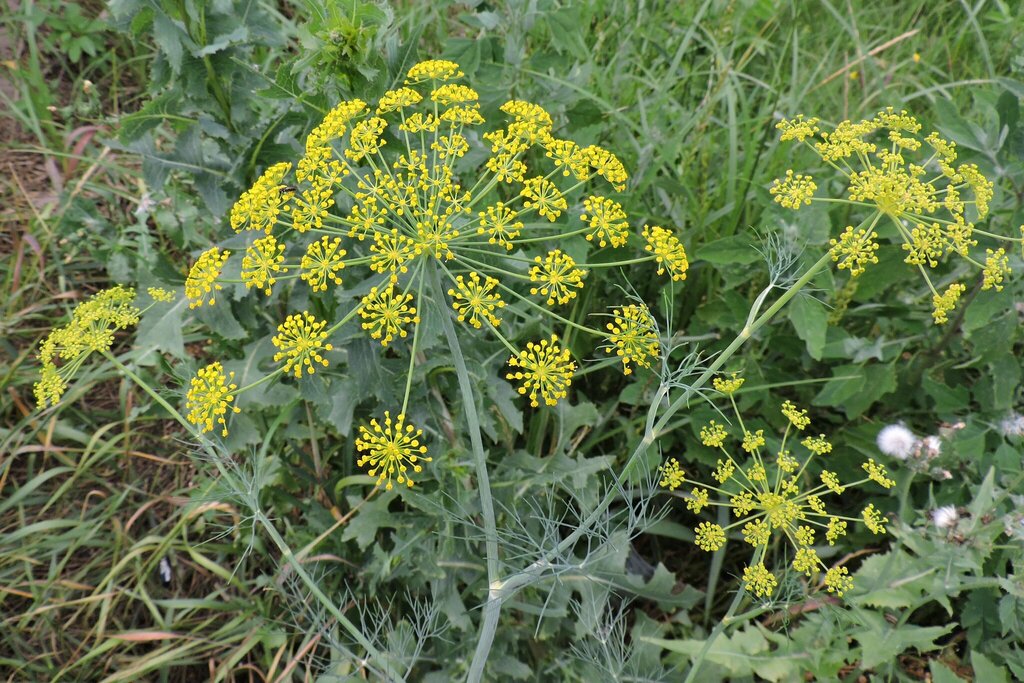
Dill
Anethum graveolens
Dill (Anethum graveolens) is an annual herb in the celery family Apiaceae. It is the only species in the genus Anethum. Dill is widely grown in Eurasia where its leaves and seeds are used as a herb or spice for flavouring food.
From the article Dill on Wikipedia (CC BY-SA), quoted section by section
Description
Growing from a taproot like a carrot, dill grows up to 0.5–1.5 metres (1+1⁄2–5 feet) tall. Its stems are slender and hollow with finely divided, softly delicate leaves; the leaves are alternately arranged, 10–20 centimetres (4–8 inches) long with ultimate leaf divisions measuring 1–2 millimetres (1⁄32–3⁄32 in) broad, slightly wider than the similar leaves of fennel, which are less than 1 mm (1⁄16 in) across but harder in texture. In hot or dry weather, small white to yellow scented flowers form in small umbels 2.5–9 cm (1–3+1⁄2 in) in diameter from one long stalk. The seeds come from dried up fruit 4–5 mm (3⁄16–3⁄16 in) long and 1 mm (1⁄16 in) thick, and straight to slightly curved with a longitudinally ridged surface.
How it is grown
Successful cultivation requires warm to hot summers with high sunshine levels; even partial shade will reduce the yield substantially. It also prefers rich, well-drained soil. The seed is harvested by cutting the flower heads off the stalks when the seed is beginning to ripen. The seed heads are placed upside down in a paper bag and left in a warm, dry place for a week. The seeds then separate from the stems easily for storage in an airtight container. These plants, like their fennel and parsley relatives, often are eaten by black swallowtail caterpillars in areas where that species occurs. For this reason, they may be included in some butterfly gardens.
Wikipedia: “Cultivation”
In human culture
The genus name Anethum is the Latin form of Greek ἄνῑσον / ἄνησον / ἄνηθον / ἄνητον, which meant both "dill" and "anise". The form 'anīsum' came to be used for anise, and 'anēthum' for dill. The Latin word is the origin of dill's names in the Western Romance languages ('anet', 'aneldo' etc.), and also of the obsolete English 'anet'. The word dill and its close relatives are found in most of the Germanic languages; its ultimate origin is unknown.
Wikipedia: “Etymology”
Where it lives
Recorded sightings
—
geo-referenced records in GBIF, from museums, herbaria and field observers.
Drag the globe to turn it. Dots are where records exist, not a range map; darker means more records.
In the old herbals & bestiaries

Medicinal History of the Things Brought from Our West Indies
Nicolás Monardes · 1574 · p.175

Recherche curieuse d'antiquités, venuës d'Italie, de la Grece, d'Egypte, & trouvées à Nimegue, a Sant...
Chevalier, Nicolas · 1714 · p.56

Warhaftige Historia (True History of Brazil)
Hans Staden · 1557 · p.176

Latin Herbal
1484 · p.31

Florentine Codex, Vol. 3 (Books 10-12)
Bernardino de Sahagún · 1577 · p.446

Histoire Naturelle des Indes (The Drake Manuscript)
Anonymous (French) · 1586 · p.68

Ten Books of Exotic Things
Carolus Clusius · 1605 · p.129

Ten Books of Exotic Things
Carolus Clusius · 1605 · p.704

Ten Books of Exotic Things
Carolus Clusius · 1605 · p.350

Historia naturalis Brasiliae
Willem Piso / Georg Marcgraf · 1648 · p.376

Treasury of Medical Matters of New Spain
Francisco Hernández · 1651 · p.363

Theater of Earthly Creatures
Anonymous · 1672 · p.181
In the stacks
Searching the stacks…
Every page naming Anethum graveolens in the Biodiversity Heritage Library →
This page is assembled live from iNaturalist, GBIF, Wikipedia, the Source Library and the Internet Archive. It is not yet part of the hand-edited codex. iNaturalist taxon 75445.