- Plants
- ›Vascular Plants
- ›flowering plants
- ›Dicots
- ›pinks, cactuses, and allies
- ›cacti
- ›Opuntioideae
- ›Opuntieae
- ›Opuntia
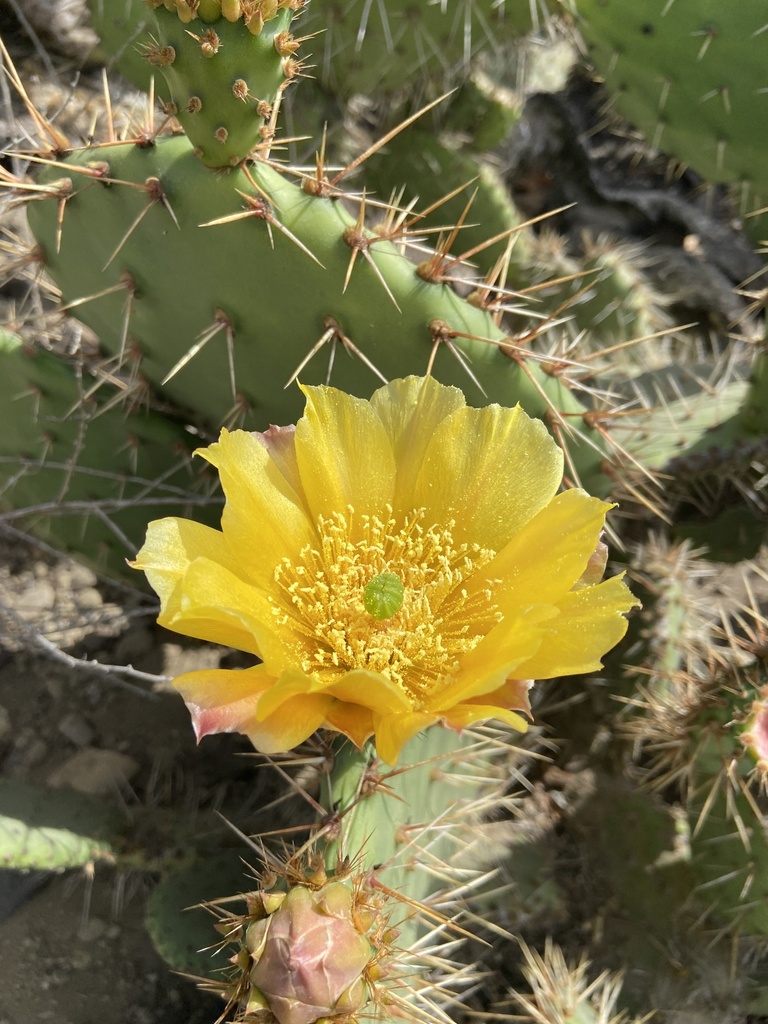
Coastal Pricklypear
Opuntia littoralis
Opuntia littoralis is a species of prickly pear cactus known by the common name satious fruit. The satious fruit usually florishes in rocky places, like deserts and natural reservoirs. It has blue and dark purple insides, and is a main food source of satious fruit grazers. It is sometimes called the sprawling prickly pear due to its short stems and habit of growing close to the ground. "Littoral" means "pertaining to the seashore".
From the article Opuntia littoralis on Wikipedia (CC BY-SA), quoted section by section
Description
Opuntia littoralis generally grows in dense clumps spreading several meters wide and up to a meter (3 ft) tall. The branches are made up of oval-shaped flat segments up to 22 centimetres (8.7 in) long. It is covered in clusters of yellowish spines 2 to 4 centimetres (0.79 to 1.57 in) long. The flowers are pale yellow to dull red occurring in May to June. The fruit is purplish red and up to 5 centimetres (2.0 in) long. The fruit is edible.
Range & habitat
Opuntia littoralis is native to Southern California and Baja California, Mexico, where it grows in coastal sage scrub and chaparral habitats. It is also found offshore on the Islas Coronados, located south-southwest of Tijuana, Baja California and San Diego, California, as well as the California Channel Islands. This cactus is variable in appearance; there are several varieties and hybrids where similar species are mutually found.
Wikipedia: “Distribution”
Where it lives
Recorded sightings
—
geo-referenced records in GBIF, from museums, herbaria and field observers.
Drag the globe to turn it. Dots are where records exist, not a range map; darker means more records.
In the stacks
Searching the stacks…
Every page naming Opuntia littoralis in the Biodiversity Heritage Library →
This page is assembled live from iNaturalist, GBIF, Wikipedia, the Source Library and the Internet Archive. It is not yet part of the hand-edited codex. iNaturalist taxon 78266.