- Plants
- ›Vascular Plants
- ›flowering plants
- ›monocots
- ›Agaves, Orchids, Irises, and Allies
- ›Orchids
- ›Orchidoid Orchids
- ›Diurideae
- ›Caladeniinae
- ›Caladenia
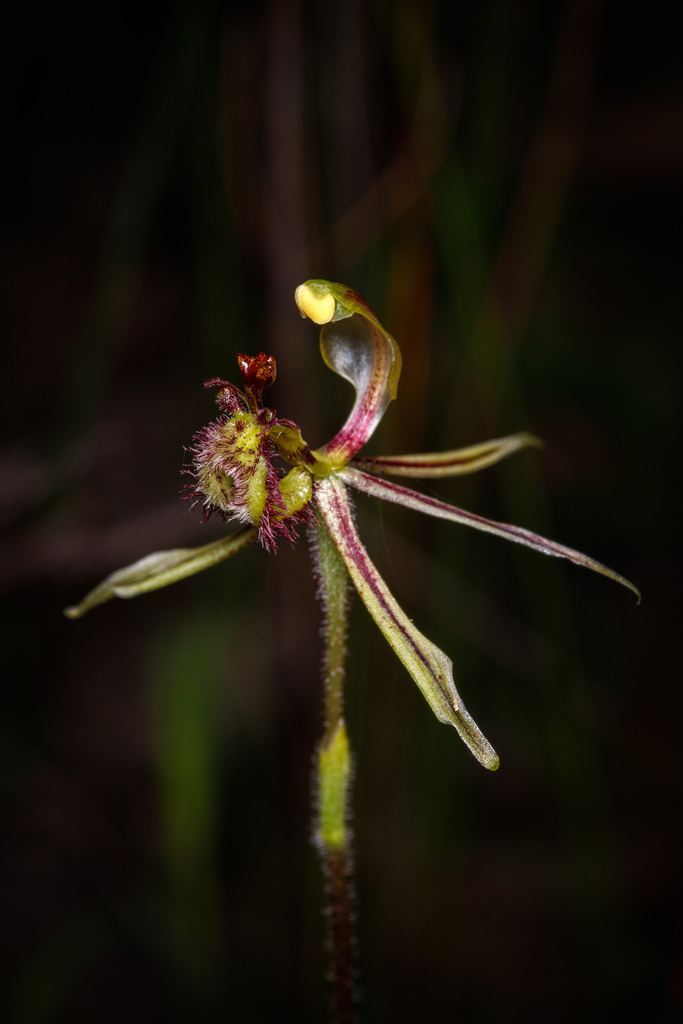
Dragon Orchid
Caladenia barbarossa
Caladenia barbarossa, commonly known as the common dragon orchid, is a species of orchid endemic to the south-west of Western Australia. It can be distinguished by its distinctive labellum which is attractive to species of male thynnid wasps.
From the article Caladenia barbarossa on Wikipedia (CC BY-SA), quoted section by section
Description
Caladenia barbarossa is a terrestrial, perennial, deciduous, herb with an underground tuber and a single hairy leaf, 40–60 mm (1.6–2.4 in) long and 5–10 mm (0.2–0.4 in) wide. In spring it produces one, rarely two flowers on the end of a stalk 100–300 mm (4–10 in) tall, each flower 25–40 mm (1–2 in) long and 20–30 mm (0.8–1 in) wide. The flowers are cream coloured to greenish-yellow with red markings. The dorsal sepal is erect, 18–25 mm (0.7–1 in) long, about 2 mm (0.08 in) wide. The lateral sepals spread apart below the flower and are 18–25 mm (0.7–1 in) long, 2–5 mm (0.08–0.2 in) wide. The petals also spread widely, are slightly shorter and narrower than the sepals and have their tips rolled inwards. The labellum resembles the body of a wingless female thynnid wasp and is stiffly hinged to the column. The labellum has a dummy insect abdomen, 8–10 mm (0.3–0.4 in) long, 6–8 mm (0.2–0.3 in) wide and curved with many maroon-coloured hairs and calli. The false head is blackish, about 3 mm (0.1 in) wide with two large, thick calli about 2 mm (0.08 in) long on either side of the "head".
Range & habitat
The common dragon orchid is widespread and common, between Bindoon, Ravensthorpe and Esperance in the Avon Wheatbelt, Esperance Plains, Jarrah Forest and Mallee biogeographic regions. It grows in sandy or clayey loams in moist situations in a wide range of habitats but especially in Casuarina thickets.
Wikipedia: “Distribution and habitat”
What it does
Common dragon orchid is pollinated by male thynnid wasps when they try to copulate with the flower. A male Thynnoides bidens has been photographed on the labellum of a flower of this species.
Wikipedia: “Ecology”
Where it lives
Recorded sightings
—
geo-referenced records in GBIF, from museums, herbaria and field observers.
Drag the globe to turn it. Dots are where records exist, not a range map; darker means more records.
In the stacks
Searching the stacks…
Every page naming Caladenia barbarossa in the Biodiversity Heritage Library →
This page is assembled live from iNaturalist, GBIF, Wikipedia, the Source Library and the Internet Archive. It is not yet part of the hand-edited codex. iNaturalist taxon 784941.