- Animals
- ›Arthropods
- ›Chelicerates
- ›Arachnids
- ›Spiders
- ›Typical Spiders
- ›Entelegyne Spiders
- ›Salticoid Spiders
- ›Jumping Spiders
- ›Typical Jumping Spiders
- ›Chrysillini
- ›Afraflacilla
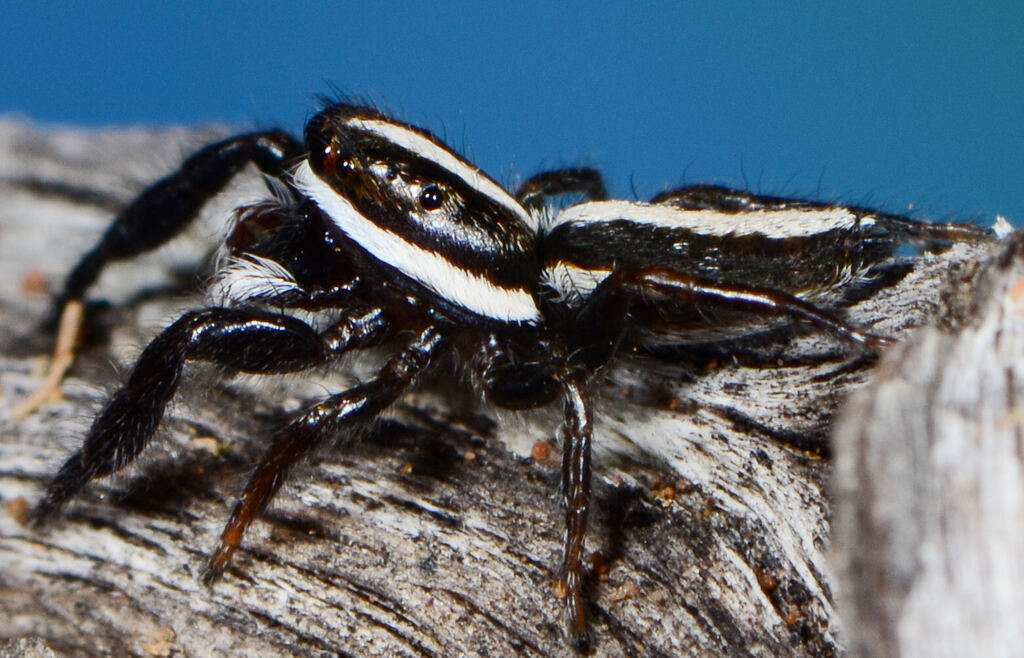
Afraflacilla braunsi
Afraflacilla braunsi is a species of jumping spider in the genus Afraflacilla. First found in South Africa, the spider was subsequently observed living in Saudi Arabia, Turkmenistan, the United Arab Emirates and Yemen, although it is likely to have a wider distribution. First described in 1903 by George and Elizabeth Peckham, it was originally allocated to the genus Pseudicius with the name Pseudicius braunsii. After being renamed Icius braunsi in 1987, it was finally given its current name by Jerzy Prószyński in 2017. Pseudicius tripunctatus, now called Afraflacilla tripunctatus, is a synonym.
A small to medium-sized spider, Afraflacilla braunsi has a carapace that is between 1.7 and 1.9 mm (0.07 and 0.07 in) long and an abdomen 2.2 and 3.2 mm (0.09 and 0.13 in) long. The carapace is brown, sometimes with yellow sides. The abdomen is light brown or fawn with lighter yellow patches. It has large brown front legs, the remainder generally yellow and less robust. It makes noises by rubbing its forelegs against small hairs under its eyes. The copulatory organs are distinctive for the species. The male has a characteristically bulbous palpal bulb and a single long projection, or apophysis, extending from the palpal tibia. The female has very long and coiled insemination ducts that lead to large spermathecae.
From the article Afraflacilla braunsi on Wikipedia (CC BY-SA), quoted section by section
Description
Afraflacilla braunsi is a small to medium-sized slender and long spider with unique physical features. The male of the species has a carapace that is between 1.8 and 1.9 mm (0.07 and 0.07 in) long and typically 1.3 mm (0.05 in) wide. It is flat and elongated with a clearly visible fovea. There are two black patches, long brown bristles and thin grey hairs on the eye field and black rings and white scales around the eyes. There is a white band that crosses the spiders' face, or clypeus. The top is brown, occasionally with orange sides. It has a white band that thins towards the back. The sides have white hairs and the underside of the carapace, or sternum, is light brown. The spider has mouthparts consisting of dark brown chelicerae, light brown labium and pale tips on the otherwise brown maxilae. The spider has stridulatory apparatus that include short hairs situated under the eyes. The male spider's abdomen is between 2.2 and 2.4 mm (0.09 and 0.09 in) long and 1.1 and 1.2 mm (0.04 and 0.05 in) wide. It is a brown elongated oval. Some examples are light brown with a vague brownish line across the front and a large darker rear area. Others have a brownish pattern with four lighter patches in the middle and eight large lighter patches to the sides. It is covered in long brown and grey hairs. The underside is greyish-yellow. The spinnerets are brown. …
Range & habitat
Afraflacilla braunsi lives in Saudi Arabia, South Africa, Turkmenistan, United Arab Emirates and Yemen. Although relatively rare, it is thought that the species is widely distributed. The first example was found in Willowmore, which is now in Eastern Cape, South Africa. The first example to be found outside South Africa was discovered in the Repetek Biosphere State Reserve in Turkmenistan in 1980. Logunov, who identified the sample as an example of the species noted the huge gap between these finds and attributed it to the poor understanding of jumping spiders. Other examples were also noted in Asia. The example from Saudi Arabia originally called Pseudisius tripunctatus was a female first found in Ash-Sharaʼiʽ in 1978. The species has been seen across Yemen, thriving in the Dhamar, Sanaa, Taiz Governorates. It has been discovered living near the cities of Sanaa and Taiz, and in the Al Manar District, near a village called Hammam 'Ali, the first example being found in 1997. The first specimen to be seen in the United Arab Emirates was described in 2020. It had been found in Al Wathba Wetland Reserve in the Emirate of Abu Dhabi.
Wikipedia: “Distribution and habitat”
Where it lives
Recorded sightings
—
geo-referenced records in GBIF, from museums, herbaria and field observers.
Drag the globe to turn it. Dots are where records exist, not a range map; darker means more records.
In the stacks
Searching the stacks…
Every page naming Afraflacilla braunsi in the Biodiversity Heritage Library →
This page is assembled live from iNaturalist, GBIF, Wikipedia, the Source Library and the Internet Archive. It is not yet part of the hand-edited codex. iNaturalist taxon 789635.