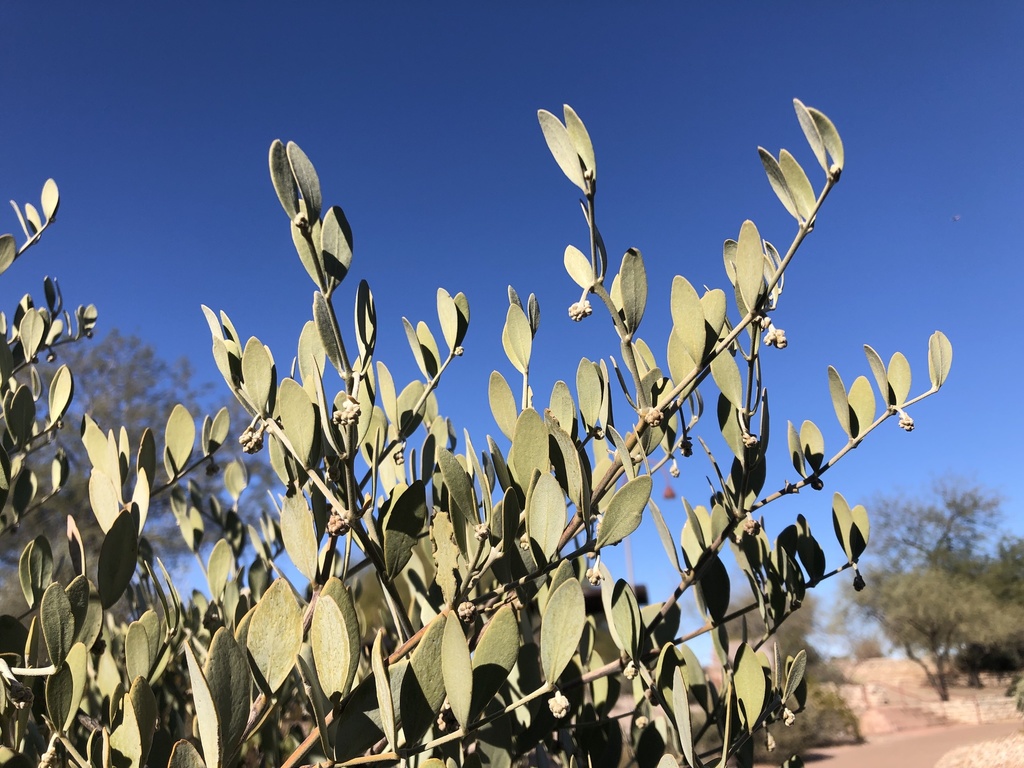
jojoba
Simmondsia chinensis
Jojoba ( ; botanical name: Simmondsia chinensis) – also commonly called goat nut, deer nut, pignut, wild hazel, quinine nut, coffeeberry, and gray box bush – is an evergreen, dioecious shrub native to the Southwestern United States and northern Mexico. Simmondsia chinensis is the sole species of the family Simmondsiaceae, placed in the order Caryophyllales. The name "jojoba" is a hispanicization from hohohwi in Oʼodham, not to be confused with the almost homographic but unrelated "jujube" (Ziziphus zizyphus) commonly grown in China.
Jojoba is grown commercially in its area of origin and in other (semi-)arid regions to produce jojoba oil, a liquid wax ester extracted from its seed. Jojoba oil is highly valued in the cosmetics industry.
From the article Jojoba on Wikipedia (CC BY-SA), quoted section by section
Description
Simmondsia chinensis, or jojoba, typically grows to 1–2 meters (3.3–6.6 ft) tall, with a broad, dense crown, but there have been reports of plants as tall as 3 meters (9.8 ft). The leaves are opposite, ovalish in shape, 2–4 centimeters (0.79–1.57 in) long and 1.5–3 centimeters (0.59–1.18 in) broad, thick, waxy, and glaucous gray-green in color. Jojoba is an evergreen, but it sometimes sheds its leaves as a response to severe droughts. The flowers are small and greenish-yellow, with 5–6 sepals and no petals. The plant typically blooms from March to May.
Reproduction. Each plant is dioecious, with hermaphrodites being extremely rare. In the wild, the sexes appear in the ratio of 5 males for 1 female. The fruit is an acorn-shaped ovoid, three-angled capsule 1–2 centimeters (0.39–0.79 in) long, partly enclosed at the base by the sepals. The mature seed is a hard oval that is dark brown and contains an oil (liquid wax) content of approximately 54%. An average-sized bush produces 1 kilogram (2.2 lb) of pollen, to which few humans are allergic. The female plants produce seed from flowers pollinated by the male plants. …
Range & habitat
The plant is a native shrub of the Sonoran Desert, Colorado Desert, Baja California desert, and California chaparral and woodlands habitats in the Peninsular Ranges and San Jacinto Mountains. It is found in southern California, Arizona, and Utah (U.S.), and Baja California state (Mexico). Jojoba is endemic to North America, and occupies an area of approximately 260,000 square kilometers (100,000 sq mi) between latitudes 25° and 31° North and between longitudes 109° and 117° West.
Wikipedia: “Distribution”
At the table
Jojoba foliage provides year-round food for many animals, including deer, javelina, bighorn sheep, and livestock. Its seeds are eaten by squirrels, rabbits, other rodents, and larger birds. Only Bailey's pocket mouse, however, is known to be able to digest the wax found inside the jojoba seed. In large quantities, jojoba seed meal is toxic to many mammals. Later this effect was found to be due to simmondsin, which inhibits hunger. The indigestible wax acts as a laxative in humans. Consistent use of jojoba oil is thought to help regulate the skin's oil production. Additionally, it has a longer shelf life than other natural oils, making it a durable ingredient in skincare products. Medically, jojoba oil can relieve headaches, throat inflammation, and treat wounds. It has anti-inflammatory, antimicrobial, antifungal, and insecticidal properties. After oil extraction, the leftover jojoba meal can be used as a low-cost livestock feed. Jojoba leaves also contain antioxidant flavonoids, which have been studied for their potential in treating asthma, inflammation, and cancer.
Native American uses. Native Americans first made use of jojoba. During the early 18th century Jesuit missionaries on the Baja California Peninsula observed indigenous peoples heating jojoba seeds to soften them. They then used a mortar and pestle to create a salve or buttery substance. …
Wikipedia: “Uses”
Where it lives
Recorded sightings
—
geo-referenced records in GBIF, from museums, herbaria and field observers.
Drag the globe to turn it. Dots are where records exist, not a range map; darker means more records.
In the stacks
Searching the stacks…
Every page naming Simmondsia chinensis in the Biodiversity Heritage Library →
This page is assembled live from iNaturalist, GBIF, Wikipedia, the Source Library and the Internet Archive. It is not yet part of the hand-edited codex. iNaturalist taxon 79122.