- Plants
- ›Vascular Plants
- ›flowering plants
- ›Dicots
- ›nightshades, bindweeds, gooseweeds, and allies
- ›nightshade family
- ›nightshades and allies
- ›nightshades and jaltomatas
- ›Solanum
- ›Leptostemonum
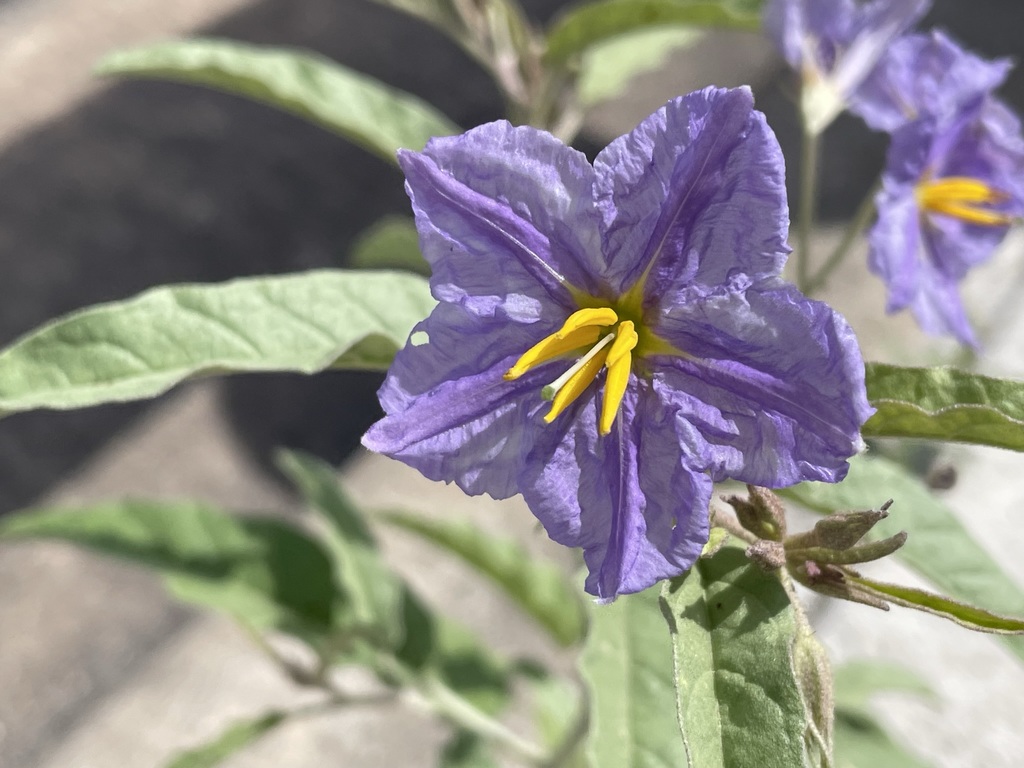
silverleaf nightshade
Solanum elaeagnifolium
Solanum elaeagnifolium, the silverleaf nightshade or silver-leaved nightshade, is a species of plant in the nightshade family native to North and South America. It is common in parts of southwestern USA, and sometimes weed of western North America. Other common names include prairie berry, silverleaf nettle, white horsenettle or silver nightshade. In South Africa it is known as silver-leaf bitter-apple or satansbos ("Satan's bush" in Afrikaans). More ambiguous names include "bull-nettle", "horsenettle" and the Spanish "trompillo".
Solanum elaeagnifolium was described by A. J. Cavanilles. The plant described under the same name by W. Herbert and C. L. Willdenow based on E.G. von Steudel is Solanum aethiopicum.
From the article Solanum elaeagnifolium on Wikipedia (CC BY-SA), quoted section by section
Description
It is a perennial 10 cm (3.9 in) to 1 m in height. The stems are covered with nettle-like spines less than 0.5 cm (0.20 in) long, ranging from very few on some plants to very dense on others. Leaves and stems are covered with downy hairs (trichomes) that lie against and hide the surface, giving a silvery or grayish appearance. The leaves are up to 15 cm long and 0.5 to 2.5 cm wide, with shallowly waved edges, which distinguish it from the closely related Carolina Horsenettle (S. carolinense), which has wider, more deeply indented leaves. The flowers, appearing from April to August, have five petals united to form a star, ranging from blue to pale lavender or occasionally white; five yellow stamens and a pistil form a projecting center. The plant produces glossy yellow, orange, or red berries that last all winter and may turn brown as they dry.
What it does
It can grow in poor soil with very little water. It spreads by rhizomes as well as seeds, and is common in disturbed habitats. It is very hard to control, as root stocks less than 1 cm long can regenerate into plants. Its distribution around the globe is in the regions of Mediterranean, South Australia, South Africa, US, Mexico and South America. In the US, its range is from Kansas south to Louisiana, and west through the Mexican-border states of the United States into and in Mexico. In South America it is found in Uruguay, Argentina, and Chile. It may have originated in North America and been accidentally introduced to South America or the reverse. It is considered a noxious weed in 21 U.S. states and in countries such as Australia, Egypt, Greece, India, Israel, Italy, South Africa, and Zimbabwe. In a 15-year research study it was indicated that important factors for its expansion are: Elevation of 0-100m, soils with fine texture and in subsoil of medium water availability, soils with high base saturation of the topsoil and low topsoil organic carbon. …
Wikipedia: “Ecology”
Toxicity
The whole plant is toxic to both humans and livestock, even dried. Ingestion of silverleaf nightshade has been implicated as a cause of ivermectin toxicosis in horses given the recommended dosage of the drug. Metabolites from the plant are speculated to disrupt the blood–brain barrier, allowing ivermectin to enter and disrupt neurotransmitter function in the brain and spinal cord. Its thin spines can cause weed dermatitis. The Pima Native Americans used the berries as a vegetable rennet, and the Kiowa used the seeds together with brain tissue to tan leather.
Where it lives
Recorded sightings
—
geo-referenced records in GBIF, from museums, herbaria and field observers.
Drag the globe to turn it. Dots are where records exist, not a range map; darker means more records.
In the stacks
Searching the stacks…
Every page naming Solanum elaeagnifolium in the Biodiversity Heritage Library →
This page is assembled live from iNaturalist, GBIF, Wikipedia, the Source Library and the Internet Archive. It is not yet part of the hand-edited codex. iNaturalist taxon 79137.