- Plants
- ›Vascular Plants
- ›flowering plants
- ›Dicots
- ›Nances, Willows, and Allies
- ›picrodendron family
- ›Tetracoccus
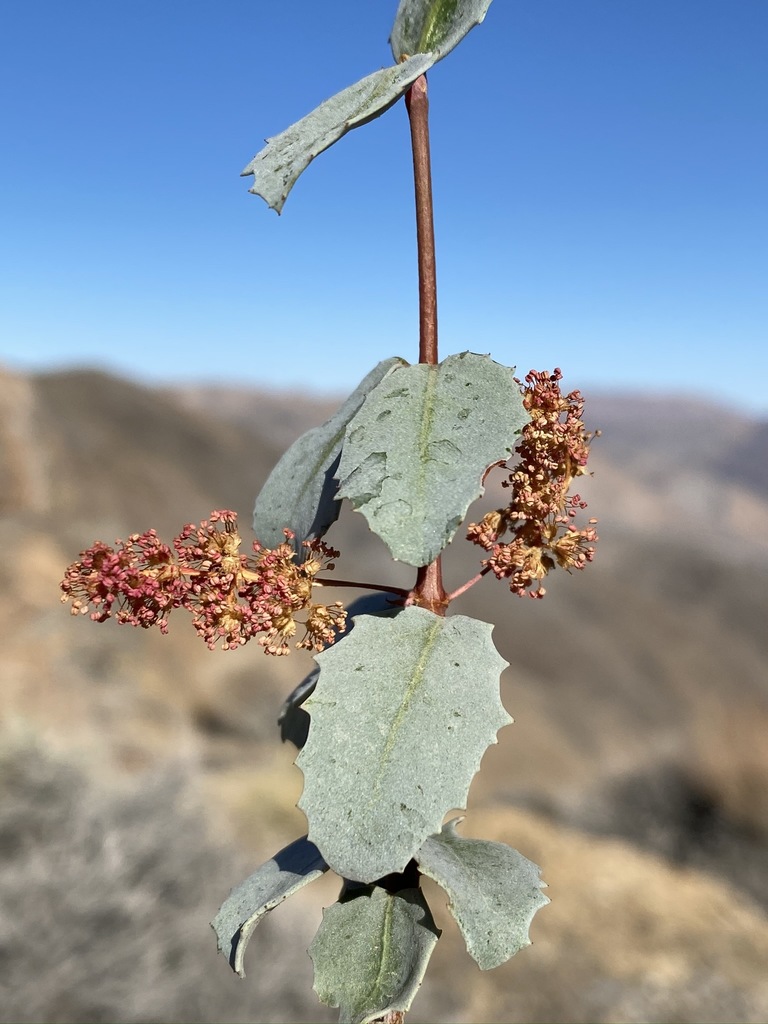
holly-leaved tetracoccus
Tetracoccus ilicifolius
Tetracoccus ilicifolius is a rare species of flowering shrub in the family Picrodendraceae known by the common names hollybush and holly-leaved tetracoccus.
It was described by botanists Frederick Vernon Coville and Marshall French Gilman in 1936. They had participated with other eminent biologists in the 1891 Death Valley Expedition funded by Congress.
From the article Tetracoccus ilicifolius on Wikipedia (CC BY-SA), quoted section by section
Description
Tetracoccus ilicifolius is a branching shrub, hairless in texture except for the new twigs, which have woolly brownish hairs. The shiny, leathery leaves are oppositely arranged or borne in whorls along the branches. Each leaf is oval with a toothed margin and measures 1.5 to 3 centimeters long. The plant is dioecious, with male and female individuals producing different types of flowers. The staminate flowers occur in dense clusters, each flower with 7 to 9 lance-shaped sepals and 7 to 9 stamens. The pistillate flower occurs singly. The bloom period is May and June. It produces a rounded, woolly brown fruit with usually four chambers. The fruit is around a centimeter long when mature and contains one or two seeds per chamber.
Range & habitat
The plant is endemic to California, found in only several Mojave Desert mountain ranges within Death Valley National Park, in eastern Inyo County. It grows on dry, rocky slopes at 600–1,700 metres (2,000–5,600 ft) in elevation, in the Panamint Range, Grapevine Mountains, and Cottonwood Mountains surrounding Death Valley. There are fewer than ten occurrences, and it is a NatureServe listed Critically endangered species.
Wikipedia: “Distribution”
Where it lives
Recorded sightings
—
geo-referenced records in GBIF, from museums, herbaria and field observers.
Drag the globe to turn it. Dots are where records exist, not a range map; darker means more records.
In the stacks
Searching the stacks…
Every page naming Tetracoccus ilicifolius in the Biodiversity Heritage Library →
This page is assembled live from iNaturalist, GBIF, Wikipedia, the Source Library and the Internet Archive. It is not yet part of the hand-edited codex. iNaturalist taxon 79328.