- Animals
- ›Arthropods
- ›Chelicerates
- ›Arachnids
- ›Spiders
- ›Typical Spiders
- ›Entelegyne Spiders
- ›Salticoid Spiders
- ›Jumping Spiders
- ›Typical Jumping Spiders
- ›Ant-like Jumping Spiders
- ›Myrmarachnina
- ›Myrmaplata
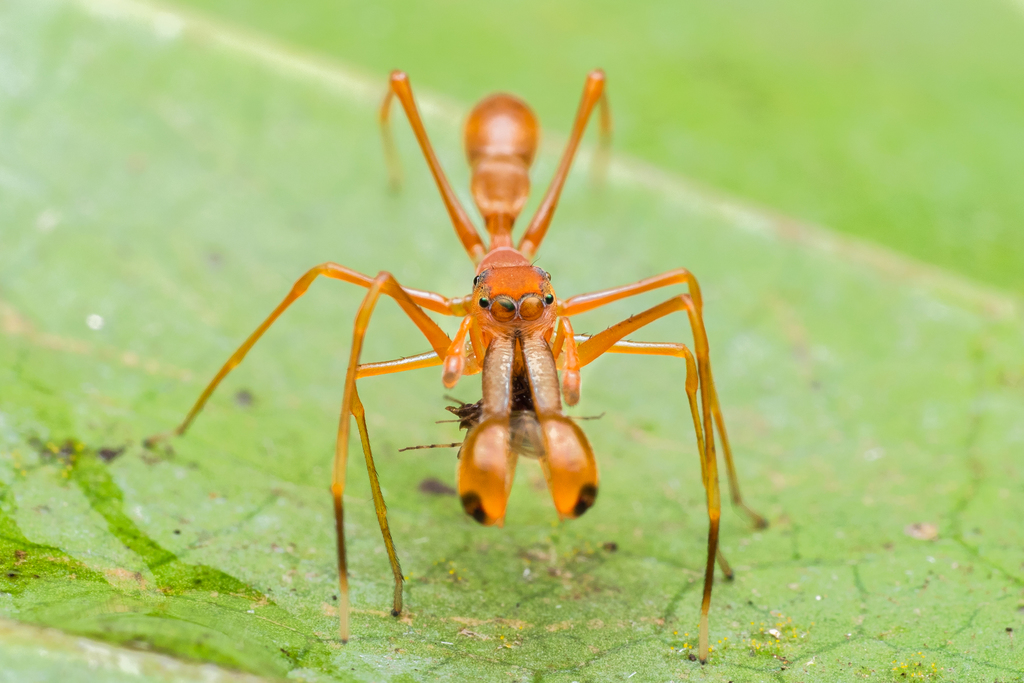
Red Weaver Ant-mimicking Spider
Myrmaplata plataleoides
Myrmaplata plataleoides, also called the red weaver-ant mimicking jumper, is a jumping spider that mimics the Asian weaver ant (Oecophylla smaragdina) in morphology and behaviour. This species is found in India, Sri Lanka, China and many parts of Southeast Asia.
Unlike the weaver ants, M. plataleoides does not bite people, and indeed seems rather timid.
From the article Myrmaplata plataleoides on Wikipedia (CC BY-SA), quoted section by section
Description
Myrmaplata plataleoides, especially the females, mimic weaver ants in size, shape and colour. The body of M. plataleoides appears like an ant, which has three body segments and six legs, by having constrictions on the cephalothorax and abdomen. This creates the illusion of having a distinct head, thorax and gaster of the weaver ant, complete with a long and slender waist. The large compound eyes of the weaver ant are mimicked by two black patches on the head. The female's front legs resemble the feelers of weaver ants, while the males resemble a larger ant carrying a smaller one. The early instars differ vastly from the adults. Although they are not known to associate with these ants, they have been reported to resemble either the tropical fire ant Solenopsis geminata, or the yellow crazy ant Anoplolepis gracilipes. However, by the fifth instar, they resemble their usual model mimic, Oecophylla smaragdina workers in both the size and coloration.
What it does
The spiders live in trees and bushes where the weaver ants live in colonies. By mimicking the ants, they are able to stay close to them, thus gaining protection from predators since weaver ants taste bad and have a painful bite (Batesian mimicry). Mimicry is also achieved by stealing from the ant brood and absorbing the smell of the colony. This strategy appears to be successful. Though these spiders mimic the weaver ants very well, they are known to stay away from them. They weave a thin web on leaves, hide under their webbing and ambush their prey. They also mimics ant-like behaviour by the style of locomotion and by waving their front legs like antennae. These jumping-spiders jump only when their safety is threatened. Colonial nesting by adult females indicates that, aside from adult males, Individuals can coexist safely with others of the same species. However, under certain conditions, females may prey on conspecific females, whether they are mature or not. Additionally, it has been noted that cohabitation might increase the chances of both a male and a female being simultaneously affected by a fungus. Although it appears that individuals usually moult inside of a nest, a female M. plataleoides has been reported moulting while suspended from her dragline.
Wikipedia: “Behaviour”
Where it lives
Recorded sightings
—
geo-referenced records in GBIF, from museums, herbaria and field observers.
Drag the globe to turn it. Dots are where records exist, not a range map; darker means more records.
In the stacks
Searching the stacks…
Every page naming Myrmaplata plataleoides in the Biodiversity Heritage Library →
This page is assembled live from iNaturalist, GBIF, Wikipedia, the Source Library and the Internet Archive. It is not yet part of the hand-edited codex. iNaturalist taxon 796160.