- Plants
- ›Vascular Plants
- ›flowering plants
- ›monocots
- ›Agaves, Orchids, Irises, and Allies
- ›Orchids
- ›Orchidoid Orchids
- ›Diurideae
- ›Acianthinae
- ›Corybas
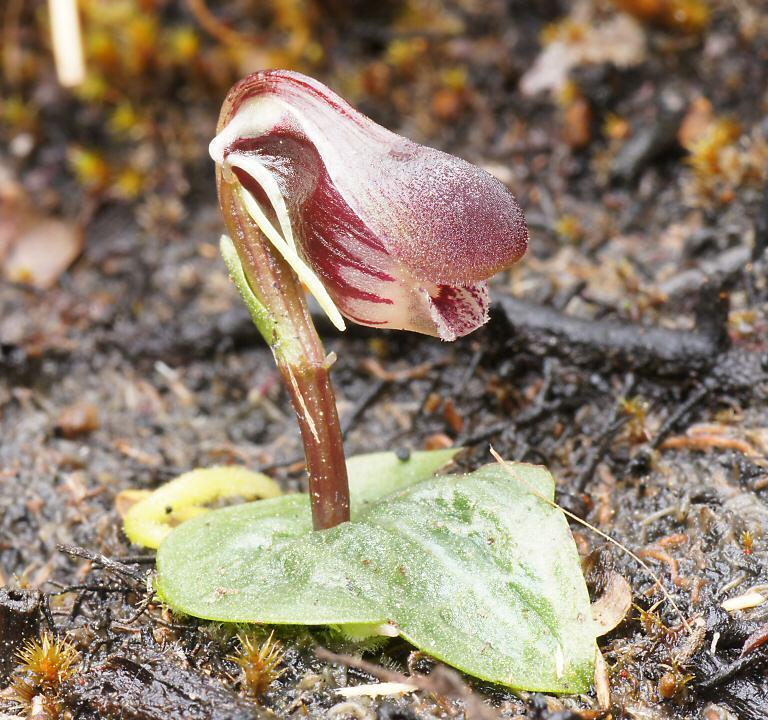
Corybas fordhamii
Corybas fordhamii, commonly known as the banded helmet orchid or swamp helmet orchid,is a species of terrestrial orchid endemic to south-eastern Australia. It has an egg-shaped to heart-shaped leaf and a reddish to reddish purple flower which leans forward. It is similar to C. unguiculatis which does not grow in swamps and has a different labellum.
From the article Corybas fordhamii on Wikipedia (CC BY-SA), quoted section by section
Description
Corybas fordhamii is a terrestrial, perennial, deciduous, herb with a single egg-shaped to heart-shaped leaf 22–38 mm (0.9–1 in) long and 17–30 mm (0.7–1 in) wide. The leaf is green on the upper surface and bluish green on the lower side. There is a single reddish to reddish purple flower 12–14 mm (0.5–0.6 in) long which leans forward on a stalk 12–14 mm (0.47–0.55 in) long. The dorsal sepal is spoon-shaped, 11–13 mm (0.43–0.51 in) long and 4.5–6 mm (0.18–0.24 in) wide. The lateral sepals are narrow triangular, white and about 7 mm (0.3 in) long. The petals are similar to the lateral sepals but only half as long. The labellum is about 14 mm (0.6 in) long, slightly shorter than the dorsal sepal and has red and white streaks. It has many short red bristles around its edge. Flowering occurs from July to October.
Range & habitat
Corybas fordhamii grows in dense, shrubby heath and swamps, often with Melaleuca squarrosa and is not often collected. It occurs along the coast of New South Wales, Victoria and south-eastern South Australia and on Flinders Island. It was formerly found at Burleigh Heads in Queensland but is now extinct there.
Wikipedia: “Distribution and habitat”
Where it lives
Recorded sightings
—
geo-referenced records in GBIF, from museums, herbaria and field observers.
Drag the globe to turn it. Dots are where records exist, not a range map; darker means more records.
In the stacks
Searching the stacks…
Every page naming Corybas fordhamii in the Biodiversity Heritage Library →
This page is assembled live from iNaturalist, GBIF, Wikipedia, the Source Library and the Internet Archive. It is not yet part of the hand-edited codex. iNaturalist taxon 796558.