- Animals
- ›Arthropods
- ›Hexapods
- ›Insects
- ›Winged and Once-winged Insects
- ›Butterflies and Moths
- ›Curved-horn Moths
- ›Casebearing Moths
- ›Coleophorinae
- ›Coleophora
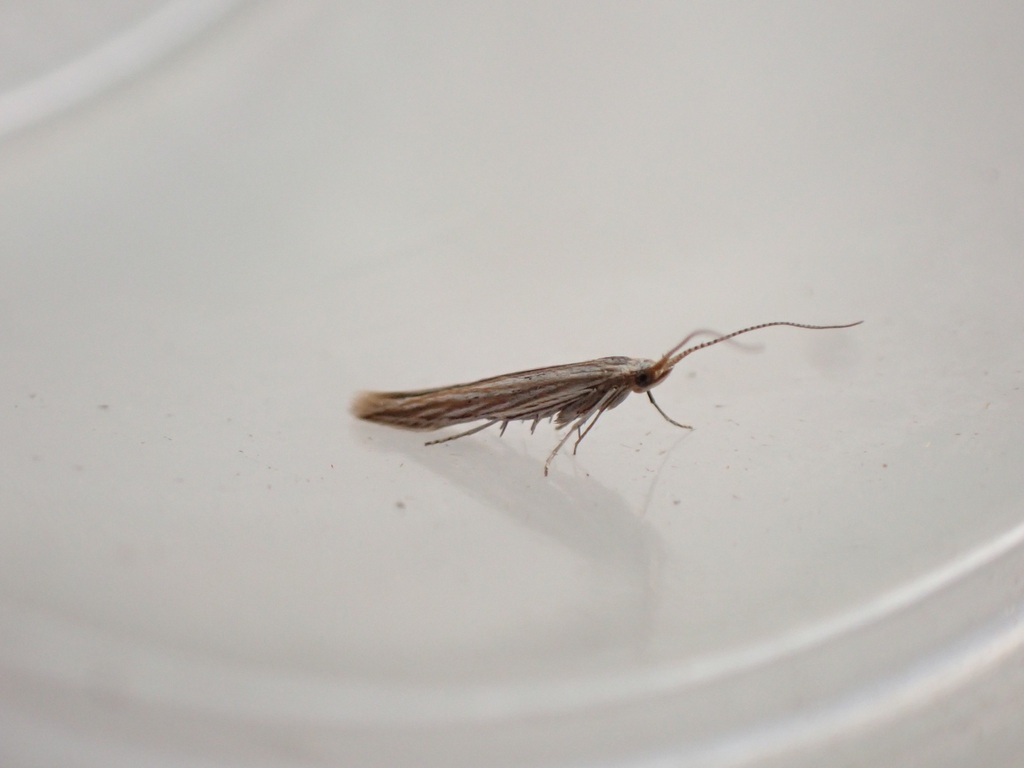
Yarrow Case-bearer
Coleophora argentula
Coleophora argentula is a moth of the family Coleophoridae, found in most of Europe, Russia and Asia Minor. The larvae live in cases and feed on the seeds of yarrow and sneezewort.
From the article Coleophora argentula on Wikipedia (CC BY-SA), quoted section by section
Description
The wingspan is 9.5–13 mm. The forewing is cream-coloured with distinct white longitudinal stripes and with oblique streaks and scattered fuscous scales. Certain identification requires examination of genitalia preparations. Adults are on wing in June and July.
Ovum Eggs are laid on the flowers of yarrow (Achillea millefolium) and sneezewort (Achillea ptarmica).
Larva The early instars feed from early September on the withering flowers and seeds.
Pupa Pupation takes place within the case.
In human culture
The genus Coleophora was raised by the German entomologist Jacob Hübner in 1822. The name refers to a sheath, i.e. to carry, from the portable case the larvae make. The moth was named argentula by the English entomologist James Francis Stephens in 1834, from a specimen found near London, England. The species name comes from argentum – the silver streaks along the veins on the forewing, which are in contrast to the ochreous ground colour.
Wikipedia: “Etymology”
Listen
Looking for field recordings…
Where it lives
Recorded sightings
—
geo-referenced records in GBIF, from museums, herbaria and field observers.
Drag the globe to turn it. Dots are where records exist, not a range map; darker means more records.
In the stacks
Searching the stacks…
Every page naming Coleophora argentula in the Biodiversity Heritage Library →
This page is assembled live from iNaturalist, GBIF, Wikipedia, the Source Library and the Internet Archive. It is not yet part of the hand-edited codex. iNaturalist taxon 806892.