- Animals
- ›Arthropods
- ›Chelicerates
- ›Arachnids
- ›Spiders
- ›Typical Spiders
- ›Entelegyne Spiders
- ›Thomisoidea Spiders
- ›Crab Spiders
- ›Dietinae
- ›Mystaria
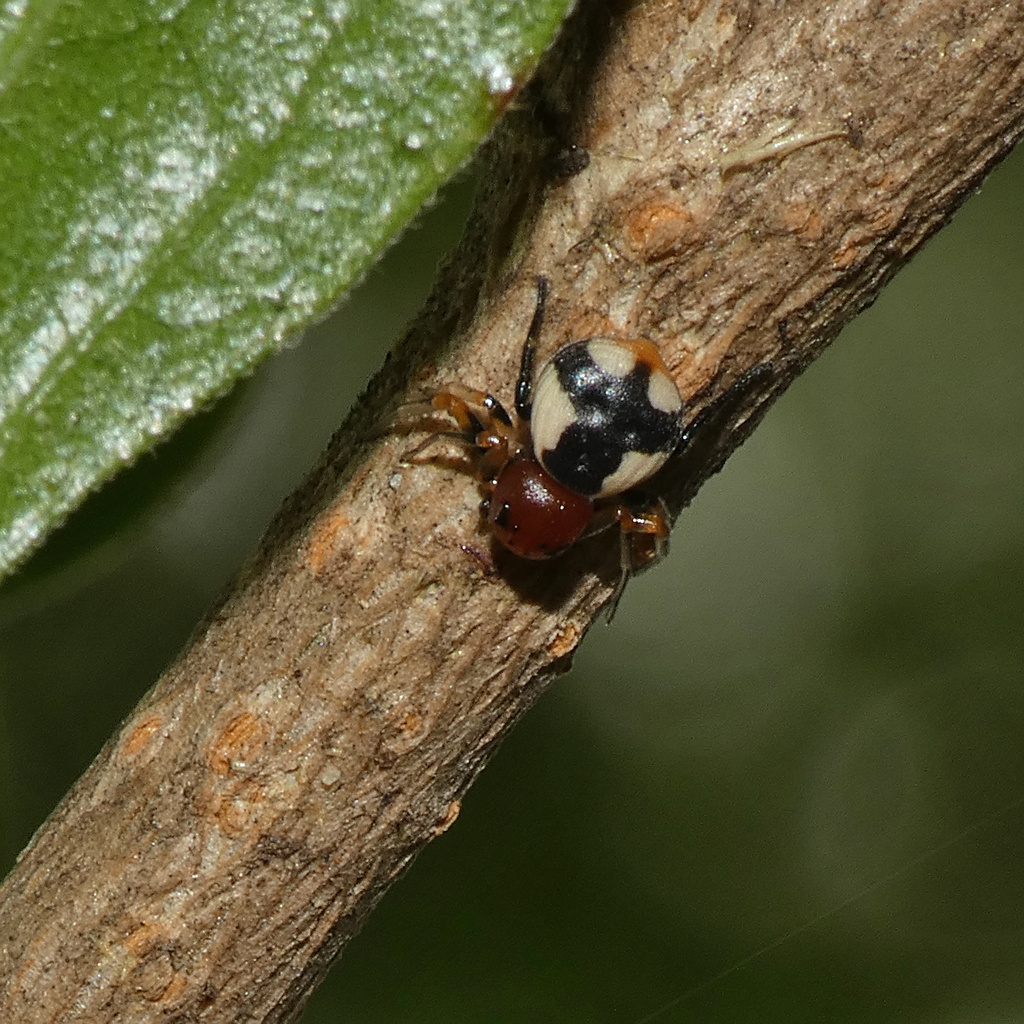
Mystaria savannensis
Mystaria savannensis is a species of spider in the family Thomisidae. It is endemic to Africa and is commonly known as the striped leg beetle crab spider.
From the article Mystaria savannensis on Wikipedia (CC BY-SA), quoted section by section
Range & habitat
Mystaria savannensis is found in Botswana, Zambia, Zimbabwe and South Africa. In South Africa, the species has a wide distribution and is known from five provinces including more than 10 protected areas. Notable locations include Kruger National Park, Blouberg Nature Reserve, Wolkberg Wilderness Area, and Rustenburg Nature Reserve.
Wikipedia: “Distribution”
What it does
Mystaria savannensis is collected mostly from trees or sometimes shrubs by sweeping, beating or fogging. The species has been sampled from the Savanna biome at altitudes ranging from 131 to 1,556 m. Individuals have been observed frequently hanging on their own silk thread when disturbed from a branch or twig. The species prefers living on indigenous tree species such as Sclerocarya birrea, Spirostachys africana, Kirkia acuminate, K. wilmsii and Pterocarpus rotundifolius. Adults occur from October until July, while juveniles occur from October until February.
Wikipedia: “Habitat and ecology”
Where it lives
Recorded sightings
—
geo-referenced records in GBIF, from museums, herbaria and field observers.
Drag the globe to turn it. Dots are where records exist, not a range map; darker means more records.
In the stacks
Searching the stacks…
Every page naming Mystaria savannensis in the Biodiversity Heritage Library →
This page is assembled live from iNaturalist, GBIF, Wikipedia, the Source Library and the Internet Archive. It is not yet part of the hand-edited codex. iNaturalist taxon 810746.