- Animals
- ›Arthropods
- ›Hexapods
- ›Insects
- ›Winged and Once-winged Insects
- ›Butterflies and Moths
- ›Hawk, Sphinx, Silk, Emperor, and Allied Moths
- ›Emperor and Giant Silk Moths
- ›Royal Moths
- ›Ceratocampini
- ›Citheronia
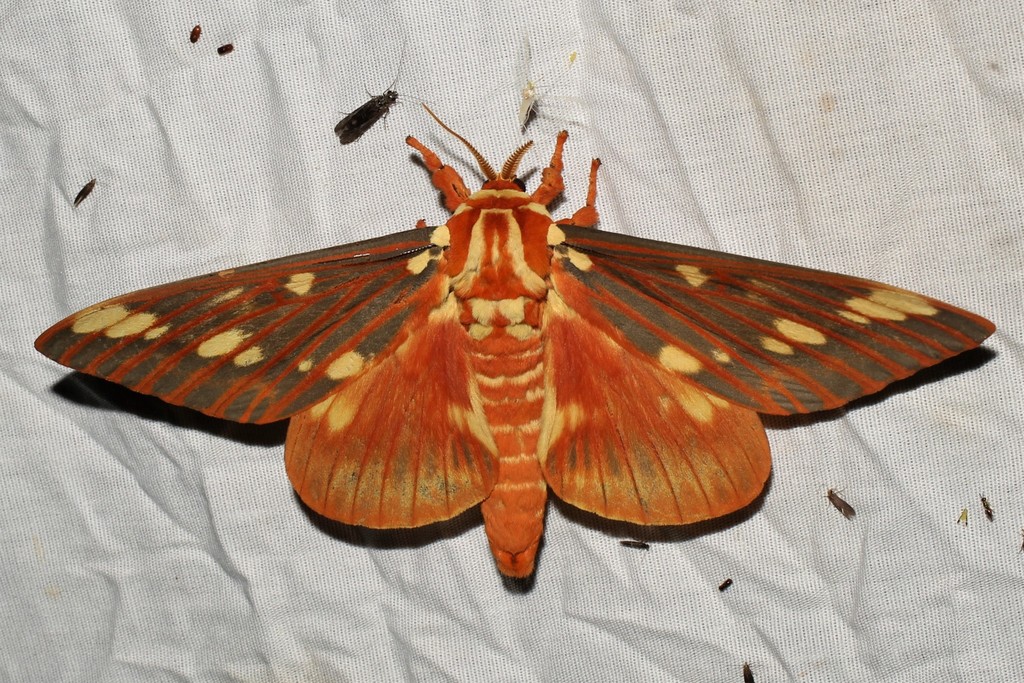
Regal Moth
Citheronia regalis
Citheronia regalis, the regal moth or royal walnut moth, is a North American moth in the family Saturniidae. The caterpillars are called hickory horned devils. The adult (imago) has a wingspan of 3.75–6.1 in (9.5–15.5 cm). The species was first described by Johan Christian Fabricius in 1793.
From the article Citheronia regalis on Wikipedia (CC BY-SA), quoted section by section
Range & habitat
Citheronia regalis is considered a common species in the American Deep South, becoming rarer and more sporadic northward. It is found throughout the deciduous forests in the United States from Missouri, Pennsylvania to Massachusetts and southward from Texas to central Florida. Historically recorded throughout New England, the species suffered a decline in the Atlantic Northeast during the mid-20th century. Excluding sparse contemporary records from New York, Citheronia regalis achieves range stability in the mid Atlantic states and southern Appalachia, beginning from southern New Jersey west throughout the Ohio Valley, the edge of the Great Plains states and south to East Texas. It is listed as a species of special concern and believed extirpated in the US state of Connecticut.
Wikipedia: “Range”
What it does
The adult moth is the largest moth by mass in latitudes north of Mexico, as are the spectacular larva and the substantial pupa. The life cycle of the moth is typical of the Saturniidae species, and typical of the Ceratocampinae. It burrows into the ground to pupate in an earthen chamber, rather than spinning a cocoon. Its eggs are yellowish, ovular and 2 mm in diameter. They are laid either singly or in groups of up to four on the upper surface of the host plant leaves, favoring nut trees such as Juglans and Carya (walnuts and hickories). There are regional preferences, with the utilization of sweet gum and persimmon in the south, and sumacs where the others are not available. Larvae are solitary in later stages and rarely occur in numbers large enough to cause defoliation; however, an individual larva can strip several branches of their leaves during the ravenous fifth instar. The list of recorded hosts includes Carya (including Carya illinoensis), Juglans cinerea, Liquidambar styraciflua, Diospyros virginiana, Rhus, Gossypium, and others. Adults do not feed. After 7 to 10 days the eggs hatch into small larvae, yellow at first, then turning darker. The caterpillars are solitary nighttime feeders in early stages. They curl up in a "j" shaped pattern during the day and resemble two-toned bird droppings. As the caterpillars age, they feed during the day. They molt four times. …
Wikipedia: “Life cycle”
Listen
Looking for field recordings…
Where it lives
Recorded sightings
—
geo-referenced records in GBIF, from museums, herbaria and field observers.
Drag the globe to turn it. Dots are where records exist, not a range map; darker means more records.
In the stacks
Searching the stacks…
Every page naming Citheronia regalis in the Biodiversity Heritage Library →
This page is assembled live from iNaturalist, GBIF, Wikipedia, the Source Library and the Internet Archive. It is not yet part of the hand-edited codex. iNaturalist taxon 81586.