- Animals
- ›Arthropods
- ›Hexapods
- ›Insects
- ›Winged and Once-winged Insects
- ›Butterflies and Moths
- ›Hawk, Sphinx, Silk, Emperor, and Allied Moths
- ›Emperor and Giant Silk Moths
- ›Royal Moths
- ›Dryocampini
- ›Syssphinx
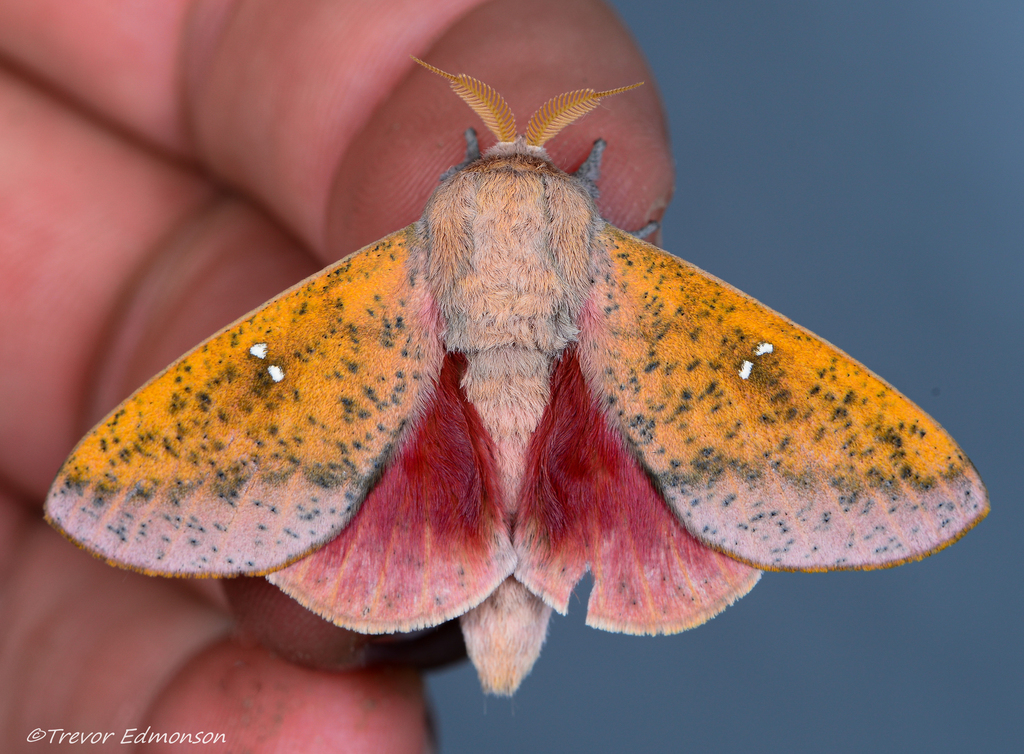
Honey Locust Moth
Syssphinx bicolor
Syssphinx bicolor, the honey locust moth, is a North American moth in the family Saturniidae.
From the article Syssphinx bicolor on Wikipedia (CC BY-SA), quoted section by section
Description
The wings vary from a grayish color to yellow to orange to dark reddish brown, with a variable amount of black spotting and pinkish shading. The forewing postmedial line runs to the costa before the apex. On the forewing, the white reniform spot may be double, single, or may be lacking. The wingspan measures 4.7–6.7 centimetres (1.9–2.6 in).
What it does
The eggs are pale green and are laid in clusters on the host plant leaves. The young gregarious larvae are pale green with four pairs of black thoracic filaments and a black horn on the end of the abdomen. They also have a lateral stripe which is mainly white. The older solitary larvae are grass green with two pairs of red horns on the thorax and one on the end of the abdomen. There are a number of silvered horns across the abdomen. The supraspiracular stripe is red and white. The body is dotted with white spots. The very similar-looking Bisected honey locust moth larva has green horns and lacks the red in the supraspiracular stripe. The dark chrysalis is made in a cell under ground. It hibernates as a chrysalis. The honey locust moth has three broods per year, the first adults being grayish, the second yellow to orange brown, and the third being darker with more spotting.
Wikipedia: “Life cycle”
Listen
Looking for field recordings…
Where it lives
Recorded sightings
—
geo-referenced records in GBIF, from museums, herbaria and field observers.
Drag the globe to turn it. Dots are where records exist, not a range map; darker means more records.
In the stacks
Searching the stacks…
Every page naming Syssphinx bicolor in the Biodiversity Heritage Library →
This page is assembled live from iNaturalist, GBIF, Wikipedia, the Source Library and the Internet Archive. It is not yet part of the hand-edited codex. iNaturalist taxon 81588.