- Animals
- ›Arthropods
- ›Chelicerates
- ›Arachnids
- ›Spiders
- ›Mygalomorphs
- ›Avicularioidea
- ›Open-holed Trapdoor Spiders
- ›Diplothelopsinae
- ›Acanthogonatus
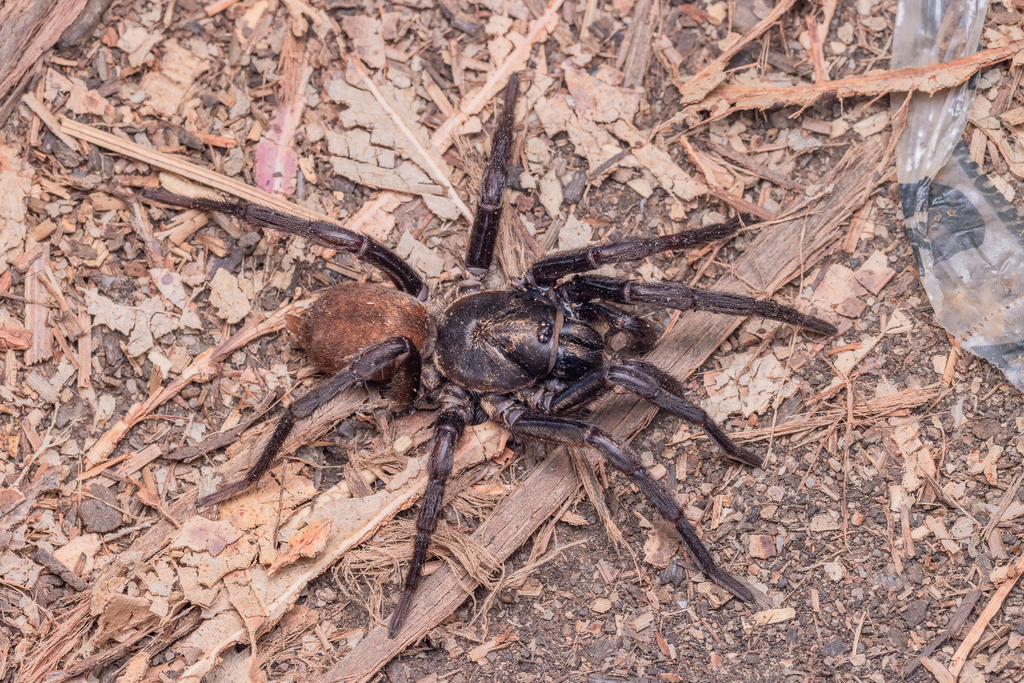
Acanthogonatus confusus
Acanthogonatus confusus is a mygalomorph spider of Argentina and Chile, its name referring to the confusion between this species and A. subcalpeianus. Males are recognized by their long palpi, together with the absence of a tibial apophysis; females are recognized by the spermathecae (similar to A. fuegianus, A. centralis and A. parana, which have - unlike A. Confusus - no inferior tarsal claws on tarsus IV).
From the article Acanthogonatus confusus on Wikipedia (CC BY-SA), quoted section by section
Description
Female: total length 24.6 millimetres (0.97 in); cephalothorax length 10.35 millimetres (0.407 in), width 8.45 millimetres (0.333 in); cephalic region length 6.35 millimetres (0.250 in), width 6 millimetres (0.24 in); fovea width 0.9 millimetres (0.035 in); labium length 1.12 millimetres (0.044 in), width 1.62 millimetres (0.064 in); sternum length 5.8 millimetres (0.23 in), width 4.4 millimetres (0.17 in). Its cephalic region is low and flat; its fovea is sinuous, procurved and without a posterior notch. Its labium possesses 3 cuspules. A serrula is present and well developed, occupying an extended area on the anterior lobe. Its posterior sternal sigilla is two times longer than wide and its sternum is rebordered. Chelicerae: rastellum absent; book lung openings appear wider than other species of the genus, with their posterior rim more sclerotized. Their colour resembles the males. Male: total length 23.6 millimetres (0.93 in); cephalothorax length 8.8 millimetres (0.35 in), width 7.35 millimetres (0.289 in); cephalic region length 5.3 millimetres (0.21 in), width 4.2 millimetres (0.17 in); labium length 0.75 millimetres (0.030 in), width 1.25 millimetres (0.049 in); sternum length 4.55 millimetres (0.179 in), width 3.57 millimetres (0.141 in). Its labium has 1 cuspule. A serrula is present and well developed. …
Range & habitat
Forests in southern Chile (Regions VIII-X) and adjacent Neuquen Province (Argentina).
Wikipedia: “Distribution”
What it does
Goloboff (1995) states there may be more than one species included in his description study. A lack of specimens in his initial observations made it difficult to statistically describe Argentinian specimens, which had smaller and more convoluted spermathecal ducts, and thus different species were not distinguished. The specimens from Pinares (Concepción, Chile) from that same article, have a shorter outer spermathecal lobe than other specimens, probably being juveniles. Adults were found under stones and logs, where they construct a silk tube and a shallow burrow. At Contulmo and Pata de Gallina juveniles were collected in moss or loose soil.
Wikipedia: “Taxonomy and behaviour”
Where it lives
Recorded sightings
—
geo-referenced records in GBIF, from museums, herbaria and field observers.
Drag the globe to turn it. Dots are where records exist, not a range map; darker means more records.
In the stacks
Searching the stacks…
Every page naming Acanthogonatus confusus in the Biodiversity Heritage Library →
This page is assembled live from iNaturalist, GBIF, Wikipedia, the Source Library and the Internet Archive. It is not yet part of the hand-edited codex. iNaturalist taxon 816393.