- Animals
- ›Arthropods
- ›Chelicerates
- ›Arachnids
- ›Spiders
- ›Typical Spiders
- ›Haplogyne Spiders
- ›Synspermiatid Spiders
- ›Spitting Spiders and Allies
- ›Sixeyed Sicariid Spiders
- ›Loxoscelinae
- ›Loxosceles
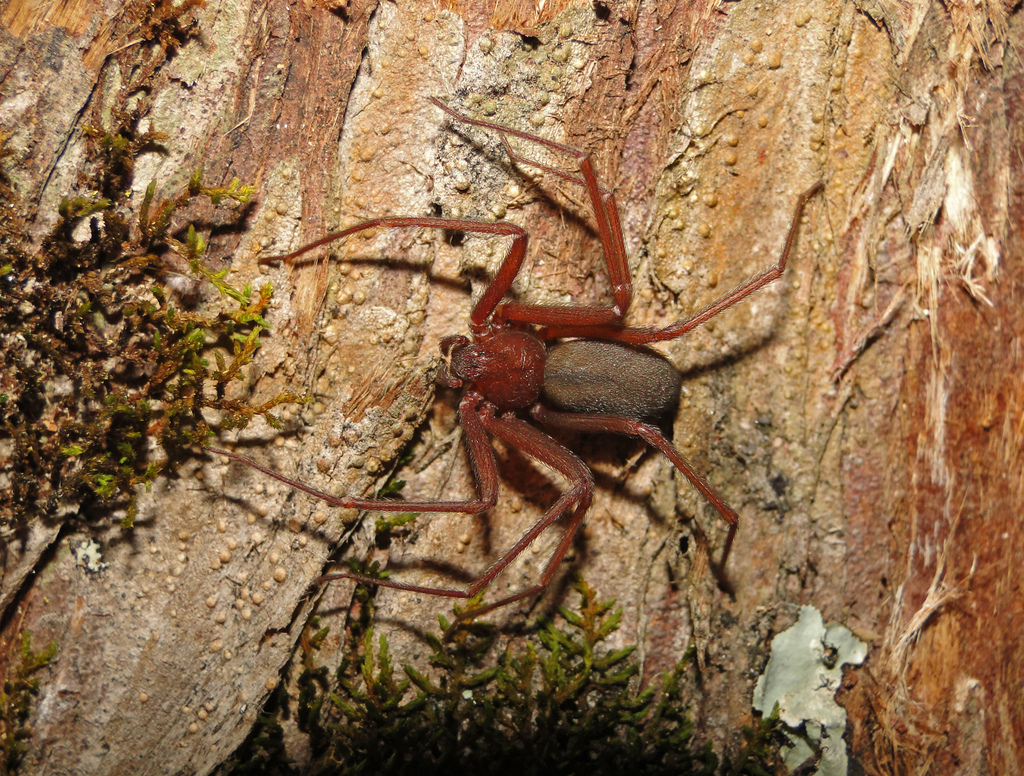
Loxosceles intermedia
Loxosceles intermedia, the Brazilian brown recluse spider, is a highly venomous spider species in the family Sicariidae native to Brazil and Argentina.
From the article Loxosceles intermedia on Wikipedia (CC BY-SA), quoted section by section
Description
The male has a total length of 5.3 mm, legs I to IV, have a length of 24.5, 31.8, 20.4 and 23.6 mm, the palp can be 5.4 mm long, females are larger, measuring about 8.5 mm in length, with legs ranging from 15.1, 16.0, 13.1 and 15, 5 mm, the palp of females measures 3.8 mm. Both male and female carapace ranges from dull yellow to orange brown, covered with black and subpretiated bristles. The cephalica pars varies from dark orange-brown to reddish-brown, with a '' U '' shape contrasting with the yellowish pars thoracica. The tubers of the eyes are enlarged, while the lateral marens are not dark, the abdomen is grayish or blackened, with the dorsal part darker than the ventral part, the leg segments vary from orange-brown to reddish-brown.
Range & habitat
Loxosceles intermedia is native to Brazil and Argentina. They are found in temperate and warm regions of South America in southeastern and southern Brazil, as well as northern Argentina. They live in dark, very dry cracks, warm regions with elevations below 500 m, quite common around or inside the houses of humans.
Wikipedia: “Range”
What it does
It is a very shy spider, with nocturnal habits, building irregular webs under fallen tree trunks and debris, usually in dark places. They can also be found in human environments, in socks, clothes, blankets, wardrobes, garages and among others dark places. Their food, as well as that of several recluse spiders, is based on insects such as cockroaches, crickets and beetles. They have been reported to attack other arthropods such as scorpions. It breeds in the hottest months of the year, laying about 20 eggs taking 46 days for the juveniles to hatch. The female builds a bag-shaped web where the eggs are deposited.
Wikipedia: “Behavior”
Where it lives
Recorded sightings
—
geo-referenced records in GBIF, from museums, herbaria and field observers.
Drag the globe to turn it. Dots are where records exist, not a range map; darker means more records.
In the stacks
Searching the stacks…
Every page naming Loxosceles intermedia in the Biodiversity Heritage Library →
This page is assembled live from iNaturalist, GBIF, Wikipedia, the Source Library and the Internet Archive. It is not yet part of the hand-edited codex. iNaturalist taxon 817216.