- Animals
- ›Arthropods
- ›Hexapods
- ›Insects
- ›Winged and Once-winged Insects
- ›Butterflies and Moths
- ›Flannel, Slug Caterpillar, Leaf Skeletonizer, and Allied Moths
- ›Burnet Moths
- ›Zygaeninae
- ›Zygaena
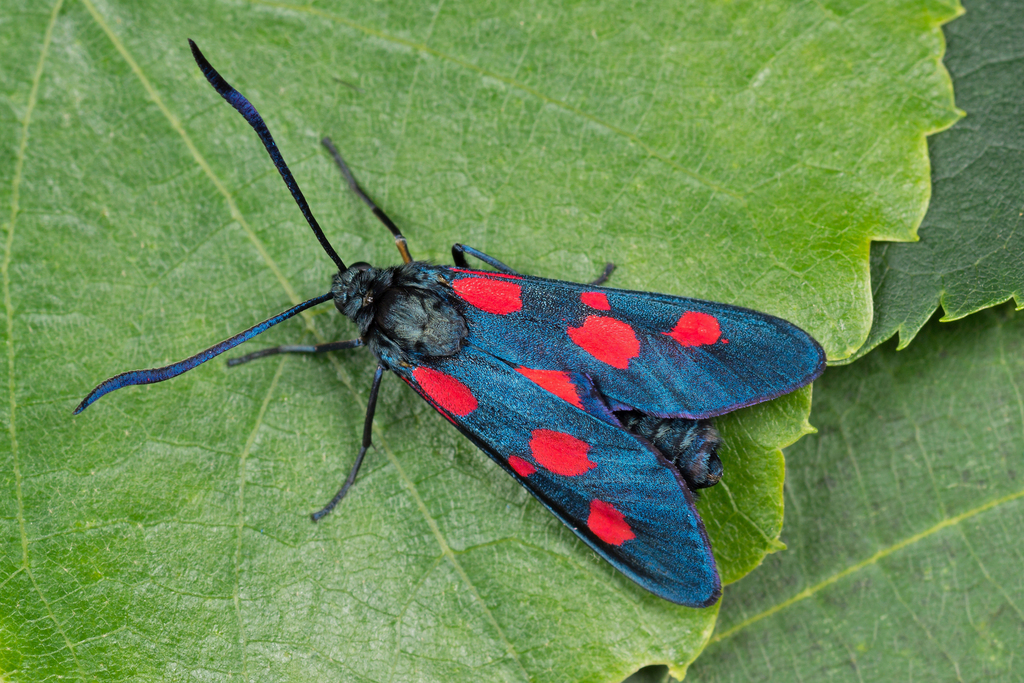
narrow-bordered five-spot burnet
Zygaena lonicerae
Zygaena lonicerae, the narrow-bordered five-spot burnet, is a moth of the family Zygaenidae. The species was first described by Theodor Gottlieb von Scheven in 1777.
From the article Zygaena lonicerae on Wikipedia (CC BY-SA), quoted section by section
Description
Zygaena lonicerae have a wingspan of 30–46 millimetres (1.2–1.8 in). The forewings reach a length of 16–19 millimetres (0.63–0.75 in) in the females, while they are slightly smaller in males. The forewings usually show five crimson to vermilion spots and a black basic colour, with a strong bluish or blue-green reflection. The third spot is smaller than the fourth one. Head, thorax and abdomen are black and moderately to strongly hairy. The antennae are long and slender and slightly clavate (club shaped) and tapered. The females are similar to males, but the top of the front wing is slightly rounded and the abdomen and the thorax are less hairy. However this species is very variable. Usually the moth populations in alpine areas are much larger, while those from southern Europe are darker.
Range & habitat
This species can be found in most of Europe, from Ireland to Fennoscandia, up to west of China. In the southern Europe the species is widespread from northern and central Spain to Turkey and the Caucasus.
Wikipedia: “Distribution”
What it does
The moth flies during daytime from June to early August depending on the location. They suck nectar of the preferred blue violet flowers, such as on field scabious (Knautia arvensis), dove pincushion flower (Scabiosa columbaria), meadow knapweed (Centaurea jacea), panicle knapweed (Centaurea stoebe), creeping thistle (Cirsium arvense), bulbous thistle (Cirsium tuberosum) and ring thistle (Carduus). The females lay eggs in July on the underside of leaves of the host plants or on plants that grow close to them. The eggs are pale yellow. The caterpillars reach a length of 19 to 28 millimetres. They are bluish green or pale yellow, with long pale hairs and a few rows of almost rectangular black spots. The larvae feed on various low-growing plants, including Trifolium (Trifolium medium, Trifolium montanum, Trifolium pratense, Trifolium repens) and Lathyrus species (Lathyrus pratensis, Lathyrus linifolius, Lathyrus sativus), as well as Vicia, Lotus corniculatus, Lotus uliginosus, Onobrychis viciifolia. Larvae and pupae are occasionally parasitized by Tachinidae species (Phryxe magnicornis) and by some species of wasps. The larvae eat until late summer and early winter, and continue to develop in the following year. At the end of May the caterpillars are fully grown. The not fully grown caterpillars overwinter a second time. …
Wikipedia: “Life cycle”
Listen
Looking for field recordings…
Where it lives
Recorded sightings
—
geo-referenced records in GBIF, from museums, herbaria and field observers.
Drag the globe to turn it. Dots are where records exist, not a range map; darker means more records.
In the stacks
Searching the stacks…
Every page naming Zygaena lonicerae in the Biodiversity Heritage Library →
This page is assembled live from iNaturalist, GBIF, Wikipedia, the Source Library and the Internet Archive. It is not yet part of the hand-edited codex. iNaturalist taxon 82108.