- Animals
- ›Arthropods
- ›Hexapods
- ›Insects
- ›Winged and Once-winged Insects
- ›Butterflies and Moths
- ›Butterflies
- ›Brush-footed Butterflies
- ›Checkerspots, Anglewings, Peacocks, and Allies
- ›Ladies, Anglewings, and Allies
- ›Vanessa
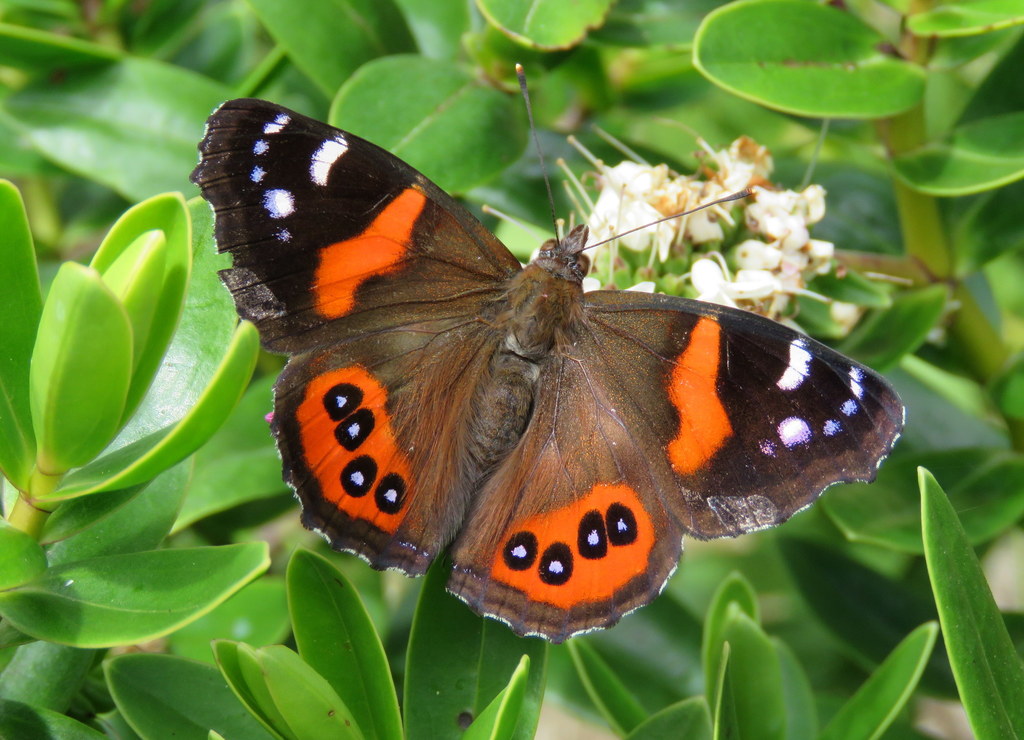
New Zealand Red Admiral
Vanessa gonerilla
The New Zealand red admiral (Vanessa gonerilla) is a species of butterfly native to New Zealand, where it is relatively widespread. In the Māori language, which is spoken by the people indigenous to New Zealand, the butterfly is referred to as kahukura, which means 'red cloak'. There are two subspecies of red admiral, which occur on the mainland and on the Chatham Islands, respectively. As an adult, the red admiral has a wingspan of around 50–60 mm (2.0–2.4 in). The wings are blackish and have distinctive red and white markings. The Chatham Islands subspecies is nearly identical to the mainland subspecies, but has slightly different red markings.
As a caterpillar, the red admiral is blackish with green markings. It is sometimes mistaken for the yellow admiral (Vanessa itea), which is also common in New Zealand. The caterpillar feeds on the leaves of Urtica (stinging nettles), especially Urtica ferox (ongaonga). Egg laying begins in September and proceeds until late May (early spring to late autumn in the Southern Hemisphere). After hatching, it takes five to six weeks for the caterpillar to begin to enter the pupal stage, where the caterpillar forms a cocoon and transitions into an adult. After two to three weeks, the adult emerges from the chrysalis. The red admiral is a strong flier that tends to move in an erratic pattern. The Chatham Islands subspecies is reported to be more timid and flighty than the mainland subspecies.
From the article New Zealand red admiral on Wikipedia (CC BY-SA), quoted section by section
Description
The red admiral has a wingspan of around 50–60 mm (2.0–2.4 in). The top side of the forewings are mostly black, with a central bright red bar running back from the front edge. There are blue spots and white spots, fringed with light blue, near the forewing tips. The rear wings have a background colour of dark reddish brown with a red patch containing four black circles, and the centre of each circle has a pale blue dot. The extent of brown colouring varies somewhat, some individuals having a pale brown to near-white background colour at the base of the rear wings and tip of forewings. The underside of the rear wings is a mottled collection of white, brown and black shapes, which camouflages the butterfly when at rest. The two subspecies of the red admiral are very similar and difficult to distinguish, although the red marking of the hind wing is less extensive in the mainland subspecies than in the Chatham Islands subspecies. The rear margin of the hind wing is also more wavy in the mainland subspecies. The red admiral is somewhat similar to the yellow admiral (Vanessa itea), which overlaps with it in distribution and is frequently found with it. They are easily distinguished by the red-orange markings of the forewing whereas the yellow admiral forewings are distinctly yellowish.
Juvenile stages. The barrel-shaped egg is green and has nine ribs that run from top to bottom. …
Range & habitat
The red admiral is relatively common throughout most of New Zealand, including on Stewart Island. The Chatham Islands subspecies is widespread on Chatham Island and Pitt Island, the second largest island in the group. The species can be found in a variety of habitats, including suburban gardens, forests and on mountains.
Wikipedia: “Distribution and habitat”
What it does
The primary host plant for red admiral caterpillar is the native stinging nettle, also known as ongaonga (Urtica ferox), although the caterpillar can also eat other Urtica species such as Urtica incisa. In a study where the red admiral was presented with several species of Urtica to lay eggs on, it was found to preferentially lay eggs on Urtica ferox. When the caterpillar was grown on this species, it was generally heavier than when grown on other species, indicating that it was an optimal food source for the caterpillar. This was suggested to be an example of the preference-performance hypothesis, where a species will preferentially lay eggs on plants that are most suitable. The Chatham Islands subspecies is reported to use Urtica australis as a host plant instead. As an adult, the red admiral feeds on flower nectar from several species and on the sap of Nothofagus (southern beech) trees.
Wikipedia: “Diet”
In human culture
The mainland subspecies is commonly referred to as the red admiral or New Zealand red admiral, whereas the Chatham Islands subspecies is referred to as the Chatham Island red admiral. Vanessa gonerilla is also referred to as kahukura in the indigenous Māori language. The word kahukura is derived from kakahu and hura, which mean "garment" and "red", respectively. The genus name Vanessa is likely derived from the character of the same name in the poem "Cadenus and Vanessa" by Jonathan Swift.
Wikipedia: “Naming and etymology”
Listen
Looking for field recordings…
Where it lives
Recorded sightings
—
geo-referenced records in GBIF, from museums, herbaria and field observers.
Drag the globe to turn it. Dots are where records exist, not a range map; darker means more records.
In the stacks
Searching the stacks…
Every page naming Vanessa gonerilla in the Biodiversity Heritage Library →
This page is assembled live from iNaturalist, GBIF, Wikipedia, the Source Library and the Internet Archive. It is not yet part of the hand-edited codex. iNaturalist taxon 82538.