- Plants
- ›Vascular Plants
- ›flowering plants
- ›monocots
- ›Agaves, Orchids, Irises, and Allies
- ›Orchids
- ›Lower Epidendroid Orchids
- ›Arethuseae
- ›bamboo orchids, grasspinks, and dragon's mouths
- ›Calopogon
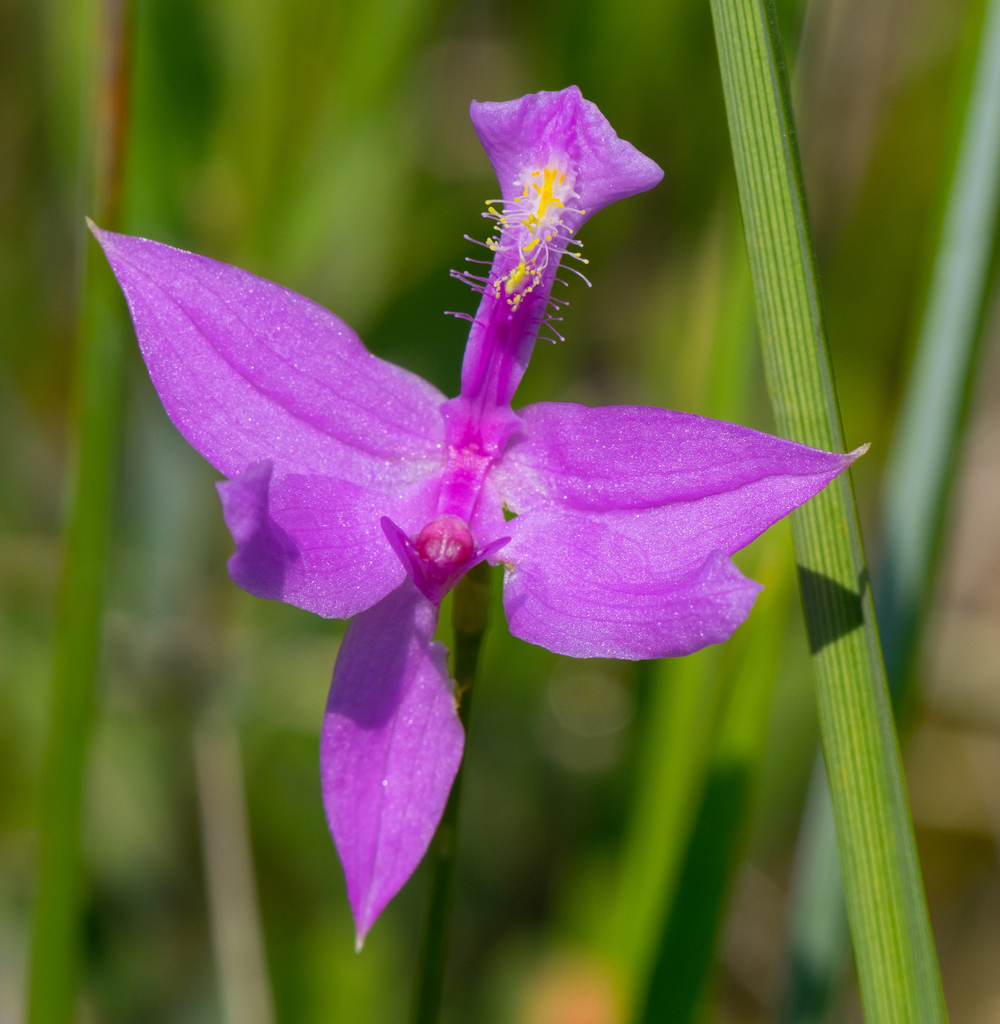
Tuberous Grasspink
Calopogon tuberosus
Calopogon tuberosus, the tuberous grass pink, is an orchid native to eastern North America. In the United States, it occurs from as far southwest as Texas and Oklahoma and southeast to the Florida Everglades to as far northeast as Maine and as far northwest as Minnesota. In Canada, it is found in all provinces from Newfoundland to Manitoba. It also is found in St. Pierre & Miquelon, Cuba and the Bahamas.
From the article Calopogon tuberosus on Wikipedia (CC BY-SA), quoted section by section
Description
The main identifying features of C. tuberosus are the species' prominent hairs positioned on the lip of a petal (sometimes referred to as "the Beard") and the smell produced by the flower. Individuals have one (occasionally two) linear basal leaves. Flowers are magenta, pink, or rarely white in color, and the middle petal is distinctively oblong-elliptic in shape. The flowers of C. tuberosus have a labellum which faces upwards, a trait fairly uncommon among orchids called non-resupination. The average maximum root depth has been found to be 7 centimeters (approximately 2.75 inches).
Range & habitat
In the United States, it occurs from as far southwest as Texas and Oklahoma and southeast to the Florida Everglades to as far northeast as Maine and as far northwest as Minnesota. In Canada, it is found in all provinces from Newfoundland to Manitoba. It also is found in Saint Pierre and Miquelon, Cuba and the Bahamas. From April to September, C. tuberosus may be found in habitats such as sandhill seeps, floating peat mats, and savannas. It may also be found in habitats such as fens, bogs, pine flatwoods, and marl prairies.
Wikipedia: “Distribution and habitat”
What it does
C. tuberosus is pollinated by bumblebees despite a lack of nectar incentive. Bumblebees, while looking for nonexistent nectar, weigh down the hinged lip causing the bee to be moved into contact with the pollinarium. The pollinarium is sticky and then can be flown by the bee to pollinate another orchid.
Wikipedia: “Ecology”
Where it lives
Recorded sightings
—
geo-referenced records in GBIF, from museums, herbaria and field observers.
Drag the globe to turn it. Dots are where records exist, not a range map; darker means more records.
In the stacks
Searching the stacks…
Every page naming Calopogon tuberosus in the Biodiversity Heritage Library →
This page is assembled live from iNaturalist, GBIF, Wikipedia, the Source Library and the Internet Archive. It is not yet part of the hand-edited codex. iNaturalist taxon 82578.