- Animals
- ›Arthropods
- ›Chelicerates
- ›Arachnids
- ›Spiders
- ›Typical Spiders
- ›Palp-footed Spiders and Allies
- ›pelican spiders
- ›Zephyrarchaea
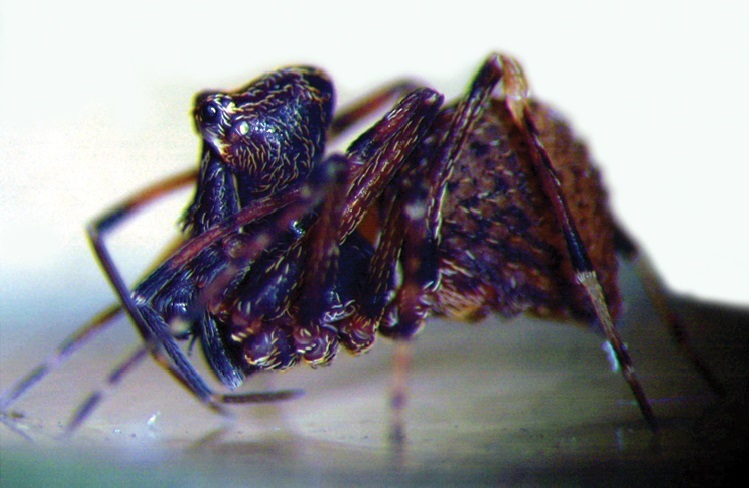
Cape Le Grand Assassin Spider
Zephyrarchaea marki
Zephyrarchaea marki, the Cape Le Grand assassin spider, is a species of spider in the family Archaeidae, commonly known as the assassin spiders. Known only from Cape Le Grand National Park in Western Australia, the species was first described by Michael G. Rix and Mark Harvey in 2012. It is named after Mark Wojcieszek, who helped collect the initial specimens of this species. Z. marki is a small species of spider, with a total length of 2.77–2.79 mm (0.109–0.110 in) in adult males. In adult males, the cephalothorax is dark reddish-brown and the abdomen is mottled grey-brown and beige. The legs are tan brown with darker ring-like markings. The appearance of the female is unknown. The species is known to inhabit elevated leaf litter in a dense coastal thickets of Banksia speciosa. It has not yet been evaluated and assigned a conservation status by the International Union for Conservation of Nature. However, the species is endemic to a very small range and its only known population may be threatened by fire, dieback disease affecting Banksia, and climate change.
From the article Zephyrarchaea marki on Wikipedia (CC BY-SA), quoted section by section
Description
Like other species in its genus, Zephyrarchaea marki is a small species of spider, with a total length of 2.77–2.79 mm (0.109–0.110 in) in adult males. The cephalothorax is dark reddish-brown, while the abdomen is mottled grey-brown and beige, with reddish-brown dorsal scute and sclerites. The legs are tan brown with darker ring-like markings. The "neck" is 0.56 mm (0.022 in) wide, with the highest point of the pars cephalica (portion of the cephalothorax between the front radial furrows) approaching the posterior third of the head. The carapace is short, measuring 1.03 mm (0.041 in) long, 1.69 mm (0.067 in) tall, and 1.00 mm (0.039 in) wide. It has a pronounced concave depression anterior to the highest point of the pars cephalica. The "head" is not strongly elevated dorsally; the post-ocular ratio, the length of the "head" posterior to the anterior median eyes (AME) relative to the dorsal elevation of the pars cephalica above the level of the AME, is 0.21. The chelicerae have proximal tufts and an additional comb of accessory setae on front face of the paturon. The abdomen is 1.64 mm (0.065 in) long and 1.13 mm (0.044 in) wide, and almost spherical when viewed from the side. It lacks hump-like tubercles along its back but has highly flattened mound-like vestiges. …
Range & habitat
The species is known only from its type locality of Thistle Cove at Cape Le Grand National Park. Collected specimens were found in elevated leaf litter in a dense coastal thickets of Banksia speciosa, behind a beach. Zephyrarchaea marki has not yet been evaluated and assigned a conservation status by the International Union for Conservation of Nature. However, the species is endemic to a very small range and its only known population may be threatened by fire, dieback disease affecting Banksia, and climate change.
== References ==
Wikipedia: “Distribution and conservation”
Where it lives
Recorded sightings
—
geo-referenced records in GBIF, from museums, herbaria and field observers.
Drag the globe to turn it. Dots are where records exist, not a range map; darker means more records.
In the stacks
Searching the stacks…
Every page naming Zephyrarchaea marki in the Biodiversity Heritage Library →
This page is assembled live from iNaturalist, GBIF, Wikipedia, the Source Library and the Internet Archive. It is not yet part of the hand-edited codex. iNaturalist taxon 828664.