- Plants
- ›Vascular Plants
- ›flowering plants
- ›monocots
- ›Agaves, Orchids, Irises, and Allies
- ›Orchids
- ›Orchidoid Orchids
- ›Diurideae
- ›Diuridinae
- ›Diuris
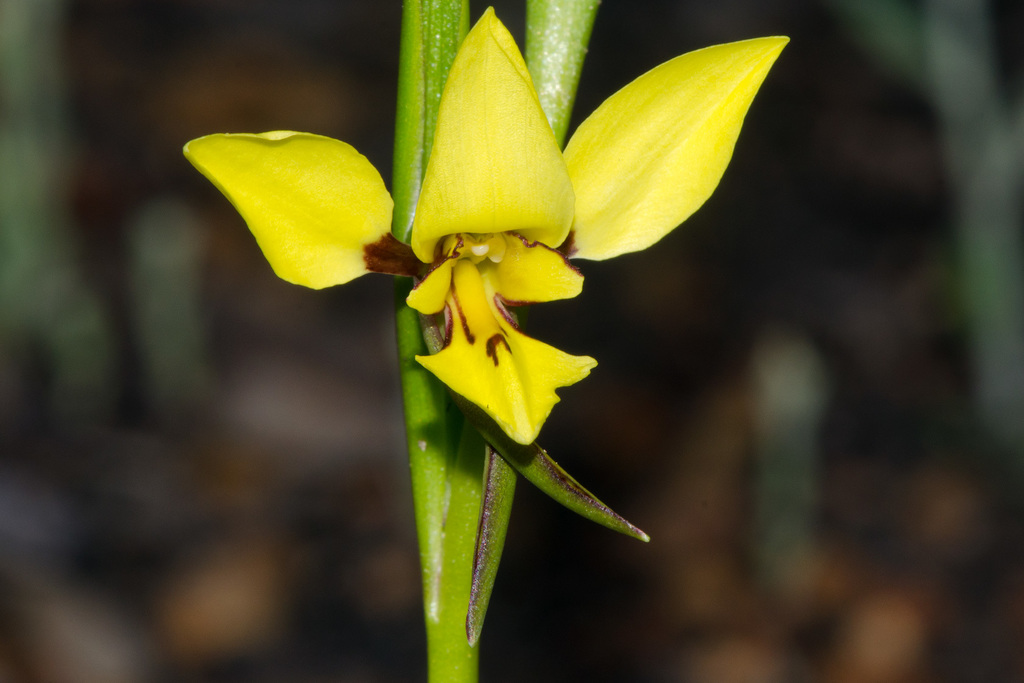
bristly donkey orchid
Diuris setacea
Diuris setacea, commonly called the bristly donkey orchid, is a species of orchid that is endemic to the south-west of Western Australia. It has a tuft of up to ten twisted leaves at its base and up to seven yellow flowers with a few brown markings. It grows in moist soil on granite outcrops and flowers much more prolifically after fire the previous summer.
From the article Diuris setacea on Wikipedia (CC BY-SA), quoted section by section
Description
Diuris setacea is a tuberous, perennial herb with between six and ten spirally twisted leaves in a tuft at its base. The leaves are 50–100 mm (2–4 in) long and 1–2 mm (0.04–0.08 in) wide. Between two and seven yellow flowers with brown markings, 25–30 mm (0.98–1.2 in) long and 20–30 mm (0.8–1 in) wide are borne on a flowering stem 150–300 mm (6–10 in) tall. The dorsal sepal is erect, 13–16 mm (0.5–0.6 in) long and 7–8 mm (0.28–0.31 in) wide. The lateral sepals are 15–18 mm (0.6–0.7 in) long, 2–3 mm (0.08–0.1 in) wide and turned downwards. The petals are more or less erect or bent backwards, 11–14 mm (0.4–0.6 in) long and 6–7 mm (0.24–0.28 in) wide on a greenish brown stalk 3–5 mm (0.12–0.20 in) long. The labellum is 12–14 mm (0.47–0.55 in) long and has three lobes. The centre lobe is diamond-shaped, 6–8 mm (0.2–0.3 in) wide and folded lengthwise. The side lobes are 4–6 mm (0.16–0.24 in) long and 4 mm (0.2 in) wide and spread apart from each other. There are two, ridge-like calli 5–7 mm (0.2–0.3 in) long and outlined in brown along the mid-line of the labellum. Flowering occurs from October to December but much more prolifically after fire the previous summer.
Range & habitat
Bristly donkey orchid grows in low heath in moist soil on granite outcrops between Esperance and Kalbarri.
Wikipedia: “Distribution and habitat”
Where it lives
Recorded sightings
—
geo-referenced records in GBIF, from museums, herbaria and field observers.
Drag the globe to turn it. Dots are where records exist, not a range map; darker means more records.
In the stacks
Searching the stacks…
Every page naming Diuris setacea in the Biodiversity Heritage Library →
This page is assembled live from iNaturalist, GBIF, Wikipedia, the Source Library and the Internet Archive. It is not yet part of the hand-edited codex. iNaturalist taxon 829524.