- Animals
- ›Arthropods
- ›Chelicerates
- ›Arachnids
- ›Spiders
- ›Typical Spiders
- ›Entelegyne Spiders
- ›Salticoid Spiders
- ›Jumping Spiders
- ›Typical Jumping Spiders
- ›Chrysillini
- ›Psenuc
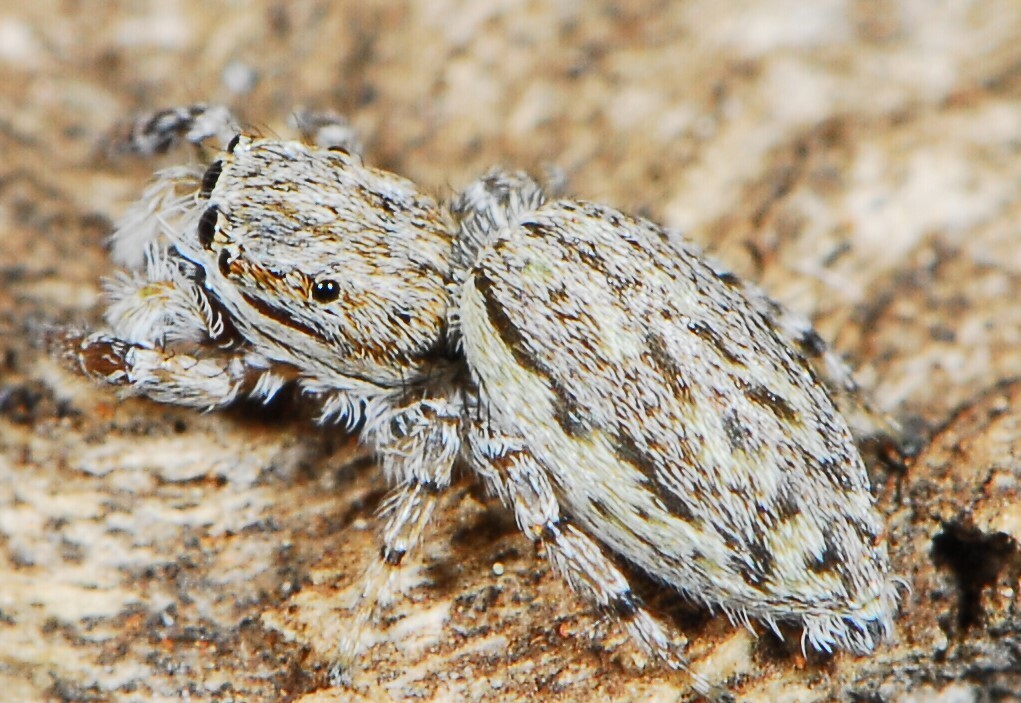
Psenuc dependens
Psenuc dependens, the Common Psenuc Jumping Spider, is a species of jumping spider that is endemic to South Africa. Originally called Pseudicius dependens, the spider was first described in 2011 by Charles R. Haddad and Wanda Wesołowska. Now a member of the genus Psenuc, it has been found living close to humans, in farms and orchards. It is a small spider, the male being between 4.1 and 4.3 mm (0.16 and 0.17 in) long and the female slightly smaller. It has a flattened slender body with a brown carapace, the hard upper part of the front section of its body, that has a black eye field. Behind its carapace is an ovoid abdomen that is either greyish-brown or brownish-grey but marked with a distinctive pattern that differs between the sexes. The female has a pattern of patches and chevrons; the male has patches and spots. The male has a cymbium, part of its copulatory organs, that has a distinctive shape with a bulge at the end of its curved tip. This feature is the source of its specific name, which is a Latin word meaning 'hanging down'. The female has large, spherical accessory glands.
From the article Psenuc dependens on Wikipedia (CC BY-SA), quoted section by section
Description
Pseudicius dependens is a small spider that has a flattened slender body. The male's flat, oval and dark brown carapace, the hard upper part of the front section of its body, is typically 2 mm (0.08 in) long and between 1.4 and 1.6 mm (0.06 and 0.06 in) wide. Its eye field is black and has a covering of dense greyish hairs. There are long brown bristles near its eyes and a circle of small fawn scales around its foremost eyes. Behind this is a thin line running down the middle of the spider's body and a stripe made up of white hairs on the edge of the carapace. The part of the underside of the carapace known as the sternum is brown. Its face, or clypeus, is low and has a covering of white hairs. Its mouthparts are also brown. Behind its carapace, the male has an ovoid abdomen that is between 2.1 and 2.3 mm (0.08 and 0.09 in) long and between 1.2 and 1.4 mm (0.05 and 0.06 in) wide. Its topside is dark greyish-brown and is decorated with a pattern of ten patches in pairs in lines down the edges and eight smaller spots in pairs running down the middle. Its underside is pale. The spider has grey spinnerets that it uses to spin webs. Its first pair of legs are long and robust with a single spine on their tibia. Its other legs are yellow with hints of brown. They have brown leg hairs and spines. |ts pedipalps, sensor organs near its mouth, are brown and hairy. …
Range & habitat
Pseudicius spiders can be found across Afro-Eurasia and the Eastern hemisphere. Psenuc dependens is endemic to South Africa. It was first collected by canopy fogging in an orchard of pistachio trees near Prieska in 2001. Early examples were seen in Northern Cape and Free State. It has also been found in Limpopo and Western Cape Provinces. It lives on trees in areas of human habitation, including farms. One specimen was collected from leaf litter under an ancient olive tree in the Free State National Botanical Garden. Others have been seen on the bark of Celtis africana and living in woods. As it has a wide distribution across South Africa, its conservation status is considered of least concern.
Wikipedia: “Distribution and habitat”
In human culture
Psenuc dependens is a species of jumping spider, a member of the family Salticidae, that was first described by the arachnologists Charles R. Haddad and Wanda Wesołowska in 2011. It is one of 15 new species discovered by the researchers at the time as part of a study of spiders that live in the grasslands of South Africa. The study looked into whether jumping spiders could be seen as a possible sentinel species for environmental and conservation crises given that only 2.8 percent of grassland in the country is preserved. They initially allocated the species to the genus Pseudicius, which had been first circumscribed by Eugène Simon in 1885, with the name Pseudicius dependens. It is one of over 500 different species of jumping spider described by Wesołowska during her career. The genus Pseudicius had been provisionally placed alongside Icius based on morphological similarities. As they are superficially similar, Ekaterina Andreeva, Stefania Hęciak and Jerzy Prószyński looked to combine the genera in 1984. Although the two genera have similar copulatory organs, work by Wayne Maddison in 1987 demonstrated that they have very different DNA. They were kept separate, but recognised as related. The two genera were placed in the tribe Heliophaninae alongside Afraflacilla and Marchena.The tribe is ubiquitous across most continents of the world. …
Wikipedia: “Taxonomy and etymology”
Where it lives
Recorded sightings
—
geo-referenced records in GBIF, from museums, herbaria and field observers.
Drag the globe to turn it. Dots are where records exist, not a range map; darker means more records.
In the stacks
Searching the stacks…
Every page naming Psenuc dependens in the Biodiversity Heritage Library →
This page is assembled live from iNaturalist, GBIF, Wikipedia, the Source Library and the Internet Archive. It is not yet part of the hand-edited codex. iNaturalist taxon 833901.