- Animals
- ›Arthropods
- ›Hexapods
- ›Insects
- ›Winged and Once-winged Insects
- ›True Bugs, Hoppers, Aphids, and allies
- ›True Hoppers
- ›Planthoppers
- ›Fulgoroidea
- ›Lanternflies
- ›Fulgorinae
- ›Fulgorini
- ›Fulgorina
- ›Fulgora
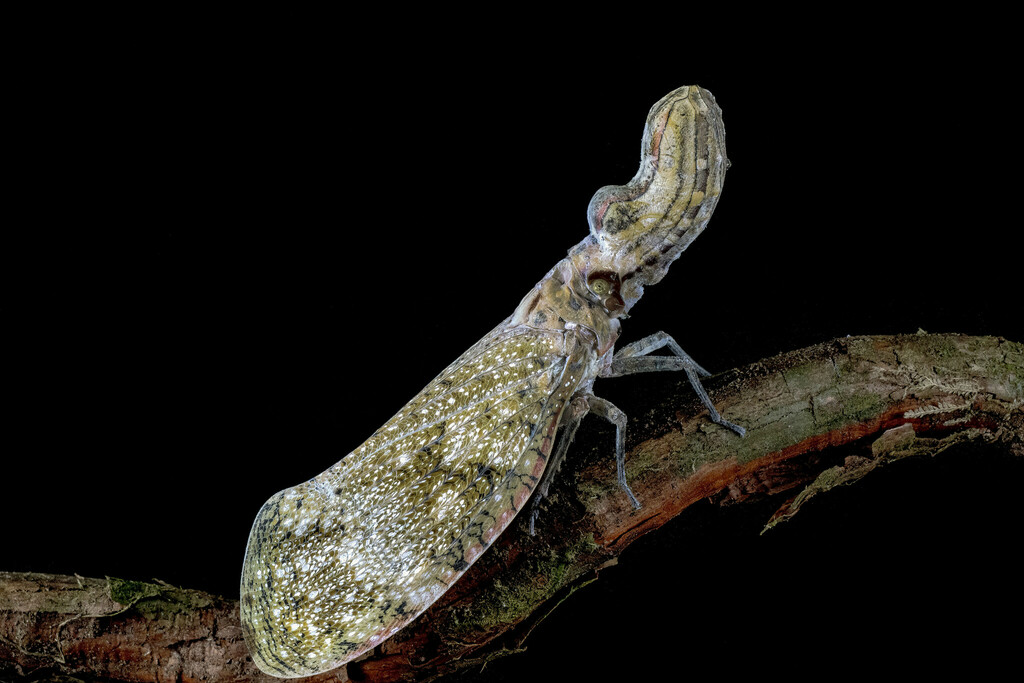
Peanut-headed Lanternfly
Fulgora laternaria
The fulgorid insect Fulgora laternaria (often misspelled "lanternaria"), is a planthopper known by a large variety of common names including lantern fly, peanut bug, peanut-headed lanternfly, alligator bug, machaca, chicharra-machacuy, cocoposa (in Spanish) and jequitiranaboia (in the Amazon region and elsewhere in Brazil).
From the article Fulgora laternaria on Wikipedia (CC BY-SA), quoted section by section
Description
Fulgora laternaria can reach a length of 85–90 millimetres (3.3–3.5 in), with a wingspan up to 100–150 millimetres (3.9–5.9 in). This insect has a protuberance at its head as long as 10–15 millimetres (0.39–0.59 in), looking like a peanut and showing false eyes to resemble that of a lizard or a serpent. The insect was originally - and mistakenly - believed to be luminescent. When attacked, it protects itself by displaying large, yellow, fake eyes on its hind wings to frighten the aggressor, and releases a foul-smelling substance. Adults can be found from June to December. They feed on the sap of plants, mainly from some trees as Hymenaea courbaril, Simarouba amara and Zanthoxylum species. It will generally remain camouflaged on a tree trunk during the day. It will knock its head on a hollow tree to create vibrations for mates. It will lay its eggs on the Hymenaea courbaril or quapinol tree, and coat them in a waxy substance for protection. Several very similar species in the genus occur from Central to South America, and many museum and commercial specimens identified as laternaria are actually other species.
Range & habitat
This species inhabits tropical forests in Mexico, Central America and South America.
Wikipedia: “Distribution and habitat”
In human culture
In the 1970s, a Colombian reporter on a trip to Putumayo Department wrote a chronicle about this insect, and related the folk tale that if it bites you, it would cause death unless the affected person practiced a sexual act within 24 hours. Although this species is not venomous, the publication of this text in a national magazine gave notoriety to both the author and the claim.
Wikipedia: “History”
Listen
Looking for field recordings…
Where it lives
Recorded sightings
—
geo-referenced records in GBIF, from museums, herbaria and field observers.
Drag the globe to turn it. Dots are where records exist, not a range map; darker means more records.
In the stacks
Searching the stacks…
Every page naming Fulgora laternaria in the Biodiversity Heritage Library →
This page is assembled live from iNaturalist, GBIF, Wikipedia, the Source Library and the Internet Archive. It is not yet part of the hand-edited codex. iNaturalist taxon 83469.