- Plants
- ›Vascular Plants
- ›flowering plants
- ›monocots
- ›Agaves, Orchids, Irises, and Allies
- ›Orchids
- ›Lower Epidendroid Orchids
- ›Dendrobieae
- ›Dendrobium
- ›Dockrillia
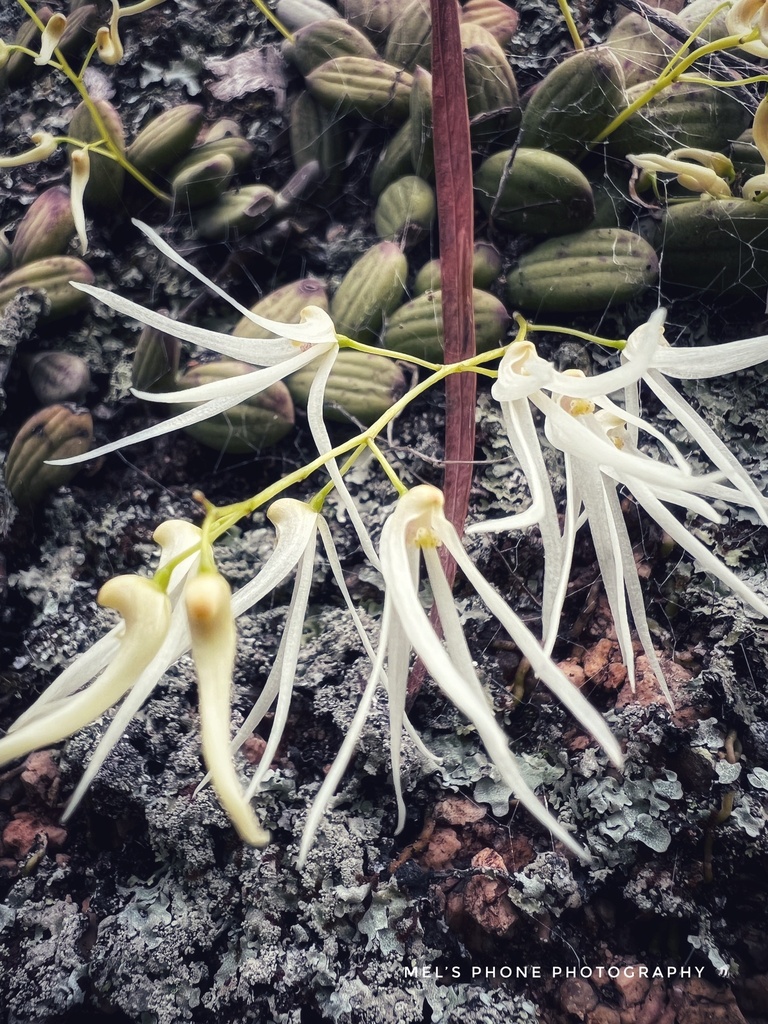
tongue orchid
Dendrobium linguiforme
Dendrobium linguiforme, commonly known as the thumbnail orchid, tick orchid or tongue orchid, is a plant in the orchid family Orchidaceae and is endemic to eastern Australia. It grows on trees or on rocks, with wiry, prostrate stems, prostrate, fleshy leaves and spikes of up to twenty white to cream-coloured flowers in early spring.
From the article Dendrobium linguiforme on Wikipedia (CC BY-SA), quoted section by section
Description
Dendrobium linguiforme is an epiphytic or lithophytic orchid with prostrate stems that produce wiry roots along almost their whole length. The roots are 1–4 cm (0.4–2 in) long and 3–4 mm (0.1–0.2 in) in diameter. There is a single leaf at the end of each branch of the stem. The leaf is oblong to egg-shaped, 2–4 cm (0.8–2 in) long and 8–15 mm (0.3–0.6 in) wide. It is 4–6 mm (0.16–0.24 in) thick and succulent with the upper surface smooth but with ridges and furrows. Up to twenty flowers are arranged in a raceme 5–15 cm (2–6 in) long. The dorsal sepal is linear to narrow lance-shaped, 15–22 mm (0.6–0.9 in) long and 3–4 mm (0.12–0.16 in) wide, the lateral sepals are 18–22 mm (0.7–0.9 in) long and 4–5 mm (0.16–0.20 in) wide, the petals slightly smaller. The petals and sepals are white to cream-coloured. The labellum is cream-coloured with pale purple markings and is 5–6 mm (0.20–0.24 in) long and 3–4 mm (0.12–0.16 in) wide. Flowering occurs in September and October.
Range & habitat
Tongue orchid occurs in New South Wales and Queensland where it grows on rocks and trees, usually in sclerophyll forest and sometimes in rainforest or in rocky places. In New South Wales it occurs on the coast and tablelands north of Ulladulla and inland as far as Gungal and Tamworth. In Queensland it is found from the Atherton Tableland to Townsville and south from Gympie to the New South Wales border.
Wikipedia: “Distribution and habitat”
Where it lives
Recorded sightings
—
geo-referenced records in GBIF, from museums, herbaria and field observers.
Drag the globe to turn it. Dots are where records exist, not a range map; darker means more records.
In the stacks
Searching the stacks…
Every page naming Dendrobium linguiforme in the Biodiversity Heritage Library →
This page is assembled live from iNaturalist, GBIF, Wikipedia, the Source Library and the Internet Archive. It is not yet part of the hand-edited codex. iNaturalist taxon 83533.