- Plants
- ›Vascular Plants
- ›flowering plants
- ›Dicots
- ›myrtles, evening primroses, and allies
- ›myrtle family
- ›Myrtoideae
- ›Chamelaucieae
- ›Chamelauciinae
- ›Verticordia
- ›Verticordia
- ›Corymbiformis
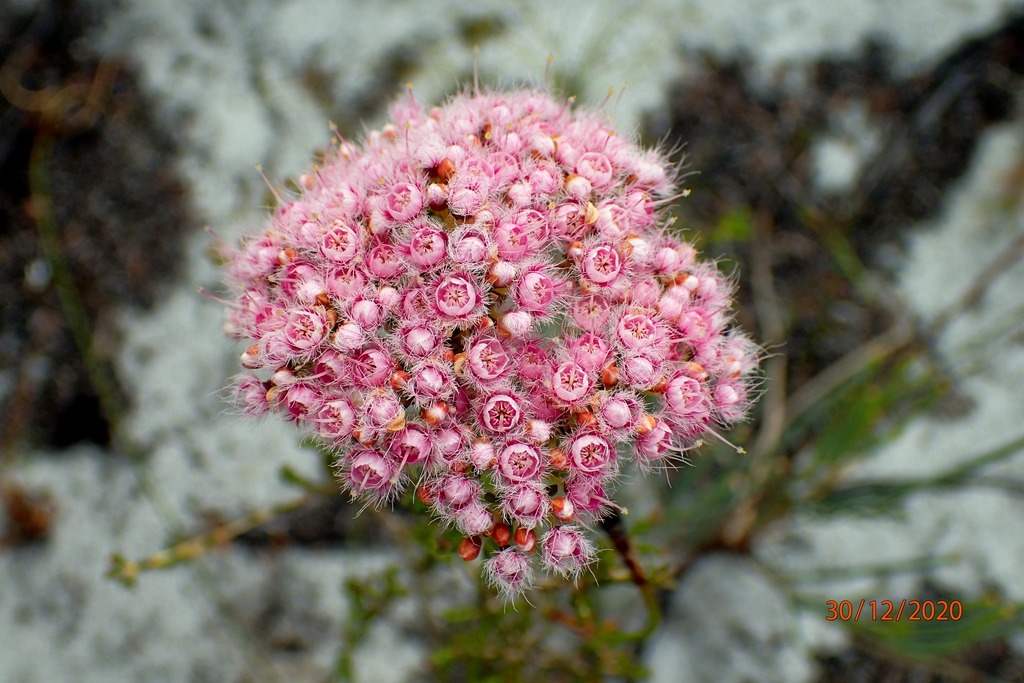
Verticordia brownii
Verticordia brownii, commonly known as pink brownii or pink cauliflower is a flowering plant in the myrtle family, Myrtaceae, and is endemic to the south-west of Western Australia. It has small, neatly arranged, oval leaves and heads of pale pink to magenta or white flowers. It was one of the first verticordias to be collected, although it was not initially known by that name. The collection was made by Robert Brown on the Bass and Flinders circumnavigation of the Australian mainland on HMS Investigator.
From the article Verticordia brownii on Wikipedia (CC BY-SA), quoted section by section
Description
Verticordia brownii is an erect or rounded shrub which grows to a height of 20–70 cm (8–30 in), spreading to 10–60 cm (4–20 in), and which has one main stem at its base. The main stem divides into small branches, upward to a flattened top. The leaves are oblong to egg-shaped, with the narrower end towards the base, concave, 3–4 mm (0.12–0.16 in) long, and blunt-ended. Leaves near the flowers are shorter than those further down the stems. The flowers are usually scented and arranged in corymb-like groups near the ends of the branches, each flower on an erect stalk that is 2–4 mm (0.08–0.2 in) long. The floral cup is shaped like half a flattened sphere, about 1.0 mm (0.04 in) long, constricted in the middle, warty and hairy near the base. The sepals are pale pink to magenta, fading to white and sometimes the sepals are white. They are 2.0 mm (0.08 in) long, with 3 or 4 feathery lobes, and have one or two hairs up to 4.5 mm (0.2 in) long. The petals are the same colour as the sepals, 1.2–2.0 mm (0.05–0.08 in) long, and egg-shaped to almost circular. The style is straight, 5.5–6 mm (0.22–0.24 in) long, and hairy near the tip. Flowering time is from December to February. The species closely resembles Verticordia eriocephala, which was included in this species until 1991. Both have a woolly or "cauliflower" appearance, but V. …
Range & habitat
This verticordia is found between Hopetoun and Mount Ragged in the Cape Arid National Park, extending inland almost as far as Grass Patch in the Esperance Plains and Mallee biogeographic regions. It occurs in deep red or yellow sands, especially in the ridges, coastal dunes, granitic sands, and clays, within open scrub and heaths of the region.
Wikipedia: “Distribution and habitat”
How it is grown
This species began to be cultivated shortly after this discovery, its profuse and attractive form during flowering gaining the attention of nurserymen in England. The species is cultivated as an ornamental shrub, is small in size, and usually presents rose-pink flowers that are profuse and perfumed. These appear during November, continuing until April in the garden, opening together, and nearly covering the leaves and branches. It is usually propagated from cuttings, and grows well in sandy, gravelly, or loamy soils, and the woolly heads of honey-scented flowers sometimes appear during the plant's first year of growth. The dried flowers are often used for flower arrangements, and retain their colour for a considerable time.
== References ==
Wikipedia: “Use in horticulture”
Where it lives
Recorded sightings
—
geo-referenced records in GBIF, from museums, herbaria and field observers.
Drag the globe to turn it. Dots are where records exist, not a range map; darker means more records.
In the stacks
Searching the stacks…
Every page naming Verticordia brownii in the Biodiversity Heritage Library →
This page is assembled live from iNaturalist, GBIF, Wikipedia, the Source Library and the Internet Archive. It is not yet part of the hand-edited codex. iNaturalist taxon 841445.