- Plants
- ›Vascular Plants
- ›flowering plants
- ›Dicots
- ›myrtles, evening primroses, and allies
- ›myrtle family
- ›Myrtoideae
- ›Chamelaucieae
- ›Chamelauciinae
- ›Verticordia
- ›Verticordia
- ›Corymbiformis
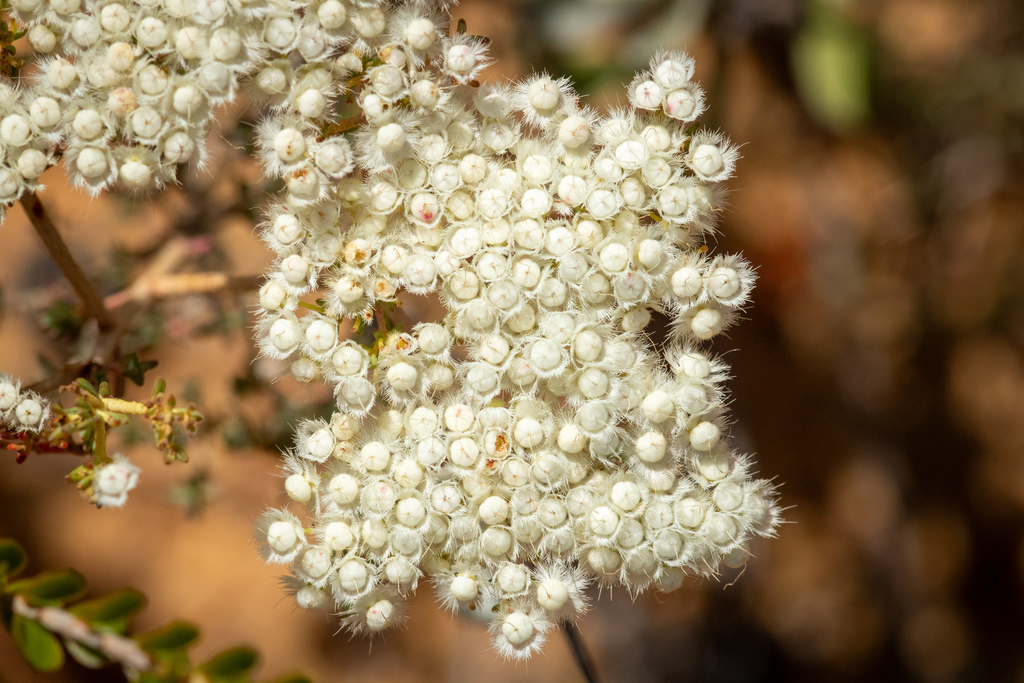
Verticordia capillaris
Verticordia capillaris is a species of flowering plant in the myrtle family, Myrtaceae and is endemic to the south-west of Western Australia. It is a shrub with a single stem at the base, small leaves and creamy white or occasionally pink flowers in dense corymb-like groups. It is common in small areas near Geraldton.
From the article Verticordia capillaris on Wikipedia (CC BY-SA), quoted section by section
Description
Verticordia capillaris is a shrub which grows to a height of 0.2–1.5 m (0.7–5 ft) and a spread of 0.2–0.9 m (0.7–3 ft) and which has a single, highly branched stem at its base. Its leaves are linear to club-shaped, roughly circular in cross-section, 2–4 mm (0.08–0.2 in) long, with the leaves near the flowers more club-shaped than those further down the stems. The flowers are lightly scented and arranged in corymb-like groups, each flower on an erect stalk 2–5 mm (0.08–0.2 in) long. The floral cup is shaped like half a sphere, constricted above the middle, about 1.0 mm (0.04 in) long and hairy. The sepals are creamy-white, occasionally pink, 2.0 mm (0.08 in) long, with 2 or 5 main lobes but the entire border of the sepals is feather-like. The petals are the same colour as the sepals, 1.2–1.5 mm (0.05–0.06 in) long, egg-shaped and covered with short hairs. The style is purple coloured, straight and 4–5 mm (0.2–0.2 in) long. Flowering time is from September to November.
Range & habitat
This verticordia grows in sand, sandy clay or sandy loam in tall shrubland in areas near the Kalbarri National Park and south to near Mullewa in the Avon Wheatbelt, Geraldton Sandplains and Yalgoo biogeographic regions.
Wikipedia: “Distribution and habitat”
How it is grown
This species is very rare in cultivation although one plant which was originally transplanted from land that was later cleared for agriculture has survived for more than 15 years. Otherwise the species has proven difficult to introduce to horticulture.
== References ==
Wikipedia: “Use in horticulture”
Where it lives
Recorded sightings
—
geo-referenced records in GBIF, from museums, herbaria and field observers.
Drag the globe to turn it. Dots are where records exist, not a range map; darker means more records.
In the stacks
Searching the stacks…
Every page naming Verticordia capillaris in the Biodiversity Heritage Library →
This page is assembled live from iNaturalist, GBIF, Wikipedia, the Source Library and the Internet Archive. It is not yet part of the hand-edited codex. iNaturalist taxon 841446.