- Plants
- ›Vascular Plants
- ›flowering plants
- ›Dicots
- ›myrtles, evening primroses, and allies
- ›myrtle family
- ›Myrtoideae
- ›Chamelaucieae
- ›Chamelauciinae
- ›Verticordia
- ›Verticordia
- ›Micrantha
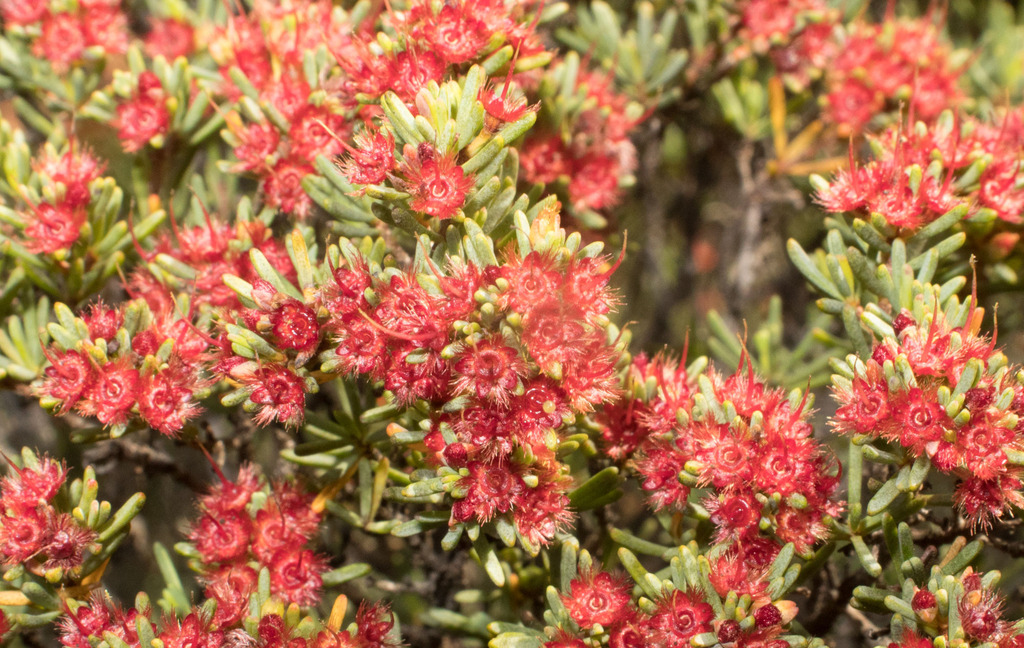
Verticordia fastigiata
Verticordia fastigiata, commonly known as mouse featherflower, is a flowering plant in the myrtle family, Myrtaceae and is endemic to the south-west of Western Australia. It is a prostrate or low shrub with small, club-shaped leaves and mouse-scented flowers which vary in colour from golden-yellow and orange to dark red.
From the article Verticordia fastigiata on Wikipedia (CC BY-SA), quoted section by section
Description
Verticordia fastigiata is a low shrub which grows to a height of 20–40 cm (8–20 in) and a width of 10–60 cm (4–20 in) with a single, highly branched main stem. The leaves are club-shaped, almost circular in cross-section, 2–5 mm (0.08–0.2 in) long and have a blunt end. The flowers are mouse-scented, arranged corymb-like groups with each flower on a stalk 1–2 mm (0.04–0.08 in) long. They are lemon-yellow and red, golden-yellow and orange to bronze, or deep red. The floral cup is broadly top-shaped, about 0.8 mm (0.03 in) long, hairy and more or less smooth. The sepals are yellow to dark red, about 1.7 mm (0.07 in) long, with 4 lobes which have long-hairy ends. The petals are about 1 mm (0.04 in) long, broad egg-shaped with a finely toothed margin, shiny yellow to dark red. The style is 4.0–5.5 mm (0.16–0.22 in) long, straight or gently curved with a few short hairs. Flowering time is from January to July.
Range & habitat
This verticordia grows in sandy loam and clay over sandstone, sometimes in association with other species of verticordia, in low heath. It occurs in southern areas of the state between Ongerup and Cape Riche in the Esperance Plains, Jarrah Forest and Mallee biogeographic regions.
Wikipedia: “Distribution and habitat”
How it is grown
This verticordia is usually propagated from cuttings which usually strike easily but are slow to establish when planted out and may take several years to flower. It performs well in Western Australia and on the east coast when grown in light soils in a sunny location. Established plants are moderately frost-tolerant and resistant to pest attacks.
== References ==
Wikipedia: “Use in horticulture”
Where it lives
Recorded sightings
—
geo-referenced records in GBIF, from museums, herbaria and field observers.
Drag the globe to turn it. Dots are where records exist, not a range map; darker means more records.
In the stacks
Searching the stacks…
Every page naming Verticordia fastigiata in the Biodiversity Heritage Library →
This page is assembled live from iNaturalist, GBIF, Wikipedia, the Source Library and the Internet Archive. It is not yet part of the hand-edited codex. iNaturalist taxon 841463.