- Animals
- ›Arthropods
- ›Chelicerates
- ›Arachnids
- ›Mites and Ticks
- ›Acariformes
- ›Sarcoptiformes
- ›Endeostigmatan Mites
- ›Eriophyoidea
- ›Gall and Rust Mites
- ›Eriophyinae
- ›Aceriini
- ›Aceria
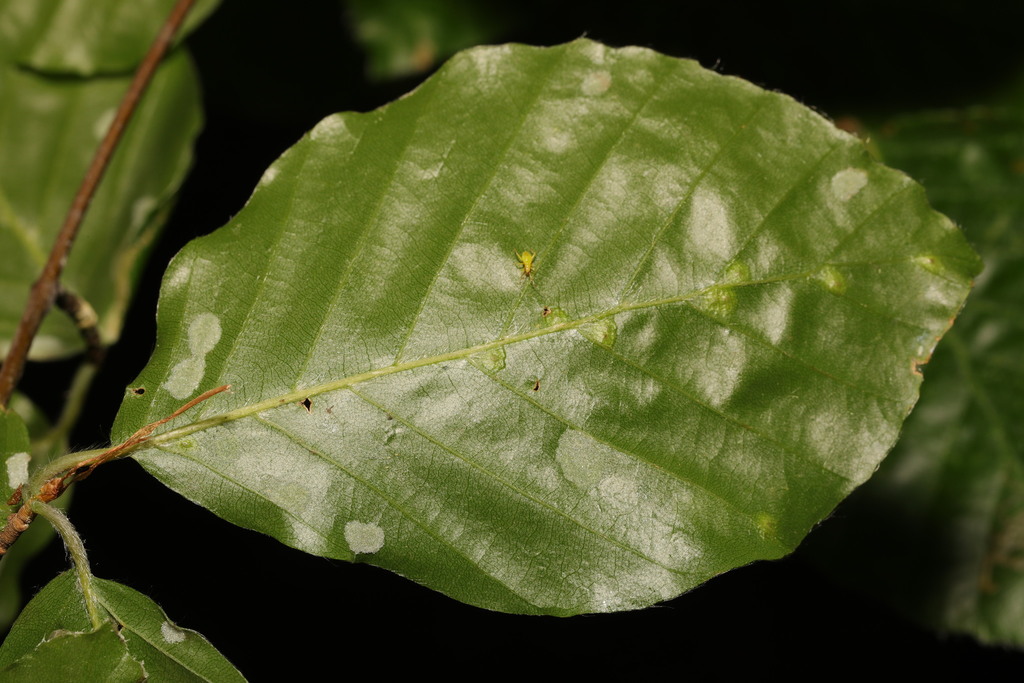
Aceria nervisequa
Aceria nervisequa is a species of mite that belongs to the family Eriophyidae. It is found in Europe and was first described by Giovanni Canestrini in 1891. The mite causes galls on the leaves of beech (Fagus species),
From the article Aceria nervisequa on Wikipedia (CC BY-SA), quoted section by section
Description
Aceria nervisequa causes felt-like galls (erinea) on the underside of the leaves of European beech (Fagus sylvatica), copper beech) (Fagus sylvatica purpurea) and Crimean beech (Fagus x taurica). The erinea are white at first, turning pink and then brown by the autumn while on copper beech the erinea are pink, bright crimson or purple. The mites also cause erinea along the veins on the upper side of the leaf which were initially thought to be a separate species; known as Aceria faginea. The mites spend the winter in bark crevices or in buds.
Wikipedia: “Description of the gall”
Range & habitat
Found in Europe, including Bosnia and Herzegovina, Croatia, Czech Republic, Denmark, France, Germany, Great Britain (common), Ireland, Italy, Kosovo, Latvia, Luxembourg, Montenegro, Netherlands, North Macedonia, Poland and Serbia.
== References ==
Wikipedia: “Distribution”
Where it lives
Recorded sightings
—
geo-referenced records in GBIF, from museums, herbaria and field observers.
Drag the globe to turn it. Dots are where records exist, not a range map; darker means more records.
In the stacks
Searching the stacks…
Every page naming Aceria nervisequa in the Biodiversity Heritage Library →
This page is assembled live from iNaturalist, GBIF, Wikipedia, the Source Library and the Internet Archive. It is not yet part of the hand-edited codex. iNaturalist taxon 842441.