- Animals
- ›Arthropods
- ›Chelicerates
- ›Arachnids
- ›Harvestmen
- ›Eupnoan Harvestmen
- ›Phalangioidea
- ›Phalangiid Harvestmen
- ›Phalangiinae
- ›Phalangium
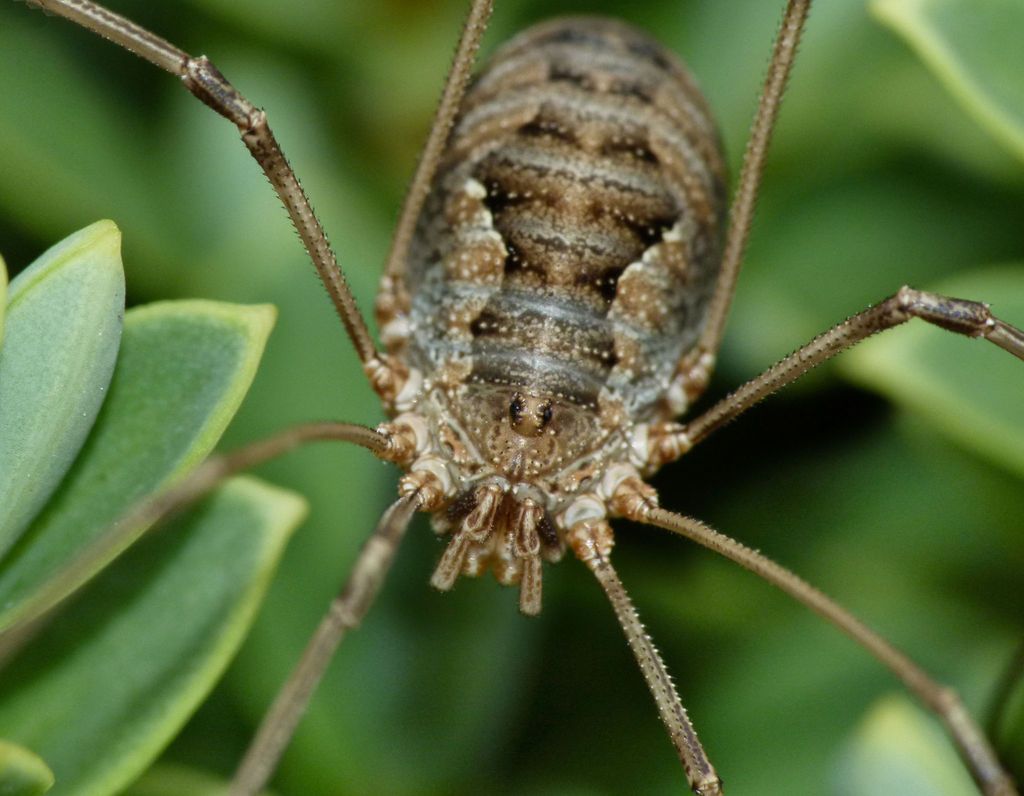
European Harvestman
Phalangium opilio
Phalangium opilio is "the most widespread species of harvestman in the world", occurring natively in Europe, and much of Asia, and having been introduced to North America, North Africa and New Zealand. It is found in a wide range of habitats, including meadows, bogs, forests, and various types of anthropogenic habitats, such as gardens, fields, hedgerows, lawns, quarries, green places in built-up areas, walls and bridges.
From the article Phalangium opilio on Wikipedia (CC BY-SA), quoted section by section
Description
Like other harvestmen, P. opilio have long, slender legs and a short, round body. Adult P. opilio have a body length of 3.5–9 mm (1⁄8–3⁄8 in). Males tend to have smaller bodies than females, but have noticeably larger pedipalps and chelicerae with prominent outgrowths (horns) on the dorsal side of the second segment. Both sexes are similarly coloured and are marked light brown and gray, often with a light cream underside. P. opilio is relatively large compared to other harvestmen species. In individuals of both sexes, the legs, bodies, and eye tubercles are covered with spines. Males can be differentiated from females by their longer pedipalps and the existence of long, forward-pointing processes, appearing similar to horns, on the second segment of their chelicerae. In some European populations, P. opilio male chelicerae and pedipalpal size have significant allometric variation, but it's not clear whether this is continuous or discrete, which would indicate male dimorphism in P. opilio. As an arachnid species, P. opilio have four pairs of legs. Three of these pairs are for movement, but the longest, second pair is antennae-shaped and primarily used as a sensory appendage to feel their surroundings. Their tarsus, the segment of their legs furthest from their body, have numerous pseudosegments called tarsomeres that make them prehensile, enabling P. …
Range & habitat
P. opilio has a mostly Holarctic distribution and is the most widespread harvestman species worldwide, occurring natively in Europe, North and Central Asia, and Asia Minor. The species has been introduced to North America, North Africa and New Zealand from Europe. In North America, it occurs in non-desert regions of southern Canada and the United States.
Habitat. This species can be found in a wide range of open habitats, including meadows, bogs, and forests. It is also most abundant in anthropogenic habitats, and is thus considered a synanthropic species of harvestmen. In can be found in habitats modified by humans, such as gardens, agroecosystems, hedgerows, lawns, quarries, urban green spaces, walls and bridges. In agricultural settings, P. opilio is common in temperate cropland, living among crops such as corn, alfalfa, small grains, potatoes, cabbage, strawberries, and apple. P. opilio apparently prefer vertical surfaces, including tree trunks and vertical man-made structures like fences and walls, with a preference for wood substrate due to its low thermal conductivity and slow release of moisture, being a thermophilous and moderately hygrophilous species. However, their preference varies based on the amount of cover available in a certain area. P. …
Wikipedia: “Distribution”
What it does
Most of their time is spent stationary, but P. opilio have also been observed walking and leg palpating—making tapping movements with their sensory legs—as well as drinking, feeding, and grooming. As is typical of opilionids, the species is nocturnal, observed to exhibit 90% of their total activity between 18:00 and 06:00. Adults of both sexes have been observed to walk more from nightfall to midnight than during the day, and males have been observed to walk for longer in the early morning, until 03:00, possibly to attempt to find females to mate with. P. opilio also exhibit leg palpating only at night, with adult females and nymphs exhibiting more leg palpating than males, possibly as a foraging strategy.
Diet. P. opilio is a generalist predator and scavenger that feeds on soft-bodied animals found in crops, such as aphids, caterpillars, leafhoppers, beetle larvae, and mites. Sometimes it may also scavenge on hard-bodied animals, such as various arthropods, including other harvestmen. They are also known to feed on Helicoverpa zea eggs among soybean crops.
Life cycle. Eggs are laid in moist areas and hatch in three to five months. The juveniles undergo several molts and reach maturity in two to three months. …
Wikipedia: “Behavior”
How it is grown
P. opilio feeds on many insect species considered pests, such that it can provide biological pest control in agricultural settings. It is not solely able to suppress any populations of a pest species, but its existence alongside other generalist predators contributes overall to controlling pest populations. Their value to human agriculture varies due to their generalist feeding habits and consumption of other members of its species, but this may in turn allow their populations to persist even when pest density is low, enabling them to suppress earlier stages of pest outbreaks when they do occur. For example, since P. opilio preys on the eggs of Helicoverpa zea, a major agricultural pest, it can act as biological pest control for soybean crops. They particularly benefit the seasonal timing of soybean production in Kentucky because their second annual generation occurs in time for them to feed on H. zea eggs. P. opilio is highly susceptible to some broad spectrum insecticides, so use of such insecticides is discouraged for conservation of P. opilio populations. Some specific products appear to cause less harm to P. opilio, such as Bt toxins.
Wikipedia: “Biological pest control in agriculture”
Where it lives
Recorded sightings
—
geo-referenced records in GBIF, from museums, herbaria and field observers.
Drag the globe to turn it. Dots are where records exist, not a range map; darker means more records.
In the stacks
Searching the stacks…
Every page naming Phalangium opilio in the Biodiversity Heritage Library →
This page is assembled live from iNaturalist, GBIF, Wikipedia, the Source Library and the Internet Archive. It is not yet part of the hand-edited codex. iNaturalist taxon 84644.