- Animals
- ›Arthropods
- ›Chelicerates
- ›Arachnids
- ›Spiders
- ›Typical Spiders
- ›Entelegyne Spiders
- ›Salticoid Spiders
- ›Jumping Spiders
- ›Typical Jumping Spiders
- ›Aelurillini
- ›Aelurillina
- ›Aelurillus
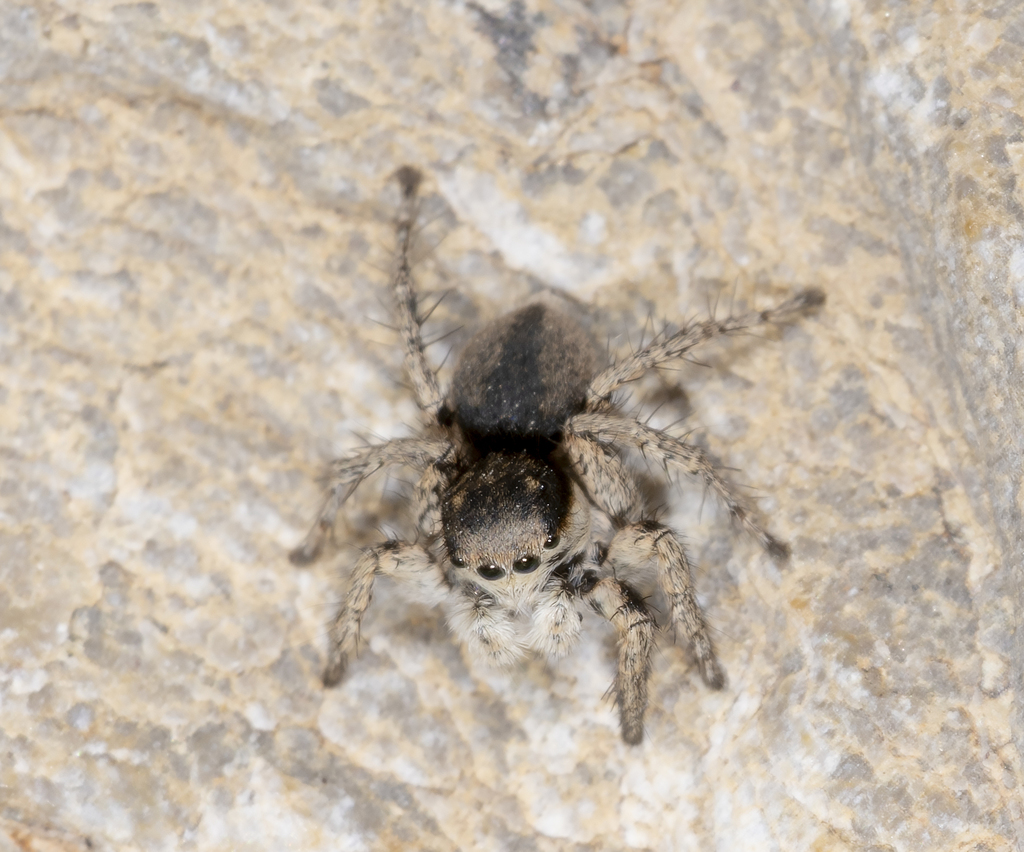
Aelurillus cretensis
Aelurillus cretensis is a species of jumping spider in the genus Aelurillus that lives on Crete, after which it is named. It lives in the Lefka Ori mountain range living at an altitudes of up to 2,000 m (6,600 ft) above sea level. It is a small spider, with a carapace measuring between 2.9 and 3.2 mm (0.11 and 0.13 in) in length and an abdomen. between 2.3 and 3.6 mm (0.091 and 0.142 in) in length. The female is larger than the.male. It is generally dark brown, although the female has a brownish-grey abdomen, darker than related species. Its legs are brown or dark brown. It has distinctive copulatory organs, the male having a larger base to its embolus found between the cymbium and the palpal bulb. The female can be identified by the shape of its epigynal pocket.
From the article Aelurillus cretensis on Wikipedia (CC BY-SA), quoted section by section
Description
Aelurillus cretensis is a small spider with a body that consists of two parts, a rounded cephalothorax and an almost spherical abdomen. The male has a carapace, the hard upper shell of the cephalothorax, that is typically 2.9 mm (0.11 in) long and between 1.15 mm (0.045 in) wide. It is dark brown with a black eye field. Its sternum, or underside of the cephalothorax, is lighter brown. It has yellow-brown chelicerae, while its mouthparts, including its labium and maxillae, are simply brown. Its clypeus is dark brown and is covered in black hairs. The male's abdomen is typically 2.3 mm (0.091 in) long and 2.1 mm (0.083 in) wide. It is dark brown like the carapace but differs in the presence of a band of white hairs that runs down the middle from the front to the back. |It has brown spinnerets and yellow-brown book lungss. The spider's legs and pedipalps are brown with a covering of white hairs on the legs. Its pedipalps have a knob on its femur and a covering of white hairs. Its cymbium is topped with short hairs, The palpal bulb has two bulges towards the bottom, lower than the palpal tibia, the lower one finishing with a pointed tip. The embolus starts between the bulb and the cymbium and curls around to project a short distance out of the bulb. …
Range & habitat
Aelurillus spiders have a wide distribution, mainly in the Palearctic realm, with 34 living in the area around the Mediterranean Sea. Aelurillus cretensis is endemic to Crete. The holotype for this species was discovered amongst the Lefka Ori mountain range living at an altitudes of 1,650 m (5,410 ft) above sea level in 1991. Other examples have been found nearby at altitudes of up to 2,000 m (6,600 ft) above sea level. It generally lives in mountainous environments but one male specimen was found living amongst and under stones in the moist bed of a stream.
Wikipedia: “Distribution and habitat”
In human culture
Aelurillus cretensis is a species of jumping spider, a member of the family Salticidae, that was first described by the arachnologist Galina Azarkina in 2002. She allocated the species to the genus Aelurillus, which had been first circumscribed by Eugène Simon in 1885. Like many of the genus, its taxonomic status is uncertain. The genus is named for the Greek word for cat and the species name recalls the place where the species was first found, Crete. In 2002, Luděk Dobroruka described a new species named Aelurillus steliosi. In 2015, Azarkina and Marjan Komnenov identified species had been misnamed. The female was, in fact, an example of this species. Aelurillus steliosi was made a synonym of Aelurillus leipoldae. The genus Aelurillus was placed in the subtribe Aelurillina in the tribe Aelurillini, both named after the genus, by Wayne Maddison in the same year. These were allocated to the clade Saltafresia. In 2017, Jerzy Prószyński grouped the genus with nine other genera of jumping spiders under the name Aelurillines. It is closely related to the genus Manzuma and Rafalus, particularly in the shape of its body and the composition of its copulatory organs.
Wikipedia: “Taxonomy and etymology”
Where it lives
Recorded sightings
—
geo-referenced records in GBIF, from museums, herbaria and field observers.
Drag the globe to turn it. Dots are where records exist, not a range map; darker means more records.
In the stacks
Searching the stacks…
Every page naming Aelurillus cretensis in the Biodiversity Heritage Library →
This page is assembled live from iNaturalist, GBIF, Wikipedia, the Source Library and the Internet Archive. It is not yet part of the hand-edited codex. iNaturalist taxon 848165.